
Blue Label’s listing of Cell C was hardly the stuff market fantasy is made of: the fintech company managed to get its previously troublesome asset away at R26.50 a share last week – far below its initial offer target of between R29.50 and R35.50. And yet, subsequent to its debut, shares in the rejigged and debt-free mobile operator have climbed to more than R31. As for Blue Label, having had a stellar run this year and a not-so-stellar slide of late, what next? Currency spoke to Blue Label joint-CEO Mark Levy.
Was it frustrating to see the Cell C share price popping only after the listing?
The market’s an interesting place and I think what the market wants to see is credibility, time and consistency. I’d be remiss to say we weren’t frustrated, but I think what we’ve come to realise is that once we’ve separated these units and they can start singing to their own hymn sheet, we’ll definitely see more accretive value in the sum of the parts. You can see more directly into the businesses. Even now it’s lower than what we think it should be, but people are going to say: “Show us a set of results, and another.”
Unfortunately the way we present our results is very, very complicated. We all can’t wait until we have a simpler set of results that people can understand. I think that’s one of the reasons people find it hard to invest.
Allan Gray emerged as a 15.538% shareholder in Cell C; did it take up the shares ahead of the unbundling?
They’ve been our partner for 15 years and I suppose in our chats with them they support a lot of what we do.
How much do you have left of Cell C?
49.5%.
Your results have always been extremely complex so is it really possible to present simpler numbers?
Yes, it should be. But again, what will your comparatives be if you don’t compare to something historic? So let’s assume you start from scratch, but you still have to say: while I was in that form, this is what I would have made, now I’m in this form, this is what I’m going to make. So we’re probably still destined for one more set of complicated results.
Rozendal’s Paul Whitburn talks about “PTSD” with regards to Cell C in investors’ consciousness. Is it a very different business now though?
It is completely different. I’d be almost tempted to say that Cell C is something of a start-up. They’re an asset-light business now; when they started they had to build infrastructure. They’ve got a very clear strategy of simplicity; they have spectrum, they will be a dividend-yielding company and cash flow positive.
All these things, years ago, didn’t exist. So when I feel aggrieved sometimes by the value, I think if you were overseas and said: “Pretend this company didn’t exist and I’m going to market with this game-plan, without this legacy drag,” maybe you would have become a unicorn overnight because people would just adjudicate you on your plan going forward – and that’s what Cell C should be adjudicated on.
What about Blue Label itself? You and your brother (Brett Levy) have just bought 20-million shares on the open market – do you think Blue’s share price has fallen too much since it peaked?
Ja, we think Blue is undervalued; we think people have missed a lot of Blue because of the concentration risk we had with Cell C. All our free money, all our free time and effort went into Cell C and people should now appreciate that these things are split; Cell C has a phenomenal future ahead of it and equally, so does Blue. Again, the sum of the parts within the stable are for us greater than the whole. The energy businesses, the data business – these are businesses with very low cost structures and massive upside.
Retail analyst Syd Vianello described you as a “pure-play token tech business, plus Cell C investment, offset by debt, that should produce robust cash flows”. If you had to describe Blue Label’s investment proposition, is that what it is?
Ja. We’re capex light, we have phenomenal rails with the most phenomenal distribution reach in South Africa. And the ability to layer on additional products and services into this sunk cost distribution environment is unparalled. So every new product you can layer on going forward is almost 100% margin accretive, because you’ve already paid for those rails.
The other is that we’ve been in the market for 20 years; we think there’s massive opportunity in the energy space, we believe there’s massive opportunity in finding the leakages of energy which would be more margin accretive.
And we’ve built a very sophisticated switching platform that allows us to integrate into anyone and everyone out there. I think everyone’s still facing a Cell C hangover because we put billions into it; but now people will say: “Okay, fine, now that you don’t have to put your free cash into it, let’s see what you can do for us.” So, fine – let’s just do what we’ve got to do.
Can you be more specific about what you’re doing in the energy sector?
When you look at Blue Label, it’s a token-vending business. Our theme this year internally was “same game, new way”.
If I go back to 2001, you used to buy airtime and you’d scratch the foil off and take that number and enter it into your phone and reload airtime; fast-forward 20 years, we sell airtime but it comes out of the ether and in theory you could use a bitcoin to pay for it.
Energy is the same thing: we vend prepaid electricity, probably close to R3bn-R4bn worth a month, but the margins are being eroded by municipalities taking away all the commission. So we are applying our mind as to how we can start generating other sets of revenue inside these munis.
There are two big ones coming to fruition; one is called “revenue assurance” where we go and look for lost and stolen electricity. We think about 30% of all electricity that is bought from Eskom is lost or stolen – probably R20bn-R40bn a year. So we are going to look for this lost and stolen electricity – but we’ll do it at risk so the municipality doesn’t have to pay unless we can prove we’ve given them an uplift. Say you do R1bn collections a month, anything north of that then we want a piece of that action and greater at the margin we’re getting.
There’s not one municipality in South Africa that shouldn’t have a revenue assurance programme. And for years we have been pushing and punting this and finally we signed one municipality on a three-year deal, and we’ve got [another] one on a one-year agreement.
Generally we focus only on large power users; you go into the environment and would more than likely replace their meters, go into the system and ensure that that customer is loaded as a factory rather than a restaurant and he’s paying 10c per kilowatt rather an 3c per kilowatt, say, so not all of it is rocket science.
And we think there’s massive opportunity there. We also want to build micro-types of green energy plants; solar environments of 20MW that we can plug directly into localised substations. What’s complicated is that we’ve been talking about it for years and that’s why maybe we get beaten up – it’s not because of the theory, but the market hasn’t been ready for all these solutions. But finally we feel we’re at a place where this market is starting to embrace a lot of these crazy ideas, if you want to call it crazy.
Another point: you know these vouchers we’ve been selling; one can put in cash and then redeem a voucher which can be redeemed online in the e-commerce universe. So you’ve managed to digitise the cash. And that business – for ourselves and two or three other competitors – is probably about R4bn a month that’s being digitised into the e-commerce universe. Why I’m giving that example is that in 2008, we launched the first voucher of this kind – it was called UCash, and the market just wouldn’t accept it. So we sold it to a UK company called DataCash.
I think a lot of the stuff that’s been built in Blue Label has been ahead of itself, but the market is now catching up.
The writer owns shares in Blue Label
This article was produced in partnership with Stanlib.
ALSO READ:
- Blue Label is up 400% — one analyst believes it can double again
- The political muscle behind South Africa’s mobile giants
- How Makate wrung more than R348m out of Vodacom
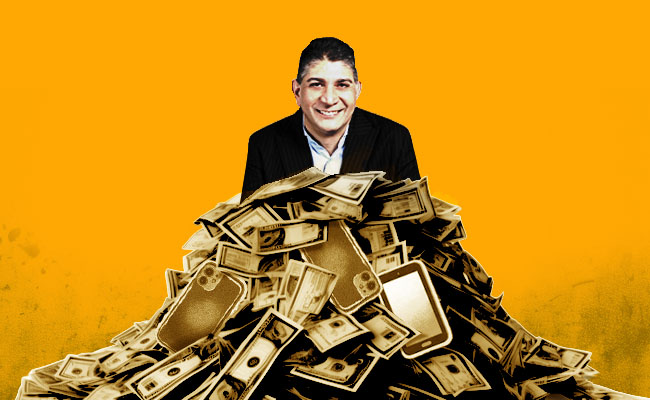
Top image: Mark Levy. Picture: supplied.
Sign up to Currency’s weekly newsletters to receive your own bulletin of weekday news and weekend treats. Register here.