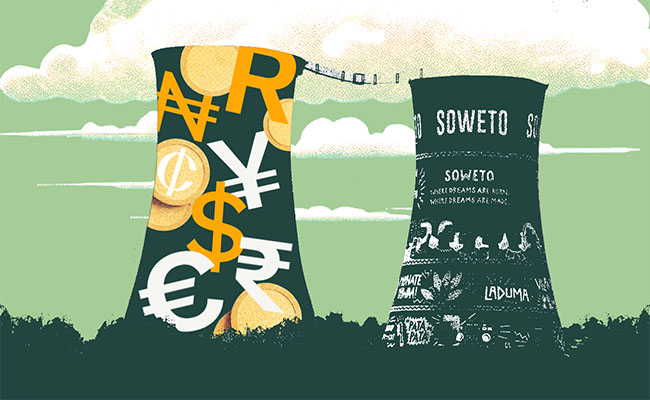

When we think of the economic hubs of South Africa, the towering skyline of Sandton probably comes to mind, alongside the picturesque view of the Waterfront or the Cape Town CBD. Few people would say the sprawl of Soweto or the corrugated squares of Philippi.
But Sum1 investments sees serious financial potential in these townships and has built an entire business model around supporting not only the entrepreneurs in these townships, but investors in them too. It’s an asset-financing company that enables stokvels – the primary savings model for many South Africans – to invest directly in township and rural-based businesses.
“Sometimes when people think about township businesses, they’re probably thinking of the mama selling amagwinya, or maybe a local carwash. But the township is far more expansive than that,” says Sum1 investments founder Kurhula Baloyi.
That’s not to say Sum1 doesn’t finance shisanyamas and the like, but there’s a lot more to it. Its investments include a leather-manufacturing company from Doornfontein that exports its goods worldwide, and a 3D printing prosthetics company from Soweto that prints low-cost prosthetics for amputees.
Match-making for small business
How it works is this: the stokvels signed up to the scheme give these township businesses a loan for a certain period. They select a portfolio of firms in which to invest, and then recoup their loan money plus a return on investment.
Baloyi describes it like a match-making business, bringing together those who ordinarily lack access to capital and those who are ordinarily frosted out of the traditional investment space.
“It’s very difficult to access capital for many township businesses because the first thing people think is, this is so risky, or, how on earth are we going to even begin to assess a business like this?”
For a myriad reasons, these businesses often have nowhere to turn. They have previously relied on government grants, but their businesses quickly outgrow the pace and size of state grant systems, and they need a larger and more immediate source of capital.
On the other end, she explains, they have a retail investment base that wants to be as involved as possible, “because that is the nature of stokvels – they debate and then pick their portfolios”.
These aren’t small stokvels either; most of the savings clubs investing with Sum1 are putting in between R100,000 and R500,000.
The building blocks of an exchange
The ultimate goal is to build this business up into the first ever independent township-based stock exchange. It’s an exhilarating idea, and not without merit.
“We do need to find a way in this country to increase the inclusiveness of finance to entrepreneurs,” says Nicky Newton-King, former CEO of the JSE.
“And smaller entrepreneurs, whether they are from informal areas or otherwise, struggle to get capital – they struggle to get loans, to get equity funding, etcetera.”
But Newton-King is circumspect about whether a stock exchange is the way to do this.
“Stock exchanges are regulated entities. And because they are regulated, they have listing requirements, requirements that companies have to meet,” she says. The heftiness of implementing these regulations is no small feat and requires extensive work.
What’s more, she argues that the technology needed to facilitate trades is hugely expensive and requires an exchange and its listed businesses to be able to sustain such costs.
“That’s the reason why looking at models of exchanges to allocate capital to very small businesses [is a] struggle.”
‘A fantastic idea’
Zwelakhe Mnguni, CEO of asset manager Benguela Global Fund Managers, is more optimistic. “I think it would be a fantastic idea. Money is being pooled one way or another through these stokvels, and I think that what is needed is a very structured manner of allocating that money to businesses.”
Mnguni says if there were a proper mechanism created that enabled entrepreneurs to apply for capital or list some sort of debt instrument, it could work.
“The people investing in a stokvel expect to get their accumulated money plus a return, or at worst they must get their money back. That automatically lends it [to being] a debt product. So, the question then becomes: what technology infrastructure is required to enable the buy and sale of the instruments created?”
Baloyi agrees that keeping the stock exchange as a debt market is the best idea, wherein businesses would sell debt securities to stokvel investors.
“We’ve seen that debt works because there’s alternative credit scoring which we can apply to the businesses, and the township businesses prefer credit [because] it’s something they can understand,” she explains.
“And then from the investor’s perspective, for them it’s ‘I want my money back as soon as possible’ and the best way we can do that is through credit.”
But Baloyi understands the intense work needed to make something like this a reality. “You know, there’s a lot of regulatory work that needs to go into that. There are a lot of financial controls that would need to go into pulling off something like that.”
Tap the secondary markets
When asked how they might make the idea of a township-based stock exchange work, Newton-King and Mnguni give almost identical answers – to collaborate with the existing stock exchanges in South Africa.
“I think there is definitely space to have a conversation with the already-established exchanges around the potential of establishing a sector for smaller entrepreneurs,” Newton-King says.
She argues that this would allow for the township-based exchange to use the already established regulatory and tech backbone of the JSE, Cape Town Stock Exchange or A2X to achieve its goals.
Both highlight the possibility – and slog – it would take to set up a secondary market, where investors coming to the exchange could sell securities between themselves, as opposed to just buying from the listed companies.
“If they could make an arrangement with the JSE to run on their systems, the JSE could then facilitate the secondary market,” muses Mnguni. “Then you won’t need the hectic regulatory requirements because you are trading on the JSE licence.”
Mnguni also suggests that stokvel members could have rights similar to those in schemes like MultiChoice’s Phuthuma Nathi.
The hope is to expand into something more long-term, gaining the trust of stokvels to invest their money for longer and longer periods. For now, Sum1 investments are doing a lot of hustling and grinding to potentially get to that point.
“But this is it,” Baloyi says. “This is the thing that gets people excited and is the thing that we’re working towards.”
Maybe it won’t be long before we’re all waiting for that IPO from a company in Langa or trading the debt securities of a mega-corporation from Thembisa. The world (and the market) is your oyster.
READ MORE:
- Can Shoprite fill the small business funding gap?
- Proof of life: Why Leila Fourie sees a revival for the JSE
- Bitcoin bubble bursts – so it’s time to buy, says Africa’s first crypto treasury
Top image: Michael Schofield/Unsplash; Rawpixel/Currency collage.
Sign up to Currency’s weekly newsletters to receive your own bulletin of weekday news and weekend treats. Register here.