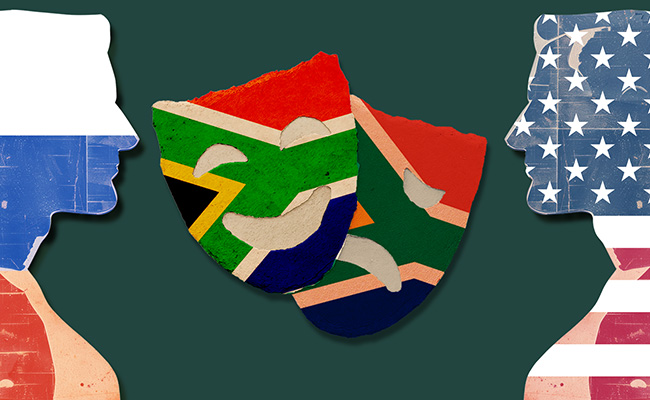


In what must be the most laughable act of diplomatic hypocrisy, South Africa has expressed its outrage at the “unilateral military strikes carried out by the United States of America against Venezuela” and the arrest of President Nicolás Maduro.
That statement, delivered at the UN Security Council by Jonathan Passmoor, South Africa’s acting deputy permanent representative to the UN, was carried as an excerpt in the state-backed China Daily. In a separate article denouncing the US action, the publication also cited comments from Cyril Ramaphosa’s administration that “no nation can claim to be legally or morally superior” to another.
“The prohibition on the use of force is a cornerstone of the United Nations charter,” Passmoor said. “Its violation undermines the very foundations of the rules-based international order.”
Yet, in a predictably one-eyed display of morality, there was no such statement on Russia’s invasion of Ukraine and no such statement on the Hamas assault on Israel. It seems that our department of international relations and co-operation (Dirco) only swings into action when Russia and China (and lately, Iran) give their blessing.
With objectivity and consistency comes the moral high ground, granting a voice at important moments, such as when concern arises about the undermining of sovereignty and the smashing of international law, no matter the perpetrator or victim.
To the contrary, Pretoria has not learnt that when you are in a hole, stop digging. Hence, Passmoor’s protest.
Silent on African travesties
When it comes to African affairs, Dirco is completely silent in the face of the most outrageous and violent violations of international democratic norms.
It failed to condemn the violent election in Tanzania, where at least 3,000 citizens are believed to have died at the hands of security forces, while the opposition was banned from participating and the opposition leader, Tundu Lissu, was in jail facing ludicrous treason charges.
South Africa is also silent on the election travesty unfolding in Uganda, where the 81-year-old despot, Yoweri Museveni, is trying to cling to a throne he seized violently in 1986, promising that democracy would reign.
In that country, which holds elections on January 15, the campaign of Robert Kyagulanyi Ssentamu, popularly known as “Bobi Wine”, has been subjected to police thuggery, including shootings with live ammunition, the detention of more than 400 campaigners, many of whose whereabouts are not known, teargas and road closures. Parliamentary funding to Wine’s National Unity Platform has been cut, and Museveni’s son, general Muhoozi Kainerugaba, has threatened to behead Wine and hang opposition politician Kizza Besigye.
South Africa’s hypocrisy is matched by that of the AU, which has singularly failed to prevent the rigging of elections and routinely turns a blind eye to violent suppression by thugs, provided they have the fig-leaf of a “liberation struggle”, never mind that the liberation has turned into a mirror of the oppression that was struggled against.
‘Grave concern’
Let’s look at two statements on international affairs issued by the AU two months apart.
After the US arrested and renditioned Maduro on January 3 2026, the AU acted with unprecedented haste, issuing a statement on the same day stating that it was “following with grave concern the recent developments in the Bolivarian Republic of Venezuela, including reports of the abduction of the President of the Republic, Mr Nicolás Maduro, and military attacks on Venezuelan institutions”.
The AU claimed that it was reaffirming its “steadfast commitment to the fundamental principles of international law, including respect for the sovereignty of states, their territorial integrity, and the right of peoples to self-determination, as enshrined in the Charter of the United Nations”.
Two months earlier, on November 1 2025, the AU issued a statement on the Tanzanian election, which its own observers found was undemocratic and unacceptable.
The statement read: “The chairperson of the African Union Commission, HE Mahmoud Ali Youssouf, takes note of the results of the presidential election in Tanzania and congratulates HE President Samia Suluhu Hassan for her victory.”
In fairness, Youssouf did say he “deeply” regrets the “loss of life” during the post-electoral protests. There was some waffle about finding a “peaceful” solution but, as the months have passed, this has turned out to be the usual vacuous posturing with no action on the ground.
The “loss of life” line is a ghoulish euphemism for the thousands of protesters killed by security forces. And while the winner of this blood-soaked election was congratulated, the AU had nothing to say about Lissu’s continued detention since April 9 2025.
The consequences
The message is clear. The AU is okay with dictatorship, on this continent and abroad, and will defend the most egregious violations of human rights to protect an autocrat.
South Africa and the AU are acting with grave irresponsibility. They know by now that violent repression is under way in Uganda, but they say nothing. When Museveni – a personal friend of Ramaphosa, who bought a herd of Ankole cattle from him – seizes power amid bloodshed, South Africa and the AU will quietly celebrate. After, of course, “regretting the loss of life” surrounding the election.
There are wider immediate and strategic costs.
It’s difficult to imagine a UN which is taken seriously on human rights with an expanded Security Council in which the likes of aspirant members, including South Africa, play a role.
Statements such as that on Maduro are hardly likely to help the troubled relationship with Trump’s Washington, as South Africa attempts to find a way forward to resolve its trade issues. There are downsides to its relationship with Europeans, too, given its ambiguity towards Russia.
It may win support among some of the Global South, though ironically probably not the majority of Venezuelans who either voted overwhelmingly for the opposition in the 2024 election or with their feet in joining the 8-million of their countrymen and women as refugees.
Dirco has not yet realised that the rights of people, not protections for incumbents or political parties, reside at the centre of international relations. Herein lies the greatest irony of all: that Pretoria’s careless ambiguity on democracy, in Venezuela as much as in Africa, makes it sound more – and not less – like Donald Trump.
Greg Mills and Ray Hartley are with the Platform for African Democrats, a forum that aims to advance democracy and end autocratic rule.
ALSO READ:
- Has Trump de-fenestrated international law in Venezuela?
- South Africa has chosen a risky approach to global politics: Three steps it must take to succeed
- South Africa tests Trump – at its own peril
Top image: Rawpixel/Currency collage.
Sign up to Currency’s weekly newsletters to receive your own bulletin of weekday news and weekend treats. Register here.