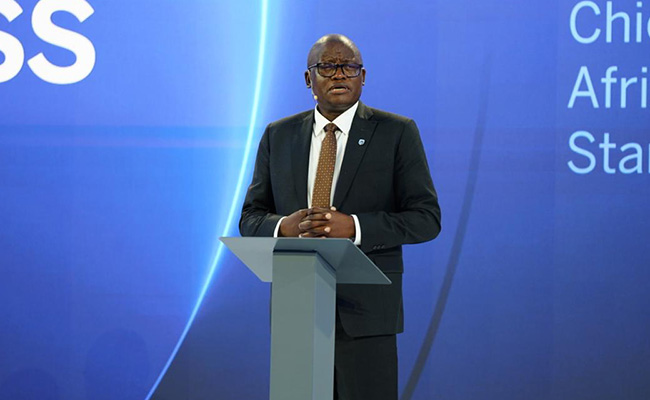

It’s safe to say Zano Nduli probably didn’t have a very peaceful end of year. On December 24, Nduli, the deputy executive director of the Takeover Regulation Panel (TRP), signed off on a withering 121-page indictment of Novus’s acquisition of Mustek.
It’s a fascinating and excoriating account of dealmaking and, of course, it is just one side of the story. It has not yet been put to the test by Novus, whose appeal is likely to be as fascinating.
The document contains a comprehensive analysis of a deal that kicked off in August 2023 and has yet to be finalised. That is when Novus, the R1.7bn JSE-listed printing group, informed insiders of its plan to buy Mustek, the R836m JSE-listed assembler of personal computers.
The crux of the TRP’s finding is that Novus will have to increase the mandatory offer price for Mustek to R15.41 a share from R13 a share. This will add R140m to a R750m deal. And, what’s more, it hinges on all of 3,000 shares.
But that’s only part of the story, and over the longer term it is likely to be the much less significant aspect of the TRP ruling.
For Mustek shareholders, the 18.5% price hike is indeed good news, assuming the TRP ruling survives Novus’s appeal to the takeover special committee. The problem is, because of the appeal it could be several months before shareholders receive any money at all – be it R15.41 or R13 a share.
Background
A recap of some of the details of this fascinating case may be useful.
In August 2023, according to the TRP ruling, Novus established a “Mustek-specific mandate”. This created a purpose-built infrastructure for the eventual acquisition of Mustek and was shared with Novus’s broker, Cape Town-based Numus.
On November 15 2024, having accumulated 35.07% of Mustek shares, Novus announced a mandatory offer for the remaining shares, pitched at R13 apiece.
Then, on November 28, Numus paid R15.41 a share for a chunk of Mustek shares.
Remarkably, it seemed that out of nowhere Novus emerged with a hefty 35% stake in Mustek. This is not unheard of, but it’s unusual. Generally, it’s possible to see evidence of a potential bidder in the market much earlier because regulations require parties to disclose to the market whenever they buy an initial 5% stake. Once the initial 5% is reached, every incremental 5% must be reported up to 35%, when the mandatory offer is made. There was no sign of any such announcements by Novus.
The disclosure is designed to protect shareholders from unwittingly selling their shares without enjoying a takeover premium. For the acquirer, the benefit of non-disclosure is that they avoid paying any takeover premium for the shares. Essentially disclosure protects smaller and more vulnerable players from large sophisticated ones.
Contracts for difference
It wasn’t long before the TRP started receiving complaints and allegations that the stake had been built up with the help of an alleged concert party. That concert party was Numus.
Furthermore, and this is an extremely consequential part of the story, it was alleged a large chunk of this stake had been accumulated through the use of contracts for difference (CFDs).
Here’s Investopedia’s definition: “A contract for difference represents a sophisticated financial derivative used by traders to speculate on short-term price movements of various underlying instruments [in this instance Mustek]. Settlements are executed in cash as there is no exchange of physical goods or securities.”
Because they’re regarded as derivative instruments, the South African regulators have not required investors to disclose their CFD positions in any takeover action. This is on the assumption the holders of CFDs do not have any beneficial interest in the underlying share.
And that’s how it was in the old days. But it hasn’t been that way for a long time. These days investors wanting to build up a position in a company, ahead of some or other corporate action, frequently use CFDs, which have the double benefit of limited financial outlay and little limelight, which inevitably improves the profit potential.
It seems that accommodating brokers with valuable clients are happy to push the definition and allow the holders of CFDs to exercise control over the underlying shares. There’s good reason why most jurisdictions across the globe now require the disclosure of CFD holdings. Nduli’s detailed and damning – if slightly repetitive – ruling is likely to see South Africa fall into line with its international peers.
Back to Novus and Mustek
The TRP alleges that between August 2023 and mid-November 2024, Novus used Numus and CFDs to build up a substantial stake in Mustek. At no stage, during this time, did Novus disclose its Mustek position to the market.
Novus explains this was because it was not acting in concert with Numus and so there was no need to make any disclosure. Furthermore, whatever exposure it had to Mustek was via CFDs, which means there was no beneficial interest that had to be disclosed.
In addition, as Numus was not a concert party, Novus argues it should not be required to increase the mandatory offer price to R15.41 just because Numus paid that price for a chunk of shares days after the mandatory offer was announced.
Here’s what Novus chair Adrian Zetler tells Currency about the R15.41 transaction: “No Novus directors or associates traded in any Mustek shares and were not beneficially or otherwise interested in the Numus hedge fund that traded 3,000 Mustek shares at R15.41 on November 28 2024.”
Zetler argues that the trade had no effect on Novus’s acquisition of Mustek, and says that, given the timing, the amount of shares involved and the fact that Novus was not an interested party in the trade, it “views this determination as ill considered by the TRP”.
As for the CFDs, Zetler tells Currency that Novus used and disclosed its use of CFDs in accordance with legal advice it received, “which also considered previous case law at the TRP”.
Zetler says the allegation that Novus misled the TRP is false and that some of the TRP’s accusations and insinuations are “just the commissioner trying to create the impression of impropriety”.
Muddying the waters?
Anyone who has read the 121-page ruling is likely to find that impression powerful. The TRP’s ruling deals at some length with the relationship between Novus and Numus, which the two parties describe as merely one of broker and client.
One conclusion the TRP comes to is that Numus, which shares offices with Zetler, served no real commercial purpose for Novus and that it was merely used to muddy the waters. Its function, says the TRP, was to “create a layer of separation between Novus and its counterparties, obscuring who was directing the accumulation strategy”.
That it was a concert party is in no doubt, believes the TRP. The fact it was prepared to pay R15.41 for the shares is more evidence of this. “The willingness to pay substantial premiums to the offer price demonstrates privileged access to information about the transaction’s likelihood of success, potential for offer price increases, and strategic development, supporting rather than contradicting concert party status,” says the TRP.
If not a concert party, it could be that Numus faces charges of front-running or insider trading.
It’s early days yet but, ultimately, Nduli may be on track to improve disclosure obligations, which should protect smaller investors.
ALSO READ:
- Barloworld’s bulldozer bid is on the home stretch
- Atterbury plays it cool on RMH buyout
- Why Canada wants Anglo for itself
Top image: Novus CEO Andre van der Veen and chair Adrian Zetler. Picture: novus.holdings; Rawpixel/Currency collage.
Sign up to Currency’s weekly newsletters to receive your own bulletin of weekday news and weekend treats. Register here.