

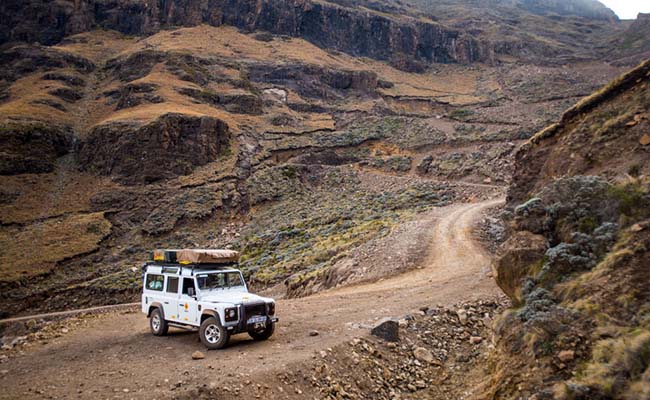

Making the decision to drive up into the cloud-drenched heights of Lesotho via the rutted, hairpin goat-track that is the Sani Pass requires a couple of things.
First, a sense of trust. Trust in your car, trust in the conditions, trust in yourself. Trust that you’re not going to accidentally get in the wrong gear and reverse backwards off the edge of the world.
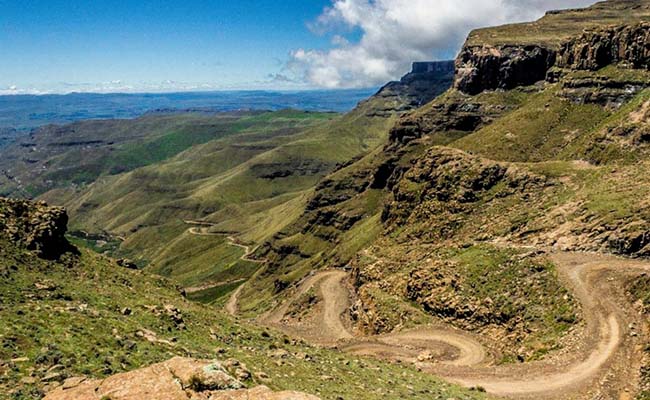
Second, you need to not necessarily be in a rush to “be” anywhere. The summit isn’t really the point – that part of the world is the literal definition of the journey being the destination. You are forced to take it slowly, and that’s exactly as it should be. Wildflowers carpet the dizzying sides of the Drakensberg at every turn, every crease and fold of rock is a waterfall, and the sounds of settling gravel and running water and ruffled grass are only really there for you when you stop. No Instagram post can ever capture how truly awesome it is to be up there.
Squads of ultra-kitted Landcruisers logoed with clip-art of buffalo, stuffed to the gills with overnight adventure campers will roar their way past you like they’re in the title-sequence for a new reality TV show. That’s fine. You wave as they go by and the endlessly rich silence of the high mountains rushes back in like a wave when the sound of their engines has faded.
A taxi to humility
Third, you will need a highly developed sense of humility. Because, just as you’re congratulating yourself on white-knuckling it up a nerve-shredding section of the pass, carefully negotiating an impossibly-steep, cratered minefield of boulders that could only be called a road if you’d never actually seen a road, then almost immediately a packed Hiace driven by a guy with his arm out the window will rattle its way past you like it’s no different from a Tuesday morning on Jan Smuts. It’s mortifying.
I’d stopped near the top of the pass to take in the endless stretch of valley that just drops away from almost directly below your feet, and two older Afrikaans guys pulled up to do the same, just as one of these taxis came bouncing past. The one guy looked at me and said, “I wanted to film my drive with my GoPro, but … (gesturing in the direction of the retreating minibus) that just makes it look stupid.”
He looked crestfallen, like someone had taken a trophy away from him. And I couldn’t disagree – I felt the same way myself. Later I learnt that these taxis are all 4x4s specially sourced from Japan. But still, it does deflate whatever sense of accomplishment you thought you were going to have.
Meeting a guy inside a cloud
That afternoon, having successfully crawled my way up into the Lesotho Highlands proper, the landscape became dramatically wrapped in the kind of dense, sudden fog that can only come from literally being inside a cloud. All there was for it was to embrace the wintery cosiness of it all despite summer being in full swing just a couple of hundred meters down below.
While taking this all in and tucking into a whiskey, I met a man from Finland, rather perplexingly called Tony. It somehow makes the retelling slightly less exotic when instead of “Henkka the Eternal, Tamer of the Great Husky of the Endless White North”, it’s … just Tony.
Anyway, Tony was a lean, fit man – the kind of person who looks as though he could get a spike through his leg, shrug it off and go for a 20km rock-climbing hike the next day. Which it turns out he had. I didn’t ask what a “rock-climbing hike” was, because it literally sounded insane.
The never-ending hike
Tony was visiting with his wife, who he’d met in Umlazi when he’d lived in South Africa, and I found out that despite having lived in Washington, Vietnam and currently Fiji in the course of his work for the World Bank, he and his family return to South Africa regularly.
They’d specifically come to Lesotho to hike (by now I was starting to understand Tony was really big on hiking), but the fog had forced a change of plans. Sunnily he said it was okay, they’d go for a 5am hike the next day.
He was a man of his word, because when I blearily stumbled out into the chilly morning to take a picture of the most breathtaking sunrise I’ve seen in years, there was Tony and his family, cheerfully setting off to no doubt swim up at least three waterfalls and hike the full circumference of Lesotho before breakfast.
Returning a lodge to its place
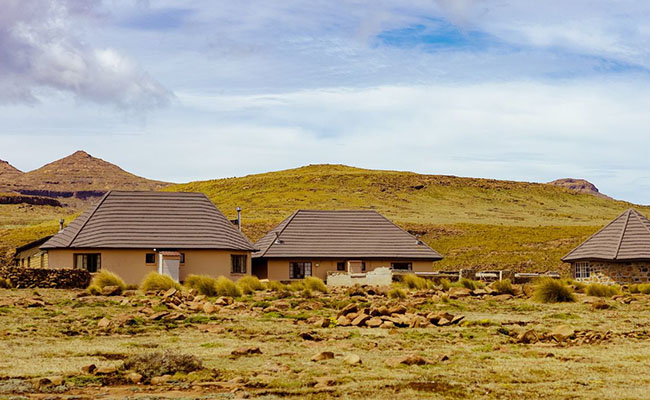
The lodge we were both staying at is run by a woman who somehow manages to make sparkle and palpable determination seem like the most naturally coexisting personality traits in the world. Khapametsi Maleke grew up in Lesotho, but spent a significant chunk of her life working in Pretoria – and it turned out her children had gone to my old school in the Eastern Cape.
How she’d come to own and run a lodge at the top of the Sani Pass is one of those wonderful stories where a person’s trajectory completely changes course because of one tiny pebble thrown into the stream of life.
Returning home one year, she accidentally reconnected with an old school friend who had grown up in the area of the Sani Pass, and while spending time together they remembered the crumbling old lodge that had always been run by a white South African man and decided to visit. Almost on a whim, and with no real previous experience at running a lodge, they decided to buy the place off him and make it into something special – two Lesotho women returning a small piece of their country to itself.
Why the mountain wins
After the chat, with cheeks warmed from highlands lamb, wine and the sting of walking out from a fire-warmed room into the dead chill of a foggy midnight, I couldn’t help but feel like I’d spent a day accidentally bumbling into a series of quiet stories that typify something wonderful, but what exactly I couldn’t really put my finger on.
Somewhere between the minibus taxi rattling past me and my fellow would-be adventurers, Tony the Finn with his melting-pot family cheerfully announcing a 5am hike as if it were a light stretch, and Khapametsi casually returning an entire mountain lodge to its own country, it occurred to me that I’d come up here thinking I was doing something vaguely brave. Something intentional. Something that would look good on Instagram.
Instead, I mostly just drove slowly, looked at fog, and felt my sense of importance quietly loosen its grip. Which, it turns out, might be the whole point.
The next morning, the clouds had lifted just enough to reveal the road curling away into nothing. Somewhere below, taxis were already moving. Tony was probably halfway to Bloemfontein. Khapametsi was already at work.
I packed my things, checked the car, and started down.
Mountains don’t really care how you get up or down them. They don’t clap when you arrive or leave. They just bring you in, with unexpected purpose or humility, or both.
Currency’s travel content is produced in partnership with Discovery.
ALSO READ:
- A journey through Samara Karoo Reserve’s wild landscape
- Books and boerie rolls: A guide to losing your way (on purpose)
- A fynbos safari in Cape Town’s back garden
Top image: Edwin Remsberg/VWPics/Universal Images Group via Getty Images.
Sign up to Currency’s weekly newsletters to receive your own bulletin of weekday news and weekend treats. Register here.





A great read thanks seeing that I am planning to tackle Sani Pass in my Mahindra Scorpio N