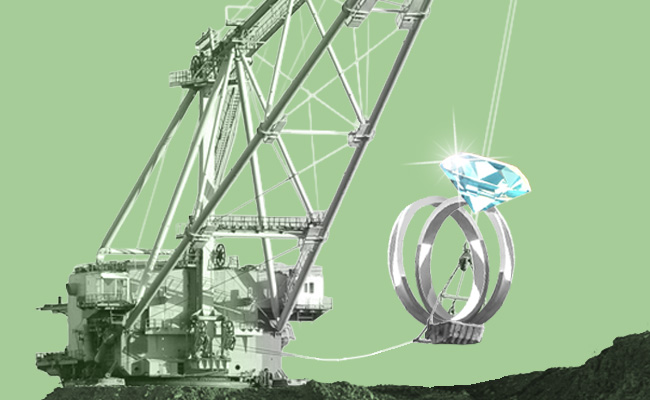

It might be the “most obvious deal in mining”, as Glencore’s South Africa-born CEO, Gary Nagle, evidently believes, but at this point the odds of a merger between the commodities trader and Australian mining giant Rio Tinto are touch and go.
A week ago, Rio Tinto confirmed it was in talks to merge with Glencore to create the world’s largest mining company, worth more than $200bn. But there was scant detail on what price Glencore shareholders would be paid, or what value Rio investors would have to give up – nor who would run it: Nagle or Rio CEO Simon Trott.
Getting this over the line won’t be easy, since investors are rightly wary of big-ticket deals struck when commodities are on a hot run like they are now.
“A lot of M&A at the top of the market hasn’t created value in the long term. So we’re certainly curious to understand why they think this time it would be different,” Mark Freeman, managing director of the Australian Foundation Investment Company, that country’s largest investment company and an investor in Rio, told Reuters.
It’s a common concern: investors are worried that companies will pay over the odds for in-demand metals like copper, which is central to the energy transition. Copper hit record highs in 2025, a year in which the price rose about 40%.
As Freeman put it: “When you’re at the top of the mining boom, there’s a lot of companies that look good. But when the cycle unwinds, the good companies stand out, and the weaker ones get found out.”
Anwaar Wagner, an equity analyst at Stanlib Asset Management, based in Joburg, says the logic for a deal remains compelling. “Yes, it absolutely makes strategic sense for Rio Tinto shareholders, since it gives them exposure to future-facing metals like copper, nickel and cobalt, and it dilutes their reliance on iron ore, which may face a tougher market in the next few years. The question is, will Rio be willing to pay a premium for this?”
Copper, again, is the big prize – it’s why BHP pursued Anglo American in a deal that ultimately failed in May 2024; it’s why Anglo American then pursued a merger with Canada’s Teck; and it’s why Rio wants Glencore.
Ultimately, it’ll come down to price, says Wagner, as well as any demands the Australian government makes, given that Rio is headquartered there. Rio and Glencore have until February 5 to answer all these questions by incorporating their plans into a formal offer document, according to the UK’s takeover rules.
There are numerous permutations. Rio could opt to buy it all, including the coal assets, or it could spin out the coal assets first into an entity, perhaps under the stewardship of Ivan Glasenberg, who wouldn’t be averse to this.
But as Freeman’s skittishness indicates, winning the support of Rio’s shareholders to offer a sizeable premium seems unlikely. This was evident from the fact that immediately after the deal was announced, Rio’s stock plunged 7%, even as Glencore’s bounced by almost as much.
Eye on the red metal prize
Perhaps Rio’s investors need to be more phlegmatic.
Vincent Anthonyrajah, CEO of Differential Capital, which has taken a sizeable stake in Northern Cape exploration company Copper 360, believes the risk of mining companies overpaying for copper assets at this point is small.
“Look, copper is the one asset that everyone wants right now, and that’s what Rio wants with Glencore,” he tells Currency. “People talk a lot about the utility of copper in AI, but actually, there is massive unmet demand for the very basics of electrification in regions like South and Southeast Asia, where countries like India, Vietnam and Indonesia have grown to become manufacturing hubs.”
While the copper price has risen 36% over the past year to $5.90 per pound, Anthonyrajah says that, in nominal terms, this is equivalent to where it was more than a century ago. In other words, there is still plenty of upside in the copper price, given the fact that there are few new mines coming on stream any time soon.
As for Rio overpaying, he believes this risk is often overhyped. “Right now, we’re still at a stage where sensible deals are being struck, like the merger between Anglo American and Teck. Perhaps if we see copper prices continue to climb through the roof over the next two years, then we’ll start to see the really silly deals.”
While it might seem like a global deal with little resonance in South Africa, Glencore retains a loyal shareholder base here. It listed on the JSE in 2013, two years after first going public on the London Stock Exchange. The move cemented its place in local institutional portfolios, and many local pension funds are still exposed to the company.
Culturally, Glencore also has strong South African roots. Glasenberg, a graduate of Wits University and the former CEO who still owns about 10% of the stock, helped craft Glencore into what it is now and shepherd it towards that listing. Nagle, similarly, studied commerce at Wits and qualified as a chartered accountant in South Africa in 1999.
It is also a company that has found itself mired in local politics – not just because it was strong-armed into selling Optimum Coal to the Gupta family in 2016, but also because President Cyril Ramaphosa’s mining company, Shanduka, was its black empowerment partner in this country.
Its assets in South Africa include 48.7% of coal company Umcebo; 79% of a ferrochrome joint venture with Merafe; and Astron Energy, the fuel company that operates the country’s third-largest refinery in Cape Town and hundreds of service stations.
None of which, of course, has earned Rio’s ardour. Rather, it is all about the 952 kilotonnes of copper produced by its operations in places like the Democratic Republic of Congo, Peru, Chile and Australia.
“Copper was the first metal ever used by humankind,” says Glencore in its marketing material – and it may also be the metal that underpins the creation of the world’s largest mining company.
ALSO READ:
- Duncan Wanblad’s unlikely reinvention of Anglo American
- Why the copper market short-circuited
- Copper 360’s R1.15bn restart
Top image: Rawpixel/Currency collage.
Sign up to Currency’s weekly newsletters to receive your own bulletin of weekday news and weekend treats. Register here.