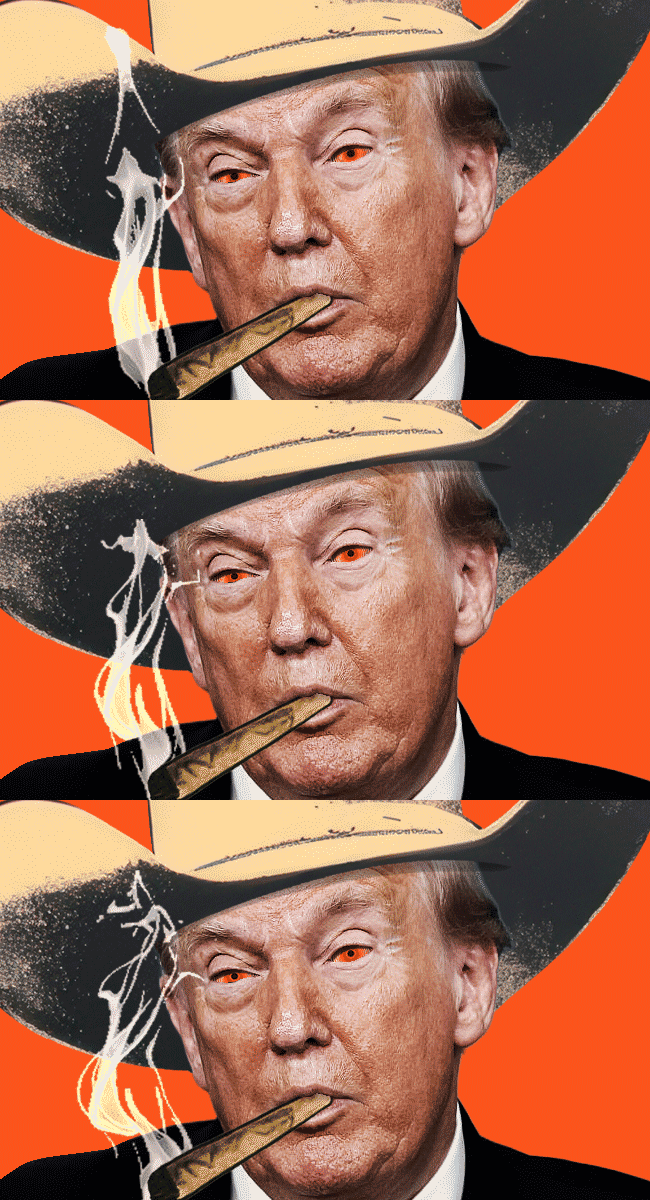

To no-one’s surprise, the soggy handwringing retreat that is the World Economic Forum in the alpine town of Davos has been upstaged by a 79-year-old Reality TV Star, who used the platform to lobby Europe to sell him the largest island on earth, a place that boasts more boats than cars.
As far as bizarre sideshows go, Donald Trump’s efforts to guzzle Greenland are something few would have predicted last year, not least because his track record when it comes to managing properties isn’t the strongest.
If you’ve had six chapter 11 bankruptcies in consumer-friendly jurisdictions such as Atlantic City and New Jersey, you’d imagine that Greenland – a country of 56,000 people, 80% covered in ice, with an ironic name gifted to it by one of Iceland’s most famous murderers, Erik the Red, in 982 CE – would be a far harder commercial proposition.
Over the weekend, the Reality TV Star threatened to impose tariffs of up to 25% on eight European nations that don’t support his annexation of Greenland, saying he would follow-through “100%” on this threat. Two days later, shortly after a foggy 70-minute speech that had dementia experts nodding in that knowing way, he said: “I will not be imposing tariffs.”
That speech was fabulous thigh-slapping theatre. It really got the crowd chuckling, for instance, as he repeatedly confused Greenland and Iceland, saying that the New York Stock Exchange “took the first dip yesterday because of Iceland”, and adding that European leaders had “loved” him until “I told them about Iceland”. All grand slapstick in the tradition of “The Naked Emperor”.
In one overflow room in Davos, there were “guffaws when Trump talked about wind farms killing birds”, according to journalists from AFP, who said that after about an hour the novelty began to wear off. “He’s a nutcase,” one executive said as he left the room.
‘Make America Go Away’
Some killjoys didn’t see the humour. “We’re in the business of democracy, we’re not in the business of mergers and acquisitions,” Swedish energy minister Ebba Busch said stiffly, adding that “we will not be blackmailed” by the threat of tariffs.
The Reality TV Star justified his giddying U-turn on tariffs by saying the “framework of a future deal” around Greenland had been struck between him and North Atlantic Treaty Organisation secretary-general Mark Rutte, a man fêted in his native Netherlands for being a “Trump-whisperer”.
Thanks to Rutte, it seems he won’t take a crowbar to Europe’s economy after all.
This “breakthrough” was news to Denmark’s Prime Minister Mette Frederiksen, who said demurely that such a deal is “not the case”. Asked whether Greenland would remain part of Denmark after this so-called “deal”, Rutte said “that issue did not come up” in any of the talks. Some “framework” then, excluding the object of the deal from the term sheet.
Unsettling and confusing, the sabre rattling has left European investors bemused. Danish pension fund AkademikerPension, for one, said this week it plans to sell $100m in US bonds, while Greenland’s only pension fund, SISA Pension, said it is debating whether to dump US equities as a symbolic stand against the US.
This didn’t go down well with the Reality TV Star, who told Fox News that if the Europeans ditch American assets, “there would be a big retaliation on our part … and we have all the cards”.
Perhaps he should consider diverting part of his country’s considerable fiscal firepower to investing in a Copenhagen vintage shop run by Jesper Rabe Tonnesen, who has done a roaring trade in MAGA-styled baseball caps adorned with the words “Nu det Nuuk”, referencing Greenland’s capital, alongside the words “Make America Go Away”.
Tonnesen told ABC News that he can’t keep up with the influx of orders for his caps – which have been worn at demonstrations in Denmark and Greenland in recent days, protesting America’s carnal intent towards the island (not Iceland). “We started to realise this probably wasn’t a joke – it’s not reality TV, it’s actually reality,” said Tonnesen.
Others have got in on the action too, with caps bearing the words “Make America Smart Again” also selling widely.
ADD bonanza
With territorial M&A occupying pretty much all the headlines, you have to ask if anything else of any consequence happened in Davos?
Well, on Thursday, Bryanston High alumnus Elon Musk – who once derided Davos as “boring” and its attendees as “trying to be the boss of earth” – spent a breezy half-hour demonstrating the power of functional attention deficit disorder to BlackRock CEO Larry Fink.
Musk veered from describing how, by the end of next year, humanoid robots would be in people’s homes, to discussing how it is “highly likely” that, at some point, humans will be able to reverse ageing – even if this isn’t always desirable.
Oh, and aliens – “I think if anyone were to know if there were aliens among us, it would be me,” he said. (In other words, there are no aliens around, maybe except for him.)
Lurching to AI, Musk said the only limitation on its potential is electrical power. By some time later this year, he said, it’s likely that there’ll be more chips being produced than there is electrical energy to turn them on.
Solar energy is the answer to this power crunch, he said – but the US has been slow to tap into this energy source properly because the tariffs imposed on Chinese panels have meant “the economics of deploying solar are artificially high”.
As a final thought, he added: “I’ve been asked a few times, do I want to die on Mars? I say, yes – just not on impact.”
With so much free entertainment, however would a country like South Africa – which wanted to use this traditional forum of collegial soft-soaping of elite bankers to make its investment case – get any attention for its serious message?
Unhelpfully, the first time South Africa made the headlines was when the Reality TV Star defended his bogus claim that there is a “white genocide” happening in South Africa. “We’ve seen the numbers, we’ve seen the records, and it is taking place,” he said.
With uncharacteristic, if unintentional, accuracy, he then described the so-called genocide as “unbelievable – you wouldn’t think it could happen today”.
Well, quite. “Unbelievable” is the closest he has yet got to the truth on this particular topic.
A good story – if anyone is watching
The country’s delegation has marshalled its charm offensive from South Africa House – a 225m space on Davos’s 49 Promenade with big banners in the windows – with the team led by finance minister Enoch Godongwana, international relations and co-operation minister Ronald Lamola, trade, industry and competition minister Parks Tau and tourism minister Patricia de Lille.
They did at least have a good story to tell. Last November, Standard & Poor’s delivered the country’s first sovereign rating upgrade in two decades. But more critically, the country can now say it has had more than 300 days without blackouts – a powerful rejoinder to the argument, persistent from about 2009 to last year, that even if someone wanted to invest, the country didn’t have the energy to make this happen.
On Thursday afternoon, one panel focused entirely on South Africa, where those ministers spoke soothingly of how the country still wants to work with everyone, including America. Discussions around tariffs with the US are “ongoing”, Tau said, while adding that efforts to find new trade partners in Southeast Asia and across Africa to insulate the country from the tariffs have gone swimmingly.
“We are in a good space,” said Reserve Bank governor Lesetja Kganyago in one interview from Davos. “We now can show that over a period of three years that fiscal consolidation is on course.”
Kganyago, perhaps the South Africa official with the most credibility, spoke of how GDP growth this year is expected to be 1.4%, which sounds modest, but it’s far above the past few years. “We have had a long period where growth potential of South Africa has been eroded, and we have rebuilt that,” he said.
Brand South Africa’s CEO Neville Matjie said the view of South Africa has improved exponentially. “Everyone wants to look at South Africa, they want to do business with South Africa – the geopolitics has actually forced us closer together,” he told Newzroom Afrika.
Evidently, none of South Africa’s new friends appear to have asked about the country’s hapless policing – the 62 murders every day, the 10,000 police with criminal records, and the diminishment of the police service to being little more than glorified first responders for the insurance industry. But maybe that’s for 2027.
There is a “South Africa Night” at Davos too, billed as a “wine and golf sector experience”, perhaps leveraging off President Cyril Ramaphosa’s surprising diplomatic success in dragging golfers like Ernie Els and Retief Goosen to the White House in May.
Whether this will achieve anything is up for debate. One CEO told this journalist that he felt the Davos event was hugely helpful, but more because he was able to hold a number of important meetings at the Alpine town in hotel rooms and makeshift offices with funders whom he would otherwise struggle to tie down.
This underscores the true value of Davos: enforced proximity to business contacts, where the temperature is likely to induce cuddling more frequently than the average Zoom call. With the occasional dash of reality TV on the side.
ALSO READ:
- RIP Davos, the birthplace of ‘woke banks’ and ‘lab-grown meat’
- Has Trump de-fenestrated international law in Venezuela?
- Ramaphosa’s hard sell at Davos
Top image: Kevin Dietsch/Getty Images; Rawpixel/Currency collage.
Sign up to Currency’s weekly newsletters to receive your own bulletin of weekday news and weekend treats. Register here.