

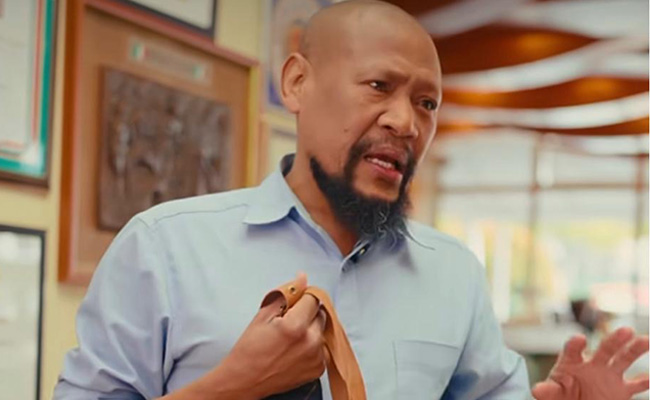

The corner offices with their fancy art are one thing, but for real insight into the deals and dramas of Joburg’s corporate world and social ecosystem, you need only spend a lunch at Mastrantonio in Illovo.
Between the grid of blonde-wood chairs, butter-yellow walls, Battiss artworks and bottles of olive oil, the city’s machinations play out over porcini and spaghetti.
In one corner you might spot a clutch of champagne socialists or, more accurately in our context, cab sav comrades. A few tables away, political opponents pretend not to notice each other. On the veranda, a quartet of M&A chaps in puffer vests celebrate a particularly brutal corporate restructure.
There are grannies celebrating their 90ths, matrics and parents flushed with relief over results, anniversaries, reconciliations, deals done and deals unravelling. This is Joburg, at table level.
For more than 30 years, all of it was Leslie Thabang Mvubu’s stage.
From the moment you walked in, he was already in motion, conducting his finely tuned orchestra of hellos and kisses (the Italian way), charming the ladies, checking on tables, laughing, moving on, looping back. Had someone taken your order? Could he recommend something delicious? How lucky the lone gentleman at the table was to be dining in the company of such beauties.
That was Leslie. Maître d’, waiter, raconteur, ringmaster, spiritual heart of the restaurant – call him what you will. His was not a corner office, but the vantage point was arguably better. And when he died in December, a small but essential piece of Joburg’s daily theatre went quiet.
A life lived front of house
Born in Alexandra in 1971 and raised in Soweto, Leslie was a Joburger in the truest sense – shaped by the city’s contradictions and improvisations. He arrived in hospitality by way of espressos at the Brazilian coffee shop on Sandton Square, becoming a barista in the early 1990s when cappuccinos in Joburg were still foam-domed curiosities and espresso was a foreign language. Those who worked with him insist he was among the best in the country, quietly introducing Italian-style coffee long before it was fashionable.
When Mastrantonio opened in the mid-90s, Leslie was there. He started behind the machine, but soon drifted, deliberately, to the floor. As Paolo Scalla, the group’s COO and co-founder recalls, “administration bored him. Stock-takes irritated him. People, however, were his natural habitat.” He asked to be moved out front and it was there that he found his calling.
Leslie did not so much serve guests as induct them. He greeted everyone. He noticed everything. He made newcomers feel welcome and regulars feel essential. He possessed an instinct for hospitality: the kind that cannot be learnt in hotel school. When he was “on song”, as Scalla puts it, there was no-one to beat him.
The house, and its elders
Mastrantonio has always been a place shaped by people rather than systems, and Leslie stood in a long, informal line of custodians. He was close to Scalla’s late partner Gianni Mariano and his family, particularly his grandfather – a formidable, old-school presence who embodied a fading idea of hospitality as something closer to a calling and duty than commercial transaction. In that world, you did not simply serve guests; you looked after them. This was Leslie’s blueprint for restaurant excellence.
He understood instinctively that Mastros (as regulars call it) was not merely a restaurant but a second home – for its owners, its staff and its regulars. He urged colleagues to greet tables properly, to look up from order pads, to acknowledge arrivals and departures. “The show is not over yet,” he liked to remind them. It was not a line. It was a philosophy.
Balustrade performances
Leslie was handsome, immaculately turned out, and carried an Italianate flair that sat easily alongside his Joburg roots. He dressed well. He loved women. He loved music – old-school soul that later gave way to house – and could often be found sitting in colleague Vanessa Cardoso’s car after service, sharing earphones and listening intently, before they had to get back to work.
He was also, improbably, extremely fit. Teammate Mduduzi Ncube recalls how he performed spontaneous feats of strength on the restaurant’s balustrade, holding handstands and hanging upside down on one arm alongside startled diners before landing with a theatrical thump. Some patrons were delighted. Others were baffled. Leslie, untroubled, carried on.
Generosity came naturally to him. He shared his toast, his pasta, his “coins”, as he called his salary. Money mattered little beyond its usefulness. Each month, without fail, he instructed that a portion of his pay be sent directly to his daughter.
Not a saint
An honest account of Leslie must include his excesses. He could be loud. He could overstep. He loved a drink and he resisted doctors, medicine and intervention with the same stubborn independence that defined much of his life.
But what mattered most to those who loved him was not that he was flawless, but that he was true. He listened, and he kept confidences.
Voices from the room
Longtime luncher and Everard Read chair Mark Read remembers the easy joy of those encounters. “I’d see Leslie and a smile would always crease my face,” he says. “He’d fist-pump me hello and I just knew that he sincerely liked me as a person. He cared deeply about where he worked, and that people were having a good time.”
Former South African Post Office CEO and perennial Joburg finance man Mark Barnes echoes the sentiment, placing the man firmly in the tradition of great hosts. “Restaurants are defined by the personalities that run them – our hosts,” he says. “What a pleasure it always was to be greeted by Leslie. You felt known, and so welcome.”
A Joburg life, properly lived
In a city obsessed with power and proximity to influence, Leslie represented something else entirely: the connective tissue. He knew politicians, dealmakers and kids who had grown up coming to Mastro. He understood that Joburg’s real business is conducted not only in boardrooms, but over lunch and at dinner tables, in shared jokes, in remembered names.
Today, the restaurant carries on as usual, but those who work there say something has shifted. The room feels quieter. Who will take his place? Those are natty, busy shoes to fill. Leslie Thabang Mvubu leaves behind his daughter, extended family, friends, colleagues who became family, and a city that is a little less attentive than it was before.
Top image: supplied.
Sign up to Currency’s weekly newsletters to receive your own bulletin of weekday news and weekend treats. Register here.



Beautiful memories for a beautiful man .
We will miss you Les .
Love from the chimes family
Very well said
Lovely article thanks Jeremy!
We have lost a true legend in Johannesburg. He will forever be remembered for his smile, his wit and sometimes a tear.
My heart breaks … he so often told me what a generous and special character he saw in me … and it warmed my heart and improved my day … thank you my friend for the dozens and dozens of lunches I’ve loved and left happy
Well said Sarah. A lovely tribute to a lovely man
Thanks everyone! I agree, he was a special human.
What a beautiful tribute.