Litigate like it’s 1999: the arms deal case is back in the Pietermaritzburg high court this Friday, and the Reserve Bank hawks are likely to hold sway at this week’s monetary policy committee meeting.
Politics
Madlanga commission of inquiry resumes
The Madlanga commission resumes public hearings this week, indicating that it “will continue where it left off in December 2025, hearing evidence from persons who have been implicated in the serious allegations made by lieutenant-general Nhlanhla Mkhwanazi and many other witnesses who corroborated or substantiated those allegations last year”.
The commission submitted its interim report to President Cyril Ramaphosa on December 17 last year.
ANC NEC lekgotla
The ANC’s national executive committee’s three-day lekgotla concludes on Monday in Boksburg. The purpose of the lekgotla has been to translate the six priorities contained in the party’s January 8 statement into a working plan for the year. A primary focus of the meeting has been preparations and plans for the local government elections expected to take place in November.
Cabinet lekgotla
Ramaphosa will convene the first government of national unity cabinet lekgotla of the year in Pretoria this week. The meeting will be focused on setting priorities and plans for the year ahead of the state of the nation address in parliament on Thursday February 12.
Zuma high court ruling
The Pietermaritzburg high court is scheduled to hand down its ruling on Friday on Thales and Jacob Zuma’s application for leave to appeal the dismissal of their bid for an acquittal in the nearly two-decade-long case stemming from the 1999 arms deal. The court is also expected to rule on an application by the state to stop Zuma’s “Stalingrad” legal tactics, designed to delay and frustrate legal proceedings.
Economics
Interest rate decision
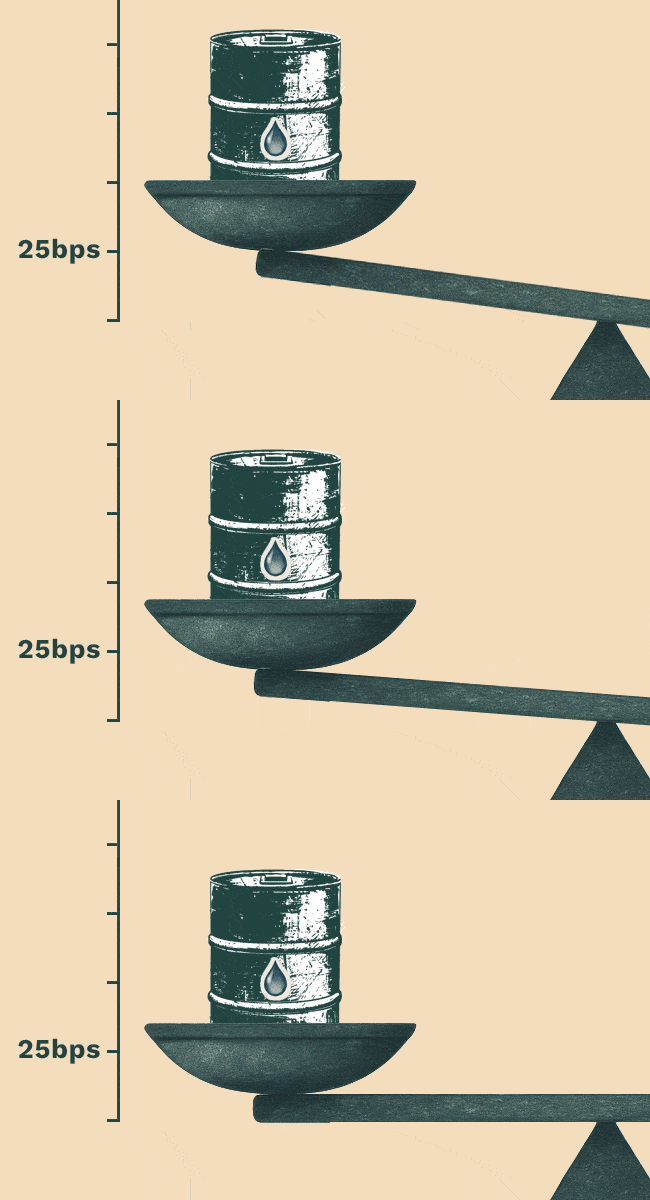
The Reserve Bank’s interest rate decision is set to dominate the week when the monetary policy committee announces its outcome on Thursday. The repo rate is expected to be held at 6.75%, extending the current pause in the easing cycle.
Inflation remains above the Bank’s 3% midpoint target, making some argument for caution, even as several upside risks have eased since the previous meeting. Global price pressures have softened, with the downturn in global food prices intensifying towards the end of last year. Oil prices, despite a recent seasonal increase, remain about 13% lower than a year ago, while the rand has strengthened on the back of US dollar weakness, expectations of further US rate cuts and a rally in precious metals. These developments have helped reduce imported inflation pressures.
The committee is therefore likely to characterise the decision as a pause rather than a turning point, with inflation still expected to move closer to the 3% target in the second half of the year, creating room for rate cuts to resume later in 2026.
Producer price index (PPI)
December’s producer price data lands on Tuesday and is expected to show that inflation pressures remain contained. PPI inflation is forecast to be unchanged at 2.9% year on year, with food and fuel continuing to drive the headline figure. Meat and meat product prices look set to remain high as the impact of foot-and-mouth disease continues, though this is expected to be partly offset by moderating prices in other food categories.
These categories are benefiting from favourable weather conditions, lower production and logistics costs, and a firmer rand. Fuel prices increased in December, narrowing the year-on-year declines in both petrol and diesel, but not enough to shift the broader inflation picture materially. A stable PPI reading would reinforce expectations that upstream price pressures remain subdued heading into 2026.
Money supply, credit and trade balance
Friday’s data drops will give a readout on domestic demand and external trade conditions at the end of 2025. Private sector credit extension is projected to have remained solid at 7.6% year on year in December, easing slightly from 7.8% in November, boosted by Black Friday spending. Corporate credit growth is expected to remain strong at about 10.9% year on year, supported by base effects and improving domestic conditions, while household credit growth is likely to have increased from 3.5% to 3.8%, led by mortgages and vehicle finance.
Trade data is expected to show the surplus narrowed sharply, with imports boosted by festive-season spending, higher real incomes and a firmer rand. The surplus is estimated to have fallen to R20.9bn in December, from R37.7bn in November, as exports softened due to seasonal shutdowns and earlier front-loading of shipments. The focus will be on whether the narrowing was driven primarily by import strength or export weakness, shedding light on trade dynamics as 2026 gets under way.

This article is published courtesy of The South Africa Brief, a political newsletter published on Substack which is a collaboration between Paul Berkowitz and Jonathan Moakes. It provides analysis and insight into the new, uncertain era of South African politics heralded by the 2024 general election. Including a specific focus on municipal politics, it will provide full analysis in the run-up to this year’s municipal polls.
Top image: Rawpixel/Currency collage.
Sign up to Currency’s weekly newsletters to receive your own bulletin of weekday news and weekend treats. Register here.