

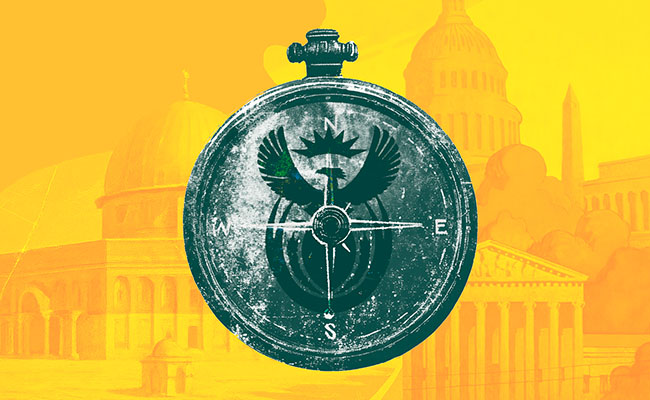


When Ebrahim Rasool was expelled from the US because of his comments that the Trump administration was driven by a “supremacist instinct”, Pretoria was outraged.
President Cyril Ramaphosa’s office said the decision was “regrettable”.
Mounting his high horse, Ramaphosa’s spokesperson, Vincent Magwenya, told the Reuters news agency that South Africa was “not going to partake in a counter-productive megaphone diplomacy”.
Fast forward to this week. In a fit of pique, South Africa declared the Israeli chargé d’affaires, Ariel Seidman, persona non grata. His offence? “The repeated use of official Israeli social media platforms to launch insulting attacks against His Excellency President Cyril Ramaphosa, and a deliberate failure to inform Dirco of purported visits by senior Israeli officials,” according to a department of international relations and co-operation (Dirco) statement.
Leaving aside for a moment the fact that the offence of “insulting attacks” on a president is exactly what Rasool did to US President Donald Trump, whose response earned the moral outrage of Dirco and the presidency, questions must be asked about the wisdom of South Africa’s continued misalignment on the Middle East.
Fresh on the heels of the unwise manoeuvres of Iranian combat vessels in False Bay, the expulsion of the most senior Israeli diplomat appears to confirm the worst suspicions – that South Africa is placing its relationship with the murderous mullahs of Iran ahead of its economic and trade interests.
The lion that didn’t roar
South Africa is already hopelessly isolated from contemporary developments in the Middle East, with the peace process between Israel and Hamas unfolding without its participation, while its case against Israel stumbles on in the Hague like a foreign policy zombie from a political reality that no longer exists.
Instead of staying true to its values of advancing peace and democracy by supporting the peace process in Gaza, South Africa appears nostalgic for the conflict, which it attempted to turn into a global foreign policy victory.
In this fast-moving world, Dirco’s actions are hopelessly out of date.
They reference a failed strategy of creating a new world order with Russia, China and Iran as the hegemons in a new global realignment.
That strategy, though briefly enjoying the limelight as the resentful commentariat cultivated by Russia and China celebrated the dawning of a new age, is as dead in the water as the South African Navy.
Writing in Foreign Policy, C Raja Mohan, a former member of India’s national security advisory board, notes: “Given the sweeping ambition of Trump’s board, one might have expected the Brics forum – the self-appointed vanguard of anti-hegemonic politics and the champion of the Global South – to rain fire on the US president. But the Brics turned out to be the lion that did not roar. Instead of confronting Trump, many of its members and aspirants have facilitated his project by either quietly joining or looking the other way.”
Mohan points out that the “Global South” proved fickle when the momentum shifted and “supposedly united in anger at Israel’s campaign in Gaza – ended up supporting a resolution that removed pressure on Israel and gave Palestinians little say in governing Gaza’s future”.
The calculus of national interest
The lesson from all of this? “When forced to choose between moral posturing and geopolitical access, the leading states of the Global South opted for influence within a US-led structure.”
The expansion of Brics to include Iran and others at the South African summit in August 2023 was supposed to represent the moment the organisation stepped up as the new master of global politics, its eyes firmly on a future where multipolarity (read Russian and Chinese dominance) was ushered in.
But, instead of a new force for global realignment, Brics has, in Mohan’s words, “accelerated incoherence”.
“Far from counterbalancing the US, the expanded Brics has revealed itself as a loose and shaky coalition of states with divergent priorities and overlapping vulnerabilities. If these states have one thing in common, it is the importance they attach to continued bilateral engagement with Washington.”
It is time that South Africa wakes up to the reality that the global order is not shaped by what Mohan describes as “slogans of solidarity or pious praise of multilateralism”. What drives the actions of rational states is “the calculus of national interest”.
South Africa has proved itself the master of sloganeering and pious praise of multilateralism – interestingly, not when it comes to the grotesque abuses of democracy in Tanzania and Uganda, for example – and it has suborned the national interest to its posturing.
While sound domestic financial management over the last year, the direct result of the DA’s refusal to sanction an irresponsible tax-and-spend budget proposed by the ANC, has protected the economy from the effects of these odd foreign policy adventures, the time will come when the effects on trade and isolation will take their toll.
Reset and reform
South Africa needs to reset its foreign policy orientation. This requires more than a limp-wristed appeal from the president for the exclusion of Iran from naval exercises, which was simply ignored. It requires the root-and-branch reform of Dirco, which is the architect of the failed policies that threaten the country’s stature.
The positive side is that the potential for strategic co-operation between Israel and South Africa still exists. There is something to work towards. But this is not a job for those looking for magical outcomes or for indolent diplomats who default to polemic and politicking over the hard grind of cultivating relationships. It will require those well qualified in patiently steering a clever and careful path through a delicate and sometimes treacherous diplomatic terrain. And it will demand abandoning the well-used “Zionism is apartheid” crude psychological political crutch.
Yet, as if to prove this psychological point, Dirco has opted for escalation at a time when South Africa’s international relations (not to mention its economy) demands quite the opposite, requiring derisking not provocation. For now, South Africa’s relationship with Washington runs through Jerusalem, whether it likes it or not.
Instead of expelling Israeli officials, we should be re-establishing diplomatic ties with Jerusalem and using our influence with both sides of that tragic conflict to boost the initiative for peace in Gaza. We should heed the words of Canadian Prime Minister Mark Carney. Nostalgia is not a strategy.
Ray Hartley and Greg Mills are with the Platform for African Democrats.
ALSO READ:
- South Africa has chosen a risky approach to global politics: Three steps it must take to succeed
- South Africa tests Trump – at its own peril
- Operation Wilt for Peace
Top image: Rawpixel/Currency collage.
Sign up to Currency’s weekly newsletters to receive your own bulletin of weekday news and weekend treats. Register here.




Well explained Dr Mills and Ray.
I’ve been following currency news since their inception but not after an article like this. What’s happened in Palestine for decades is nothing but a genocide at the very least. This article is disgraceful to South Africans, and humanity at large