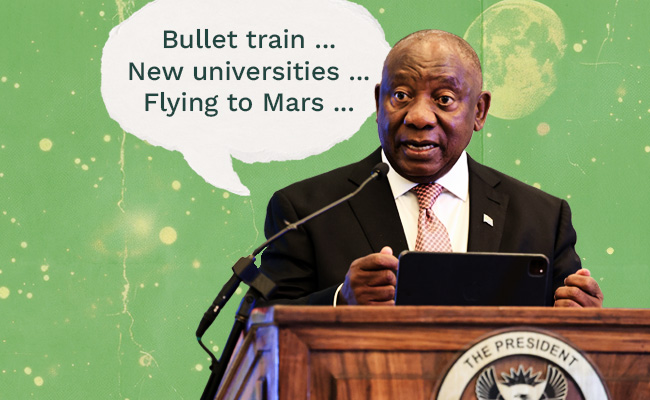

Cyril Ramaphosa has never had a problem delivering rousing, chest-thumping speeches, unlike his hapless and numerically-challenged predecessor, Jacob Zuma.
No, if anything, Ramaphosa’s weakness has been not acting quickly enough – certainly not a charge you could level at Zuma, who energetically cycled through three finance ministers in a weekend in 2015 and gamely repurposed the state machinery to help his buddies in Saxonwold.
Oh sure, Ramaphosa can convene a commission or two, and establish “dedicated task teams” smartly enough – but when the rubber hits the road, is he willing to axe a crooked police minister? Can he fire his army chiefs when they directly disobey him on holding manoeuvres with a rogue state like Iran? Will he boot out a water minister who can’t keep water flowing?
Yet on Thursday night, the president’s state of the nation address began in an exceedingly impressive way when it came to pledges of accountability, action and acknowledging reality. With more energy and purpose than in any of his previous nine speeches, Ramaphosa quickly isolated the two biggest issues affecting South Africans: a cascading water crisis, and a crime wave against which the authorities seem resoundingly defenceless.
Reviving memories of his first state of the nation address back in 2018, he pledged rapid action: soldiers on our streets, a crackdown on guns, jailing municipal officials.
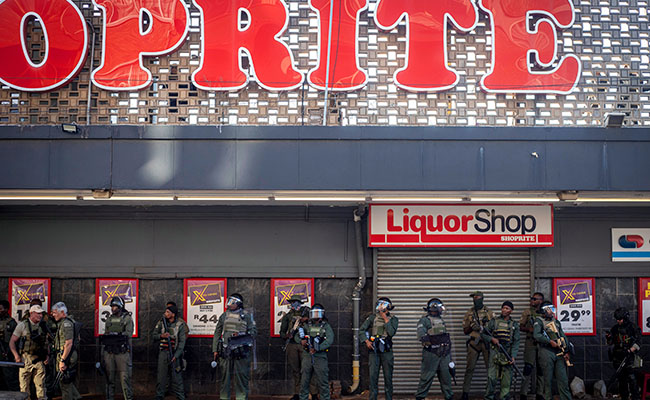
“I am deploying the South African National Defence Force to support the police,” he declared in a sombre tone. A tactical plan will be drawn up to deploy the soldiers “within the next few days in the Western Cape and Gauteng to deal with gang violence and illegal mining”.
Also: all senior management in the South African Police Service will be “re-vetted” to root out corruption, with lifestyle audits nogal, while existing gun laws will be implemented with more muscle too.
Before the speech, much of the discussion by analysts was about whether Ramaphosa would address the “lived experience” of South Africans, an awful cottonwool phrase with at least one too many words, which prioritises subjective and emotive responses over objective truth.
Nonetheless, Ramaphosa did well enough on this score, displaying a deft empathy that so many others in his government seem to lack – most notably, Panyaza Lesufi, the premier of the country’s wealthiest province, Gauteng.
Speaking of the crisis that has left some suburbs without water for weeks, Lesufi said this week that “we all go through this”, adding, unhelpfully, that “in some instances, I have to go to a certain hotel so that I can bathe and go to my commitments”.
This Freudian slip provided a deeply revealing insight into the narcissism of so many officials, ensuring that long after Ramaphosa’s vows this week of “responsive governance” are forgotten, many will remember Lesufi’s Marie Antoinette moment as indicative of a wider dissonance from the society the ANC is meant to represent.
Ramaphosa, by contrast, is far more politically skilled. “Water is now the single most important issue for many people in South Africa,” he said. “We have all seen the pain that our people have been expressing through demonstrations in various parts of Gauteng.”
Without excuse, he copped to his government’s culpability for this disaster. “Poor planning and inadequate maintenance of water systems by many municipalities are the main cause of the problems we are going through now and are the reason that taps often run dry. There is no silver bullet to address this challenge, which has its roots in systemic failures and many years of neglecting infrastructure,” he said.
His answer: R156bn in new funding for water and sanitation infrastructure over the next three years, and jail terms for municipal officials who don’t provide water.
“Government has already laid criminal charges against 56 municipalities that have failed to meet their obligations. We will now move to lay charges against municipal managers in their personal capacity for violating the National Water Act,” he said.
The root of the problem, he said, is that money paid to municipalities for water is simply re-allocated for “other purposes” (think salaries) and not spent on maintaining the infrastructure. Now, he said, the government will ensure that money for water is put straight back into fixing pipes, reservoirs and pumping stations. Which seems such an obvious enough fix that you wonder why this hasn’t happened before.
This is all about restoring a “culture of service” in the state, the president added.
‘Political manifesto’
Had Ramaphosa stopped there, it would have been a job well done. He had pledged action, revived hope, and boasted of the country’s achievements in the past year: removal from the dirty-money greylist, four quarters of GDP growth, a stronger rand, one of the best-performing stock exchanges around (which returned a world-beating 57% last year in dollars). And the lights are on.
Instead, as his speech meandered beyond the 100-minute mark, it began to wander into tedious operational specifics. Unnecessary detail on “workplace learning” and student accommodation, for instance, felt like the sort of detail you’d find in the appendices at the back of a dull ANC policy manifesto document of more practical application in an insomnia workshop.
While Gayton McKenzie, the leader of the Patriotic Alliance and Ramaphosa’s minister of sport, arts and culture, described this as the “best” state of the nation ever, other opposition politicians were more stingy in their praise.
Songezo Zibi, the leader of Rise Mzansi, said the country has heard big promises like this in the past. “The talking is over,” he said.
Julius Malema, the leader of the EFF, said South Africans heard a man “using a government platform in an election year to launch an election campaign”. The only difference this time, Malema said, is that “today he is saying it with energy”.
That energy was, in itself, no small achievement, given how long the president banged on for, seemingly intent on giving a school governing body-style report on every portfolio under his watch.
Ramaphosa ended his speech by saying “this is the time for all South Africans to rise” – and you had a sense that, after a 100-minute report back, so many in the Cape Town City Hall couldn’t have been happier to do just that. Were any of them reassured that when they wake up tomorrow, they’ll be safer and their taps will flow when turned on?
Probably not, even if the palpable energy in this speech was a welcome departure from the past few years.
This scepticism may feel somewhat churlish given that Ramaphosa’s state of the nation speech did far more than anyone could reasonably have expected. But at this point, it can only be truly marked against the backdrop of the thwarted hope of the past eight years, which means that most South Africans will probably wait to see what he does this time, rather than bet the farm on what he says.
ALSO READ:
- Cyril, and the soft art of the empty promise
- Government, we beg you, step aside!
- When dialogue costs more than delivery
Top image: Gallo Images/Luba Lesolle; Rawpixel/Currency collage.
Sign up to Currency’s weekly newsletters to receive your own bulletin of weekday news and weekend treats. Register here.