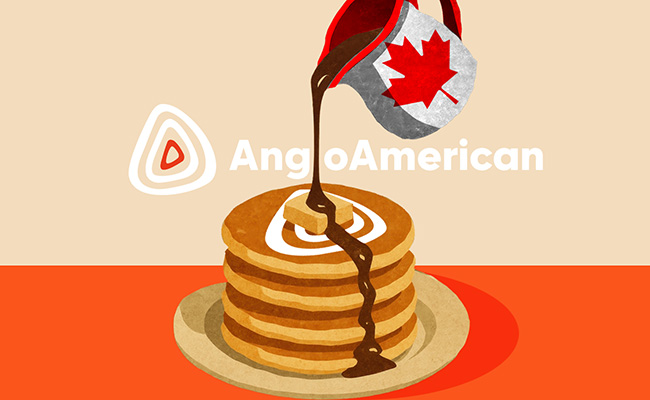

There are few companies in the world that have struggled as much as Anglo American over its national identity, unwittingly predicted from the very start by choosing a name associated with not one but two countries on separate continents. But is it possible that in the not-too-distant future Anglo could settle this perplexity by becoming – tada! – Canadian?
Since 1999, Anglo has sat somewhat uncomfortably between investors in South Africa and the UK, having made the latter its primary domicile.
But now, barring last minute regulatory setbacks, it seems likely that Anglo’s grand merger with Canadian firm Teck Resources will proceed, and part of this deal is the agreement that the head office will move to Vancouver.
Soon after that, Anglo is expected to dispose of its stake in De Beers, which will jettison the company’s last directly-owned mine in South Africa – Venetia. All that will remain of its South African assets will be a majority investment in iron ore miner Kumba.
That stake is significant, but the company has large iron ore interests in Brazil too, so the weight of corporate interest in this mineral will probably tend towards Latin America, roughly the same time zone as its new headquarters. The company’s huge gold, paper, coal and platinum assets, which collectively made it the largest company on the JSE back in the day, are all now sold or unbundled.
Finding its identity
It’s common for large mining companies to own assets all over the world, so their corporate identity is not often linked with their asset base, unlike companies that do have a distinct national identity.
So, since its asset base does not define its nationality, and the head office will be based in Canada, what are the chances that over time, Anglo might shift its primary listing to Toronto? Canada has a large and dynamic mining sector, with 175 mining companies on the main exchange and an incredible 900 mining companies on the Venture Exchange.
The total market capitalisation of London-listed mining stocks is now about $300bn; the value of mining stocks in Toronto is roughly twice that.
It is certainly the desire of the Canadian government, which according to the Canadian press last year, was urging Anglo to shift its centre of gravity to Canada as part of the huge $50bn “merger of equals” with Teck. Canada’s most prestigious newspaper, The Globe and Mail, reported that no less a person than Canadian Prime Minister Mark Carney made approval contingent on Anglo moving its head office to Canada. For now, the deal structure has kept the primary listing in London, and Canadian regulators approved the deal on that basis.
But what about the longer term?
‘Well served’ by London
In an interview at the Mining Indaba, Anglo CEO Duncan Wanblad, who will be CEO of the combined company, deflected the question, but appeared to defend the London listing.
Asked if the company would in future consider shifting its primary listing to Canada, Wanblad said: “It would have to make financial sense for that to happen. I mean, we are very well served by the London markets today.”
For listed companies, raising finance is always a factor, and the London Stock Exchange (LSE) is one of the deepest pools of finance out there. “They understand mining, it would be quite expensive for us to be able to move it. I mean, there’d be an extraordinary amount of flow back that we would have to manage.
“It doesn’t seem worth the effort,” he concluded.
It’s true that the LSE is larger in total market capitalisation than Toronto, but actually not by that much. The LSE is the world’s sixth-largest exchange, with a total market capitalisation of about $6-trillion. The Toronto exchange is now the world’s eighth largest, with a market capitalisation of $3.8-trillion, and a much larger proportion of that is taken up by mining companies.
Portfolio problems
By “flow back” Wanblad refers to the “return flow” of a company’s shares into the public market as a consequence of holding constraints. Many investment portfolios constrain investments to, for example, only shares on the FTSE/JSE top 40 index. If that constraint is removed, those portfolios may be required to sell the share, which can be a nightmare for companies’ investor relations teams.
In Anglo’s case, it benefits from a whole bunch.
Yet it’s also easy to overstate the importance of these constraints. When BHP dropped its London listing in January 2022 and consequently fell out of the FTSE 100, the company’s share price actually increased over the following few months, and is now 30% higher than it was then.
The gradual internationalisation of stock trading and the global co-ordination of listing rules has made the specific stock exchange on which companies are listed less critical, corporate finance experts say.
On the other hand, in an era of growing geopolitical tensions, corporate identity could become much more important than it is now. For Anglo American, being American might conceivably be key to its longer-term future.
ALSO READ:
- Why Canada wants Anglo for itself
- Anglo’s trek to Vancouver underscores South Africa’s slide
- Duncan Wanblad’s unlikely reinvention of Anglo American
Top image: Rawpixel/Currency collage.
Sign up to Currency’s weekly newsletters to receive your own bulletin of weekday news and weekend treats. Register here.