President Cyril Ramaphosa’s 10th state of the nation address was widely lauded, packed with economic optimism, infrastructure promises and appeals to investor confidence. But it raised deep questions over South Africa’s supposed commitment to the just energy transition.
It began well enough. When Ramaphosa spoke about the floods in Limpopo and Mpumalanga, he used emotive language, speaking of the “catastrophic flooding” that had caused “the loss of at least 45 lives and widespread destruction of homes, schools, clinics and other infrastructure”.
Yet he treated these floods as isolated disasters to be managed, rather than part of a wider climate crisis that must be confronted head on. Were he to have looked at the science, he would have known that global warming is intensifying rainfall in the region by 40%.
Ramaphosa did, however, concede that “we are increasingly vulnerable to extreme weather conditions”, but stopped there. He didn’t say why, who was driving this, and what the implications are of the scientific consensus that Southern Africa is warming at roughly twice the global average rate.
The deaths of those 45 people were framed as misfortune – not as the consequence of a changing climate for which a clear plan for adaption is needed. There was no strategy for climate resilient infrastructure, no mention of early warning systems, no focus on how to support farming communities when seasons are no longer predictable.
True, Ramaphosa did speak about “investing across our country in roads, bridges, rail lines, ports, dams, wind and solar farms”, committing “more than R1-trillion in public investment over three years to build and maintain infrastructure”, but after that, scant detail.
In particular, there was zero mention of how this infrastructure must be designed for an entirely different climate than in the past.
The new extractivism
Perhaps the most enthusiastic parts of Ramaphosa’s speech focused on mining.
“South Africa has some of the world’s largest reserves of critical minerals [with] ore reserves valued at more than R40-trillion, making mining a sunrise industry,” he said. After years of falling investment in exploration, he said the country is dedicating funds towards geological mapping and exploration to harness our critical mineral reserves”.
He cited the Industrial Development Corporation’s investment of R300m in funding for the Frontier Rare Earths Project in the Northern Cape, something mining minister Gwede Mantashe had alluded to earlier in the week at the Mining Indaba. This project, he said, “has the potential to become one of the world’s largest and lowest-cost new producers of minerals that are needed for smartphones, lithium batteries and other products”.
These are minerals apparently needed for electric vehicles, wind turbines and battery storage – presenting these minerals as South Africa’s path into a decarbonising global economy.
Recognising this opportunity is not wrong – but context matters. If anything, Ramaphosa repeated the same extractive logic that has shaped South Africa for more than a century: the country’s role in the energy transition was reduced to simply digging resources out of the ground and exporting them.
Beneficiation received scant attention. Ramaphosa did say that at the G20 leaders’ summit in November, the other countries “supported our proposal to expand local beneficiation of critical minerals and the export of finished products”, but the focus was all about external markets – not building industries that meet local needs.
Selective embrace of renewables
Ramaphosa spoke exceptionally favourably when it came to renewable energy too.
“By 2030, more than 40% of our energy supply will come from cheap, clean, renewable energy sources,” he said, praising the “regulatory changes [that] have enabled a massive and growing pipeline of investment in renewable energy”.
On Eskom, Ramaphosa said the state is going ahead to establish a fully independent state-owned transmission entity, commending “the first round of independent transmission projects to enable private investment in expanding our national grid”.
These are welcome steps obviously. Load-shedding, nobody needs reminding, did immense harm to the economy and ending it has been a considerable achievement. And from the embers of this disaster, South Africa now at least has solar and wind energy that is cheaper and faster to build than most alternatives.
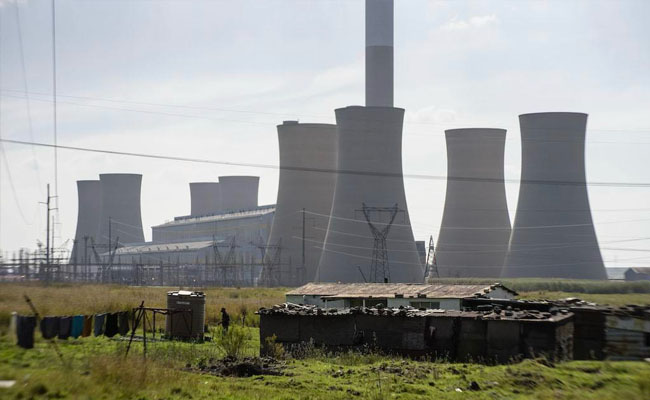
Yet Ramaphosa avoided specific realities. Coal, which still produces about 80% of the country’s electricity, was mentioned only once. And, while he talked of “new gold, copper, rare earths, platinum and coal mines”, there was no mention of gas. There was no acknowledgement that the Integrated Resource Plan includes new gas capacity, and no mention of offshore exploration or the planned liquefied natural gas terminals.
This selective approach allows the government to appear deceptively green on the global stage.
So, it can celebrate R250bn in pledges for the Just Energy Transition Project, and talk boldly of 40% renewables by 2030, while simultaneously pursuing a far less clear energy path at home.
It is easier to say “we have brought an end to load-shedding and built a more dynamic and resilient energy system” than to explain why Eskom wants exemptions from air pollution laws for old coal plants. It is easier than explaining why the gas masterplan remains policy, when gas is a fossil fuel that conflicts with scientifically sound mitigation measures.
Carbon tax contradictions
But the clearest contradiction in the speech related to the Just Energy Transition Partnership (JTEP).
Ramaphosa said “international pledges to the Just Energy Transition Investment Plan now stand at approximately R250bn”, which is being used to finance “investment in manufacturing, infrastructure and skills”.
This is the largest climate finance package given to any single country. The JTEP exists because South Africa’s economy is highly carbon intensive and the country has shown reasonable ambition to change this, so international partners have pledged money on the basis that domestic policies will discourage pollution.
And yet, there are people in the cabinet proposing the suspension, or even removal, of the Carbon Tax Act – a foundational tool in South Africa’s mitigation strategy. Taking this foreign money while weakening this legislation undermines that trust. It places the partnership at risk, and threatens this flow of funding.
This resistance from inside Ramaphosa’s own cabinet also reveals deeper priorities. Carbon taxes make pollution more expensive, pushing investment towards cleaner options – but opposing them effectively means opposing the transition itself. It is a choice to protect fossil fuel interests instead of the JTEP. You can’t have it both ways.
Reading between the lines of Ramaphosa’s speech reveals a basic tension about South Africa’s future in a changing climate. It shows a government that wants to manage climate impacts without fully taking responsibility for their causes; a government that wants the benefits of transition without challenging polluting industries.
These contradictions do not lead to climate justice, which requires clear choices – identifying the problem, acting on it, and putting people, rights and the environment first. Until that happens, and climate change isn’t treated as some side issue, South Africa’s transition will remain uncertain. And it won’t be long before those who provided that R250bn in funding notice.
Dr Jonty Cogger is a public interest attorney at the Centre for Environmental Rights; Brandon Abdinor is a senior climate advocacy lawyer at the centre.
ALSO READ:
- Billions pledged, no playbook: South Africa’s climate finance problem
- Banks retreat from climate change commitments – but it’s business more than politics
- Investing in nature: Time for financiers to act
Top image: Gallo Images/Jeffrey Abrahams; Rawpixel/Currency collage.
Sign up to Currency’s weekly newsletters to receive your own bulletin of weekday news and weekend treats. Register here.