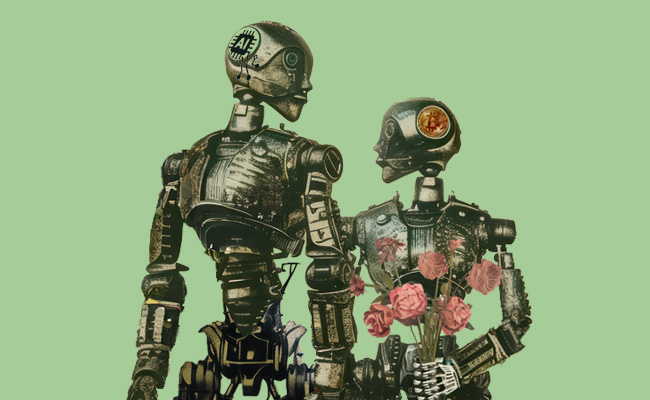

The 21st century has produced two technological revolutions that have fundamentally altered how we think about intelligence and value.
AI is transforming just about everything, from writing to education to medicine. Cryptocurrency and blockchain technology have built new models of money, ownership and trust. But there has been little real overlap between them, as they stared at each other in mutual incomprehension for nearly two decades.
That they lack overlap is not because they’re incompatible. It’s because they’ve been solving different problems. Crypto grew up obsessed with co-ordination among strangers: how to agree on “what happened” without a referee, how to move value without human oversight and permission, how to build markets that don’t need a central operator. AI grew up solving a different set of problems: how to recognise, predict, generate and act. These are two very different magisteria.
For the past few years, attempts to force AI and crypto into the same room felt more like a marketing opportunity than a genuine technological convergence. Projects would slap “AI-powered” onto their blockchain pitch decks, hoping to capture investment from both camps.
The synergies seemed obvious at a superficial level: AI was becoming increasingly centralised in the hands of a few technology giants; crypto promised decentralisation. AI operated as an opaque “black box,” often poorly understood even by its creators; blockchain offered complete transparency. But, upon deeper digging, concrete applications remained elusive.
That is about to change.
About-turn
Vitalik Buterin, the creator of Ethereum, the second-largest blockchain, is one of the most closely followed voices in crypto. Previously, he was famously ho-hum about where that intersection may lie. He acknowledged the intuitive appeal while noting its historical limitations. “It’s easy to come up with synergies at a superficial vibe level,” he wrote in 2024. “But over the years, when people would ask me to dig a level deeper and talk about specific applications, my response has been a disappointing one – ‘yeah, there’s a few things, but not that much.’”
Buterin has now shifted. In a blog post earlier this month, he weighed in on four specific areas where these two technologies are finding common language.
He writes that crypto presents a tailored solution to a profound problem already bedevilling AI: provenance. This is particularly vexing in the world of generative AI: is the output human originated or AI generated? Pictures, music, posts, animation, news reports, audio.
The problem is both non-trivial and freighted with urgency – AI-generated disinformation swamping social media is the nexus of all sorts of darkness and horror. The ideal solution is called “proof of personhood”. There have been several initiatives here, because this is crypto’s happy place – the ability to perfectly and immutably attest to provenance and ownership through cryptographic wizardry.
The best-known of these is Sam Altman’s Worldcoin, where people visit a retail location to have their irises scanned, which are then saved to a blockchain. Leaving aside a long list of details, it ensures that an individual can prove their personhood – much like a fingerprint, only more secure. How would this work? A news report or post, for example, could be proven to have come from a human – or, if you like, definitively proven not to have been generated by AI.
Changing the game
Buterin’s post also optimistically discussed a reciprocal benefit: AI will come to crypto’s aid. AI’s skill in writing and analysing computer code has now arguably surpassed the best human developers – so much so that Anthropic CEO Dario Amodei has reportedly stated that most of the new versions of his AI model Claude are now written by itself (try that one on for cognitive dissonance).
What Buterin now argues is that using AI to verify code and catch bugs in crypto projects is an excellent match. Smart contract bugs are the bane of the industry and a rich vein of larceny for cybercriminals who drain billions of dollars in seconds when one is detected. He says: “Right now, Ethereum’s biggest technical risk probably is bugs in code, and anything that could significantly change the game on that would be amazing.”
AI agents
Buterin’s third crypto/AI intersection concerns payment – and here the new big thing, agentic AI, is in play. Agentic AI musters a small army of micro task-completers (the agents) in pursuit of a larger goal. These run around the internet doing things on your behalf – for which you have given them permission – and some of them will be buying things: API access, air tickets, database access, subscriptions, data feeds, tips. The crypto industry has developed a protocol (x402) that allows computer code to make secure payments at negligible cost, using stablecoins or other cryptocurrencies as the payment token.
It changes everything, because it allows payments – and, critically, micropayments – that carry no costs. This has long been a lacuna in internet applications. Your AI agents will carry your cryptowallet in their pockets, and pay when and as needed to complete a task for you.
An example: “Subscribe to the three top sports streaming channels in the US and sign up for a medium-cost VPN through which to access them. Also book the cheapest tickets and accommodation for my family and me for the next World Cup – only three-star hotels within 5km of the venue. Book and pay for air tickets, KLM only. Oh, and please tip Noah Smith $3 for his latest online post. Call the Uber to the airport when the time comes, but remind me the week before.”
The need for overlap
Finally, there is the centralisation problem. The computing power that drives AI is controlled by just a few large companies – a risk to everyone except the megacompanies themselves. If compute could be distributed across hundreds of thousands of anonymous computers that sometimes lie idle, the scale of compute would increase, and the cost would go down.
No prizes for guessing which architecture has this licked: crypto. Chris Dixon, a major crypto investor and theorist, put it like this in a podcast: “Left unchecked on its current trajectory, AI will likely lead to even further consolidation of power … I see blockchains as a potential counterbalancing force.”
Crypto and AI didn’t overlap much because they didn’t have to. Now they do – because the internet is about to be populated by entities that can speak, click, buy and persuade at scale. We need ways to know what we are dealing with, who stands behind it, and how it pays its way, with hardened security and no minimums.
Steven Boykey Sidley is a professor of practice at JBS, University of Johannesburg, and a partner at Bridge Capital.
ALSO READ:
- How AI and crypto will break the internet’s payment model
- The other blockchain
- Crypto: Has the banking industry finally surrendered?
Top image: Rawpixel/Currency collage.
Sign up to Currency’s weekly newsletters to receive your own bulletin of weekday news and weekend treats. Register here.