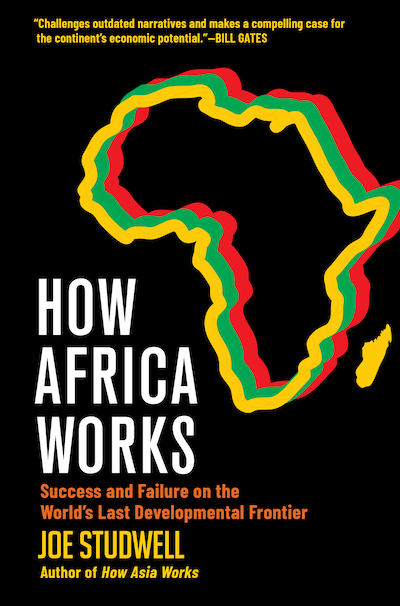
When Joe Studwell’s new book, How Africa Works, landed at the Currency HQ, we took notice. Studwell is the acclaimed author of 13 books, including 2013’s How Asia Works. Now he’s turned his attention to our continent and the result is a new study of Africa’s developmental history. It considers everything from settler colonialism to soil conditions, the role of elephants (yup, you read right – elephants), disease development and eradication, and land expropriation. It explores the mass economic seizure the continent has witnessed.
It’s engaging and comprehensive stuff and, given the topic, we decided on top of asking him the fun questions, we’d run an extract, so you get a flavour of his work too. You’ll find it below Studwell’s talk of octopus and managing offspring.
What’s the best book you’ve read in the past year?
Eugene Rogan, The Arabs: A History. A fabulous primer on a subject I knew too little about.
How do you keep fit?
I run.
Week-night, lowkey restaurant go-to?
There is a very good Chinese jiaozi place in Cambridge, where I live. My kids love it.
What is the one artwork you’ll always love, and why?
It is not really my favourite, but I often stop to peruse George Stubbs’ Whistlejacket in the National Gallery in London. It is a life-size – eight-foot – racehorse with a flat background that totally dominates the viewer. It is one of those artworks that was ahead of its (1762) time.
Do you have a hobby?
Child taming.
The one unusual item you can’t live without?
I eat a lot of octopus. In general, the British won’t eat it, so it is cheap. I get octopus for £6 a kilo or less at Billingsgate Market in London. It makes my arms hurt because I buy 20kg each visit.
Who was your high school celeb crush?
It is so long ago that I cannot remember. Olivia Newton-John?
Three songs that you’d take to a desert island?
Bob Dylan, Simple Twist of Fate. Neil Young, Old Ways. Cat Stevens, Hard Headed Woman.
Africa’s aid myth: An extract from Joe Studwell’s ‘How Africa Works’
The role that international aid plays in African development has been questioned aggressively in recent years.
The White Man’s Burden by William Easterly, published in 2006, and Dambisa Moyo’s Dead Aid, published in 2009, firmly put the boot into well-meaning white people and others.
Easterly asserted that $2.3-trillion had been spent on aid worldwide over the previous five decades with meagre results. He deplored planning – despite the fact that every successful developing nation in East Asia followed a plan – and decried “the development expert, the heir to the missionary and the colonial officer”.
Moyo wrote yet more starkly: “Aid has been, and continues to be, an unmitigated political, economic, and humanitarian disaster for most parts of the developing world.”
Now, the aid sector is far from perfect. For a start, it is a fashion business.
On a visit to the World Bank’s annual Land and Poverty Conference in Washington DC in 2019 I was told that just two things are required to make a poor country rich: land titling systems employing technology like drones, and projects that empower women.
Those causes owned the catwalk and filled the halls. Periodically, the dominant aid show changes.
“The fashion when I joined [the World Bank] was community-driven development,” Simeon Ehui, a regional director for Africa, told me.
In part, fashion in the aid industry is driven by a natural human desire to identify a developmental magic bullet, even though none exists. In part it reflects the fact that donors are more responsive to simple, tidy solutions.
In aid, fashion is inevitable. But more deleterious than fashion is ideology in aid.
Ideologically driven aid offers only one option. Its heyday was the 1980s and 1990s, when the International Monetary Fund (IMF) and the World Bank pedalled a single flavour of financial sector reform that was born out of free-market policies in Reaganite America and Thatcherite Britain. Developing countries were suddenly deemed to require the same mix of freely-tradable currencies, private banks and lightly-regulated stock markets that rich countries required.
For capable developing-country governments nurturing infant export industries, it was terrible advice because it curtailed their capacity to finance and run industrial policy.
Successful developing states ignored the advice. Less capable leaders swallowed the pill.
Abebe Selassie, the director of the African department at the IMF, recalls, after the reforms, receiving an earful from the Ugandan president, Yoweri Museveni. “He said: ‘You guys told me to liberalise forex, privatise banks. Where is the industrialisation that was supposed to come?’”
Fortunately, the worst of the ideological era at the IMF and World Bank ended in the 2000s. Ideology is today probably more present in bilateral aid agencies. USAID, which all but stopped agricultural investments in the 1980s and 1990s, contributing to the decline in African farm output, also spurned packages for industrial development because of the taint of “planning”.
Instead, part of USAID became embedded in military command structures, providing food to populations where US forces were active, such as Iraq and Syria. Much of USAID ceased to be development aid.
None the less, in February 2025, citing expenditure “antithetical to American values”, President Donald Trump cut USAID’s budget by 90% and its headcount by 97%, and terminated 5,200 of 6,200 global programmes, including ones for HIV/Aids, tuberculosis and malaria.
A model created by the School of Public Health at Boston University estimated that by March last year, 103 additional deaths per hour occurred in poor countries as a result of the closing of USAID medical programmes.
President Trump left the Millennium Challenge Corporation (MCC), set up in 2004 by President George W Bush, intact. The MCC was established as a deliberately ideological aid agency, given funds to target large grants at “good” governments. The MCC requires recipients to pass a scorecard on democracy and economic freedom.
Across the full range of Western bilateral aid agencies claiming to support agriculture, none entertains land reforms, credit for farmers or support for farmer collectives because of political sensitivity about appearing to endorse “left-wing” agendas.
Why aid works
For all the failings of the aid sector – many of them ideologically self-inflicted by rich nations – the case that aid is a waste of money does not bear scrutiny.
Even in the most benighted parts of Africa, aid projects generated positive change. The change does not necessarily translate quickly into economic growth, but it is measurable.
Since 2000, the share of African children dying before their first birthday has fallen from 8% to 4%; the share dying before their fifth birthday has fallen from 15% to 7%. Child mortality has been reduced in every country on the continent. Malaria cases have fallen by more than half – a result of eradication, bed nets and other preventive measures. Women reporting the use of contraception increased from 22% in 2000 to 33% in 2019, and a woman’s chances of living 65 years increased from 46% to 61%.
Aid programmes were instrumental in these changes – with Africa delivering some of the fastest health improvements in the world.
With respect to economic development, the aid system delivered support to each of Africa’s early outperformers – Mauritius, Botswana, Ethiopia and Rwanda – far in excess of what they should have received based on population. The states were grateful, made good use of the funds and aid-givers were enthused to have recipients that did what they most crave – deliver projects on budget and on time.
There are data regressions which indicate that economic aid has not produced growth in the aggregate in Africa. But these depend on timelines that include the Cold War era, when a lot of money was spent on supporting military and political allies rather than on developmental administrations.
Since 2000, data shows that there has been an Africa-wide connection between aid and growth, though growth is not the only objective of aid.
These findings reinforce what we know from Asia. When China entered its reform era in the 1980s – which led to the biggest reduction in poverty the planet has seen – World Bank advice was critical to its policy. The Chinese did not ask the World Bank open questions about what it thought they should do. They set the agenda. China wanted, and got, concessional loans, becoming the World Bank’s biggest borrower.
Long before China, the US gave aid totalling $6bn to South Korea and $2.4bn to Taiwan between 1946 and 1978. In Taiwan’s unprecedentedly successful agricultural sector, the US funded half of all investment and paid for the densest network of agricultural extension agents in the world.
Unlike today, American aid was given with no strings attached. This is not what Donald Trump’s administration will be doing in Africa.
The most effective aid programmes are contextual and inductive – ones based on an understanding of conditions on the ground, including beneficiaries’ self-interest and incentives to pervert a project, rather than what outsiders think is missing.
Aid for wildlife conservancy in Africa is a good example. In many countries, such as Kenya or South Africa, well-meaning white people give funds that pay for gamekeepers to ride around in expensive, imported four-wheel-drive vehicles with guns.
They are supposed to catch poachers, but poaching continues because rural communities obtain no material benefit from stopping it, while certain animals are valuable. Around 1,300 white rhinoceroses are poached each year in South Africa.
A different approach was taken in Namibia. There, a 1996 law accorded ownership and management of wildlife to communities so long as they set out transparent management criteria.
By 2015, 82 conservancy areas had been established. Communities earned $8m a year from high-end ecotourism, which boomed, and from licences for sustainable hunting of wildlife. The revenue funded 2,000 jobs. The conservancies grew to include 20% of the land mass and 9% of the population.
The number of black rhinoceroses, which had been close to extinction, rose to more than 2,000, while lion increased 10-fold. There were still problems – such as conservancies with low incomes – but the international aid that supported the Namibian transition was far better spent than in other countries.
“It is a stand-out example that needs to be replicated,” says Steven Lawry, a tenure specialist at the Center for International Forestry Research.
Shoddy critiques
In the end, the anti-aid critiques of William Easterly and Dambisa Moyo fall flat for the same three reasons.
First, they depend on a fantasy comparison in which development in East Asia – a region that neither specialised in – is presented as unsupported by international aid and driven instead by free markets without government planning.
In reality, the most successful developing economies in East Asia received considerable international aid and depended on competition around which were wrapped detailed, market-manipulating national development plans.
Second, aid, contrary to what Easterly and Moyo maintain, has also been important in Africa and has given donors value for money, at least since the end of the Cold War.
And third, when aid has failed it has been more often the failure of the donor than the recipient. There have been plenty of examples of disastrous individual aid projects in Africa, as there have been in developing countries around the world.
But in the aggregate, since its expansion after the Second World War, aid has helped struggling nations become healthier, better educated and more prosperous.
It is critical to understand this, because Africa is coming onto the world’s radar as never before. In another decade, at 4% growth, the continent’s economy will be half as big again. It will have many more companies turning over more than $1bn a year, and a few turning over $10bn.
The world’s multinationals will increase their presence in the planet’s last great frontier market. Some – as in China in the 1990s – will pile in with aggressive investments too early. The wise will start small, hire and train local staff and bide their time for the right deal.
As Africa grows, its economically fragmented nature will become clearer. Regions like East Africa and coastal parts of West Africa – across Côte d’Ivoire, Ghana, Benin and Nigeria, plus Senegal in the north – will be hubs of growth with populations of hundreds of millions.
In the south, the economic prospects of South Africa, torn between black control of political power and white ownership of land and capital, are a soothsayer’s nightmare. In North Africa, unpopular military regimes in Algeria and Egypt, mayhem in Libya, absolute monarchy in Morocco and chaotic democracy in Tunisia make one of Africa’s wealthiest regions one of the most politically constrained.
Going forward, the rich world will speak not of Africa as a troubled continent, but of parts of it as troubled and parts of it as promising.
If you live outside Africa, Africa is going to be a bigger part of your life. In trade, investment, tourism, literature and music, African integration into the world system is beginning in the way it did for Asia over half a century ago.
Where Asia was the world’s biggest receptacle of poverty after the Second World War, and eradicated that poverty, Africa is now home to the majority of the world’s poor, but is starting the process of removing that blight.
The road will be long, hard and winding, and led by a minority of outperforming states, but demographic, political, economic and educational change have reached a point where there is no turning back.
ALSO READ:
- The poor continent
- Investing in Africa: From uncertainty to opportunity
- Parity not charity: What Africa wants
Top image: supplied.
Sign up to Currency’s weekly newsletters to receive your own bulletin of weekday news and weekend treats. Register here.