
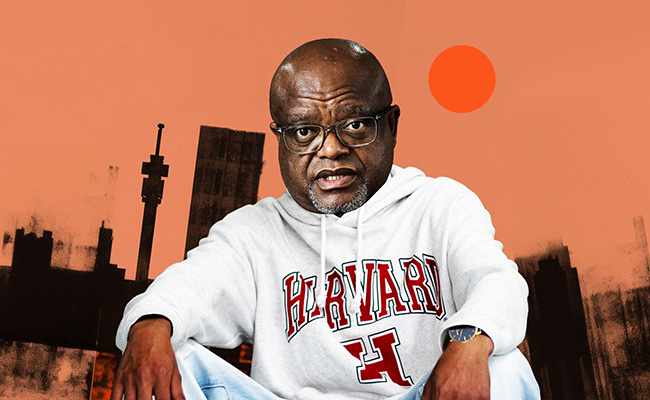

Let it not be said that Dada Morero is without a sense of irony.
This week Joburg’s intrepid mayor traded the sinking city for the refined halls of Harvard. There, he joined a panel discussion on “Global Challenges, Local Leadership: How Mayors Deliver Results”.
Clearly the organisers came up short on due diligence. Had they looked into Dada’s mayorship at all, they would have discovered a city riven by a distinct lack of leadership, defined largely by mismanagement, not to mention a staggering lack of results – unless Gogo Helen takes to the nearest pothole in her bathing suit.
Not that you’d think so from Morero’s address.
The topic of discussion focused on climate – and how fortuitous it was for Morero that the preceding two speakers covered the bases for him.
Alyia Gaskins, mayor of Alexandria, Georgia, focused on how climate change has caused flooding in her city; Regina Romero, mayor of Tucson, Arizona, spoke of heat maps of inequality and the importance of planting trees in poor areas, as well as the city’s move to no- or low-emissions public transport.
This laid out the carpet for Morero to talk about all three – insipid as his delivery may have been. Nothing like a solid crib-sheet.
But first, some context: Tucson rolled out a climate action plan in just 14 months after Romero took the corner office. Joburg has taken more than a decade. As Morero told it, the 2014 Growth and Development Strategy paved the way for Joburg to develop a climate action plan – in 2014/15.
What has that done in the intervening years? Precious little, apparently.
Calling Copenhagen
For a start, the city is suffering climate-related flooding, Morero said, and has had to negotiate partnerships to try resolve the issue. To that end, it’s working with the city of Copenhagen to respond to an area that Joburg apparently struggles with: shacks getting “wiped away” during floods.
Now, far be it from me to criticise the good mayor. But people are living in shacks in low-lying areas because the city is not delivering on its housing mandate. Back in 2022 already, one in five Joburg residents lived in informal settlements, according to the South African Cities Network. According to the housing minister, there are more than 500,000 Joburg households on the National Housing Needs Register. Yet the city has handed over just 5,000 housing units in the past five years.
This is not a problem for Copenhagen; it’s a Joburg problem. More specifically, a governance problem. You can’t help but wonder where the R1.9bn capital budget for the human settlements department is going; or the R129m grant for the Joburg Social Housing Company, or how it’s spending its R270m budget. And what of the unspent R61m of the Municipal Disaster Response Grant – surely to mitigate the effects of events like flooding?
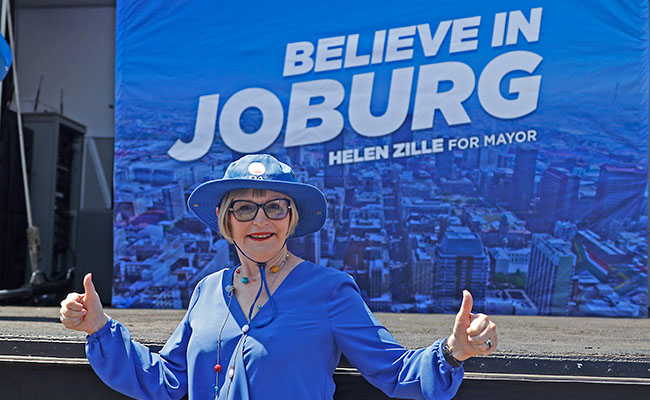
And all of this is not to forget the flooding of streets as a result of inadequate drainage – an issue Zille made crisp by rowing down a road in Soweto this week. Another infrastructure failure on the part of the city; the same city that spent only 26% of its R8.7bn capital budget by December 2025.
Then there’s the e-bus fleet that the city plans to roll out in the next couple of years. Which is all good and well, and a noble idea for reducing emissions. But if the city couldn’t even get the Rea Vaya bus stations up and running over more than a decade, what are the odds of an electric-vehicle fleet? And with what money? And, more to the point, surely buying the buses before fixing the roads is putting the cart before the horse?
Stump up, or else
As for the tree-planting. Well, Morero has apparently planted 3,000 trees so far. Go him. But the real plan for the city is to get its 39,000 employees to each stump up R250 of their own money to fund trees. How’s that for passing the buck? Especially when Joburg City Parks and Zoo rang up R86m in irregular expenditure in the past financial year.
Still, I guess you need to touch your employees for cash when you’ve blown through the budget.
And while Morero extolled the virtues of a pollution measuring app that’s been introduced in the city, it doesn’t really seem to be a city-specific app at all; it’s Morero squatting on the South African Weather Service’s South African Air Quality Information System. So there’s that.
But wait for it: when asked a question about the human side of being a mayor, Morero told a real tear-jerker. There’s a 78-year-old Joburg woman who’s been on the list for a government house since 1994. She’s one of many elderly residents who’ve waited 30-plus years for the government to fulfill the promise of a real home.
Dada was touched. “That case startled me so much,” he said. “That the conditions she lived in were so dire. There was not any form of support whatsoever.”
Um. Quite. No support from an administration Morero leads. Dire living conditions in a city Morero governs. No house from a municipality Morero oversees. No dignity from a political party – of which Morero is a prominent regional leader – that has been in power for 30-odd years.
Morero thought introducing the anecdote would make him look like a man of the people – a caring leader with the best interests of residents at heart. All it did was show the black hole at the centre of Joburg’s governance. And the empty suit that occupies the mayor’s office.
This article has been updated to reflect the City of Johannesburg’s human settlements department budget.
ALSO READ:
- In it to win it: Is Zille Joburg’s last chance?
- No laughs at Dada Morero’s Joburg circus
- Borrow now, pay later: Joburg’s budgetary balancing act
Top image: Gallo Images/Luba Lesolle; Rawpixel/Currency collage.
Sign up to Currency’s weekly newsletters to receive your own bulletin of weekday news and weekend treats. Register here.









I hope Harvard is suitably embarrassed!
The amounts mentioned for housing seem like small change.
Superb assessment of a shameful PR stunt by an appallingly inept administration. I can’t believe Harvard didn’t even bother to do research, given the state of JHB is so notorious now its been reported on GLOBALLY.
A once noble institution has well and truly embarrassed itself!
the mayor of johannesburg addressing other international mayors has to be fake news, unless it was how not to do anything without accountability and shame !!!!
Great reporting 👍