

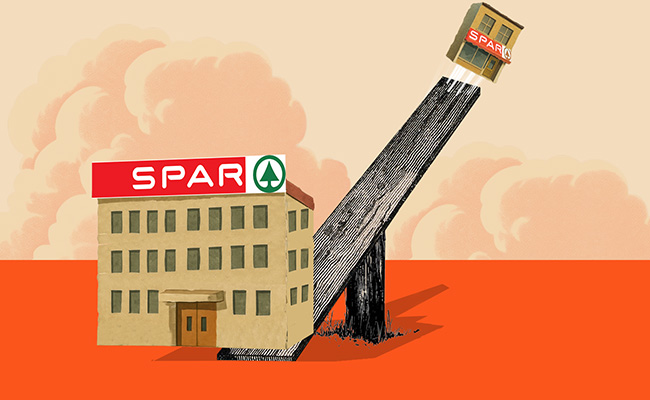

You have to wonder if Spar shareholders don’t sometimes look back on 2020 and 2021 with fond memories of a period dogged by Covid-induced operational shocks, incessant power outages, civil unrest in KwaZulu-Natal and a flattened economy. Management seemed to take it all in its stride.
Even then, the group was apparently handling its newly acquired international businesses without too much stress. Hardly a surprise that the Spar share price was in firm territory, occasionally bouncing over the R200 mark.
But then came 2022. The post pandemic surge in fuel and energy costs, a battered economy, growing evidence that Poland was going to be a tougher-than-expected problem and, towards the end of the year, a governance implosion.
By year-end the share price had cratered to R113. Key shareholders decided something dramatic had to be done. They appointed a new chair.
Mike Bosman came in with a no-nonsense attitude, determined to right the listing Spar ship. Management heads rolled. A new board was appointed. In the early months of 2023, the share price slide was reversed.
SAP fallout
But then came news of a botched rollout of the SAP system. Intended to upgrade the group’s KZN distribution system with faster order processing and better inventory control, it cost Spar a staggering R1.6bn in headaches instead. Longer term was the damage it wreaked on the group’s relationship with its independent retailers, who were forced to deal with the fallout.
Things were to get worse. Towards the end of the year, presumably realising it would never turn a profit, the Spar board announced it was selling the Polish business. The sale that was finalised in 2024 saw Spar take a hit of about R5bn.
Hardly surprising that the board decided to indefinitely suspend dividend payments.
Then, in 2025, the sale of the Swiss operation and part of UK Spar resulted in another hit, this time of almost R1bn.
Any hope that the group might have been heading into calmer waters in 2026 were dashed when, in February, CEO Angelo Swartz announced he was quitting.
Spar’s share price sank another 9% to R66, and has spent the past few months tottering just over the R60 mark.
For shareholders, the extremely frustrating aspect of this litany of woes is that, apart from the flatlining economy and spiked fuel prices, they are all self-inflicted. Governance standards appear to have been appallingly low; the board went on a hubris-driven international spending spree, unaware of its own management’s failings. Arguably, poor governance as well as the same blinding hubris convinced them they were prepared to implement a business-altering stock management system when they obviously weren’t.
In all of this it’s important to remember the current board and leadership were not behind the inevitable massive value destruction. Indeed, the Bosman-led board has done well to take the necessary decisive action.
The Spar network
But this is Spar – and so the story is not just about frustrated shareholders. The very essence of Spar is its network of independent retailers. For them, Spar is not part of a portfolio of investments, it is their livelihood.
You don’t get too far into any Spar literature before reading about the importance of these store owners; Spar exists to service its independent retail customers, we’re told. “Our strength lies in the entrepreneurial independent retailers at the heart of their communities, whose local expertise and customer focus drive sustainable growth across our international footprint,” Spar explains again and again to its investors.
While successful international expansion would certainly have benefited shareholders – increased share price, more generous dividends – it’s difficult to see what advantage it would have brought to the retailers. But its resounding failure means important management resources have been distracted from the day-to-day running of the group, a crucial consideration when you’re operating in a fast-moving, tough and highly competitive market.
Then there’s the money. In its search to shore up what was frittered away in foreign markets, Spar leadership must surely be tempted to cut some corners in its offering to the retailers. That’s certainly what they are feeling.
Spar’s relationship with its retailers is structured around a guild system, which regulates the provision of services from Spar in exchange for a fee. It’s not just about retailers accessing fresh food, groceries and liquor, but also about marketing and promotional activity.
If Spar’s leadership is distracted and under cost-cutting pressure, it’s hard to see how the retailers don’t suffer.
Empty shelves, broken promises
As for the SAP rollout, that disaster went to the very heart of the relationship. Here’s how one expert described what happened: “Distribution delays multiplied because the system couldn’t match purchase orders to supplier capacity. Stock visibility evaporated. Replenishment cycles broke. Warehouse staff, unable to trust the system’s logic, reverted to manual workarounds that were slow and unreliable. Empty shelves became the norm in hundreds of Spar-branded stores.”
Imagine you were one of those retailers whose custom depends on a decent service from Spar – and all you could do was watch as your customers headed off to Checkers or Pick n Pay.
It’s hardly surprising that these store owners are exasperated enough to break with all precedent and publicly call for leadership changes at Spar and a voice on the board. They acknowledge the clean-up work done by the Bosman-led board but are worried their concerns are not being addressed: too many management changes, promotional activity gone erratic and no-one seemingly listening to them.
But here’s the thing: what chances have they got of being heard by a board whose duty is to act in the best interests of the company? The company, in this context, is the listed entity Spar – not the guild. And the interests are those of shareholders.
By law, Spar’s directors are required to put the interests of the shareholders above those of the retailers. If they don’t, they’re vulnerable to legal action.
This hardly seems appropriate when you consider the crucial role retailers play in Spar’s life compared with that of the shareholder.
Accidental listing
Of course, in theory, and over the long term, the interests of shareholders should coincide with the retailers. But that’s in theory and over the long term.
The reality is that Spar should not be listed. In no other country is it a publicly-traded company; its listing in South Africa was almost accidental and came about as part of the unbundling of Tiger Brands’ non-core businesses in 2004.
Yes, when things go well – as they did for the first 15 years of its listed life – shareholders benefit from generous dividends and share price appreciation, while retailers also thrive.
But the potential for conflict between the short-term profit demands of shareholders and the long-term vibrancy of the retailers is too great. And is always present.
Over the next few months the Spar board and representatives of the guild are going to have to hammer out a solution to this dilemma. Or things will get worse, not better.
ALSO READ:
- Spar retailers revolt, call for chair’s head
- When it rains, it pours for Spar
- Spar CEO’s exit clouds turnaround hopes
Top image: Rawpixel/Currency collage.
Sign up to Currency’s weekly newsletters to receive your own bulletin of weekday news and weekend treats. Register here.




My local Spar relies heavily on its local savviness and agility to meet varied demands of a fluctuating tourist market. The Spar people I know are not the kind of people that “get deployed”, they’re the kind that built their business in their hometown over most of their life. They have true skin in the game: instead of seeing an unrealized loss in their investment portfolio click over, they get irate customers, loitering workers, and their personal pride ebb away in lockstep with their business profits. I agree that the Spar retailer should get the final vote, and this is a good argument on why public listings don’t always make sense.
I was a SPAR retailer (8 stores over 14 years), as well as a Retail Operations Director, for many years. So, I understand both the retail and wholesale part of the business.
I was part of a team that attempted to convince Tiger to allow retailers a stake in their Distribution Centre structure, firstly to cement the loyalty factor to SPAR and secondly, the assist in implementing the slogan then “Think Retail”. In other words, every DC employee would be required to ask “Is this action beneficial to our retailers?” in their every move while performing their duties. We failed.
My recommendations to SPAR
1. Delist from the JSE
2. Find a way to involve your retailers in the Group corporate structure, other than the Guild.
3. Appoint at least 3 retailers with multiple skills (finance, marketing, customer service, etc…) as part of your managing team.
4. Go back to the basics of retailing.
Interesting points, I think Spar is going to have to really ramp up the ‘local’ dimension if it hopes to compete with the other big groups. As for the independent retailers being issued shares on the listing, that was surely a missed opportunity. It wouldn’t have changed the legal situation as any ‘representative’ of the share-owning retailers on the board would have had to act in the best interests of the company and not in the retailers’ interest. But it might have ensured more vibrant debates and a better hearing for the retailers. Ann Crotty