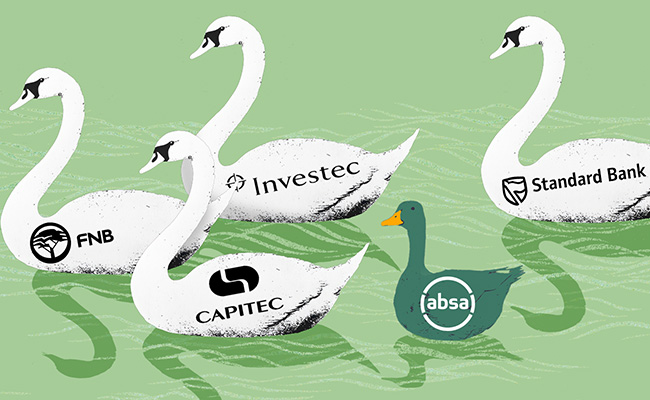

Looking at the major banks in South Africa, every one of them seems to have a star factor. With FNB, it’s eBucks and its digital ecosystem. With Capitec, it’s the simple product, lower fees and branch accessibility. With Standard Bank, it’s the clarity and consistency of its African and Corporate Investment Banking (CIB) businesses. With Investec, it’s a highly personalised service.
But with Absa? Well, the experts aren’t quite so sure. “Outside of lending, why else would I want to deposit my salary with Absa?” asks Kabelo Moshesha, an analyst at Mazi Asset Management.
It’s a critical question – and for the past few years, Absa has looked “less clear” compared with the other banks in the market, says Anchor Capital investment analyst Keagan Higgins. “It is a large universal bank, but it has not always been obvious where it is outperforming peers.”
Without a strong pull factor, Absa has been stumbling around in the dark for some time, not least as it’s lurched from one CEO to the next in an effort to reinstil some sort of corporate identity. But after six CEOs in just seven years, the question lingers: why bank with Absa? “As long as that question remains unanswered, these challenger banks are relevant,” warns Moshesha.
No margin for error
A bank adrift is not only bad for its customers, but for investors, too. Shares in Absa – as with Nedbank – are up only 53% over the past five years. Compare that to FirstRand’s 71% gain, Investec’s 138% rise, Standard’s 142% increase and Capitec’s 188% surge.
Then came Absa’s trading update on June 30, which drove its shares 7% down in one day. In its update, Absa downgraded its forecast return on equity (ROE) to 2025 levels of about 15%, with headline earnings growth of “mid to high single digits” for the six months ended June.
For Vincent Anthonyrajah, CEO of Differential Capital, the fall was a “proper overreaction”.
“I wasn’t too surprised about the result. What I was surprised about was the extent of the weakness of the share price,” he says.
Clearly “the market has been far more optimistic about the turnaround that is under way at Absa”.
But Moshesha, as well as Kokkie Kooyman of Denker Capital, were surprised – and disappointed.
“We ourselves didn’t expect the Ghanaian losses,” admits Kooyman, “and I think that is where the market is fairly upset.
“A lot of the facts that they reported now must have already been known some time ago,” which would only add to the frustration.
Of the ROE setback, Moshesha says: “Downgrading just after giving us guidance, that was surprising. If you’re framing a 2027-2030 16%-19% ROE target and in 2026 you’re still at 15%, questions need to be asked. You start questioning the achievability of that target.”
Africa angst
Ghana has been problematic for the bank before. In 2023, Absa’s earnings sustained damage due to Ghana’s sovereign debt crisis. Now, the bank expects the region’s headline earnings to decline due to lower net interest income and higher credit impairments.
Absa has a “decent Africa franchise” worth holding onto, the experts agree, but it’s not yet diverse enough to offset the issues that come with a single portfolio holding. “What’s missing for Absa is a broader footprint,” Anthonyrajah says.
While Higgins argues that Absa’s African footprint is good enough, he believes the issues stem from having a standardised approach to banking on the continent. “Africa is not one single opportunity. Every country has different currency risk, rate cycles, credit risk, regulation and competitive dynamics,” he says.
“Absa cannot just rely on having a broad footprint. Realistically, it needs to be more disciplined about where it allocates capital, which markets it backs, and where it can earn acceptable returns through the cycle.”
In any case, Anthonyrajah agrees that Absa is not approaching the situation correctly. “What they need is a careful review of what is causing the volatility in these African countries … it would be nice to get some clarity on what is causing [this].”
An identity crisis
Indeed, “clarity” seems to be the overarching buzzword for analysts.
Anthonyrajah says he has heard “every story in the book” over the years as to the cause of Absa’s problems. “And every time, I hear a different story from a different CEO. It’s either a lack of scale or this or that or pricing, I don’t know what it is, but it’s a mess.”
When asked what he thinks Absa’s issue is, Kooyman says: “It’s history.” Looking back, even the birth of Absa, back in the early 1990s, was problematic in his view. “The real problem then was that Absa was the merger of two mortgage banks and Volkskas, which was largely retail.” It was hardly a match made in heaven and left the new bank “subscale in corporate banking”.
The entry of Barclays, which bought a majority stake in 2005, was a promising sign, Kooyman says, given that it could grow the CIB, while also giving Absa wider access to Africa. “But then the problem was they appointed Maria Ramos as CEO and she changed the culture, she lost a lot of the retail banking expertise, and Absa started gradually losing its mojo in retail banking, and it lost market share.”
Barclays then decided to sell out in 2016, finally exiting its last holding in 2022. The bank flailed around for a while, trying to revitalise its retail banking sector under Arrie Rautenbach. But that didn’t work out, and internal management issues seemed to be the cause. “So Absa gradually lost its brand and its retail leading edge, and I think this is still a large problem now, and why, in the end, Kenny Fihla was brought in [as CEO], to really turn that and the whole bank around,” Kooyman says.
Anthonyrajah describes Absa’s personal loans business as “really weak” compared to its peers. “If you’re not able to successfully do unsecured lending, you miss out on a big part of the market that is very profitable.” At this point, he considers it subeconomic.
Absa’s front end also needs work, Kooyman says, especially compared to the retail giant Capitec. Absa needs to change “how [it] serves clients; it’s got to retrain staff and make them more client friendly”.
Yet there are pockets where Absa has done very well – like its corporate banking division. In fact, CIB overtook RMB in headline earnings in June 2023 and is today nearly double the size of Nedbank’s CIB.
Ultimately, a consistent performance across divisions requires stable leadership, which has been absent from Absa. “You need a clear strategy to fix problems,” Higgins says, “but you also need stable execution over many years. Absa has had many changes at the top, and that has probably made it harder to build momentum.”
Moshesha agrees Absa has missed out on “the cream” of banking profits due to leadership problems. “It was a lot of unwillingness to change the status quo.” The bank seemed stuck to a lending-led strategy that may have worked during Covid, but which “came back to bite in a big way more recently”.
There’s another aspect to it. “When you’ve got so many issues at board level, infighting and continuous changes, in the end your staff lose heart and lose interest,” Kooyman warns. “And you don’t attract the right people.”
Buying the turnaround
So, it makes sense why former Standard Bank South Africa head Fihla was brought on as fresh blood to jumpstart the Absa turnaround story, and also why he and the bank have gone on a hiring spree of late, poaching several Standard Bank executives.
Kooyman sees it as a sign that, “internally, [Fihla] didn’t find enough capable management to help him in the turnaround”. Moshesha agrees it could be this, or simply an “unwillingness” from those within Absa to make the radical changes needed.
If Absa has no pull factor for customers, what about fresh talent?
It’s made headlines around the large incentives being offered to new management to pull them into the organisation. While Anthonyrajah dismisses the costs as not worth worrying about, other experts are more wary.
“Strategically, I understand why Absa has done it,” says Higgins. “But hires only become worthwhile if they meaningfully change the operating performance.” And, of course, there’s no guarantee yet that these changes will stick, or will help.
Fihla received a hefty R148m remuneration package in his first year after leaving Standard Bank for Absa (despite shareholder outrage), and new transfers such as Leon Barnard, Zaid Moola, Clive Potter and Francisco Khoza will likely be remunerated along a similar framework.
“There is also risk in assuming that Standard Bank’s success can simply be transplanted into Absa. While new hires can bring discipline and experience, Absa has its own systems, customer base and legacy issues,” Higgins warns.
Proof still pending
So besides hiring a legion of new executives, what can Absa actually do to right its wrongs and start competing effectively again? Kooyman argues that, truthfully, the “most important thing for Absa is just for the economy to start growing”.
Trying to boost its retail banking sector will be a difficult task as consumers continue to face economic pressure, meaning increased default rates and lowered loan demand.
“For any bank in the retail space, to grow in an environment like that is very difficult,” he continues. “Nedbank is fighting tooth and nail as well for its space, and you’re up against formidable competitors like Capitec, which is gradually just taking your market share.”
For Higgins, the missing ingredient for Absa is “consistent execution”.
“It does not need a complicated new story. It needs to consistently deliver better revenue growth, keep costs under control and lift ROE sustainably.” On top of this, he recommends creating a sharper customer proposition, and fostering the ability to show that its Africa footprint isn’t just strategically attractive, but financially attractive too.
“That makes the job harder, and it will not happen overnight,” he warns.
Still, if Fihla gets it right, providing more stability and better execution, “Absa does not need to become Standard Bank,” says Higgins. “It just needs to become a more focused and consistent version of itself.”
ALSO READ:
- Don’t let the door hit you: Absa names Fihla CEO
- Standard Bank’s next target is Tshabalala’s last big test
- Investec’s five-year plan: smart humans on tap, not chatbots
Top image collage: Rawpixel; Currency.
Sign up to Currency’s weekly newsletters to receive your own bulletin of weekday news and weekend treats. Register here.