
Investors often rush to buy shares in the latest IPO, hoping to win big – but the historical record suggests many are losing big. On average, early investors in mega-IPOs make money on day one and then lose it over the following three years.
IPOs, or new listings, give the public a first chance to own businesses they’ve watched from the outside for years, often ones that raised billions privately before ever needing the public market, and the temptation is obvious. SpaceX is already publicly traded, while OpenAI and Anthropic are likely soon to follow. But the excitement has to be set aside long enough to ask the cold question: is the price being asked worth paying?
Engineered for lift-off
The SpaceX IPO was carefully engineered to push the share price up, both in the hours after listing and in the weeks that followed, through a combination of deliberate choices:
- A large part of the offering went to retail investors, and Elon Musk has some fervent retail followers who will buy almost anything with his name on it.
- The free float, meaning the stock actually available to trade as a percentage of all stock in existence, was kept deliberately small, at under 5%.
- Index providers like the Nasdaq were also pushed to fast-track inclusion, turning every fund tracking those indices into a forced buyer.
Demand on day one has little to do with how many shares are sold, so if you shrink the supply, the same wall of demand is left chasing fewer shares and the price gets pushed up.
The historical data backs this up, with IPOs floating 10% or less popping an average of 32.4% on day one against 7.6% for those floating more than 40%.
None of these tactics is unusual on its own, but the willingness to pull every lever at once was, and that was only possible because SpaceX grew so large in private markets that it carried real negotiating leverage with index providers and underwriters alike. OpenAI and Anthropic will surely have been taking notes.
What the numbers show
The chart below compares the price-to-sales ratio, day-one pop, and average returns over three years for various stocks, with different performance categories ranging from under five times to above 40 times, and sample sizes for each category.
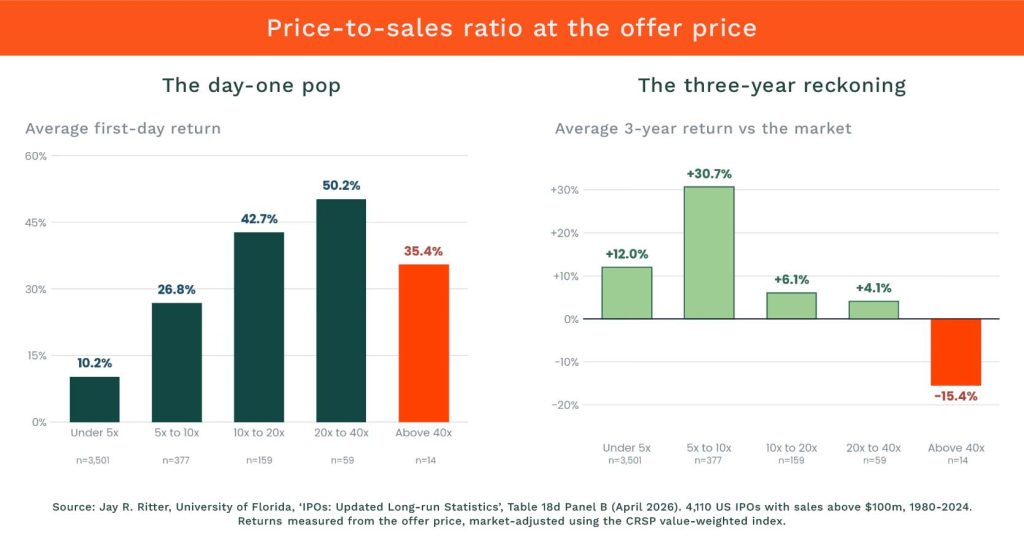
Talk is cheap, so let’s look at what happened to investors who bought the past few decades’ worth of richly priced IPOs. Jay Ritter of the University of Florida has tracked this for years and has the best data available. The pattern for large companies is consistent: as the price-to-sales ratio climbs, the day-one stock price “pop” gets bigger and the three-year return gets worse. In other words, you are paid more on the first day and punished more by the third year.
Of the 4,110 large IPOs in Ritter’s sample, only 14 were priced at more than 40 times sales. Those 14 jumped an average of 35.4% on day one, but 12 of the 14 then went on to trail the market over the next three years by an average of -15.4%. This makes uncomfortable reading for SpaceX, which priced at roughly 96 times sales, more than double the threshold of that most expensive bucket and outside the range of anything in the sample.
The damage also rarely arrives immediately. Insiders who held stock before the listing are usually locked up for the first few months and cannot sell, and when that door opens, the selling pressure builds. The underperformance shows up across the first few years and is worst in years one and two, when these IPOs have lagged similar-sized companies by 5.8% and 7.9% respectively.
The price, not the company
The lazy conclusion is that IPOs are a fool’s game, but the data does not fully support that, and it is worth being precise about where the danger actually lies. Buying into a large IPO at a sensible price multiple is generally fine, as every price-to-sales bucket beat the market over three years except the most expensive one, which trailed it badly. Nor is this a story about tech stocks being overpriced. Strip out the dot-com bubble years, and large tech IPOs bought at the first close actually beat the market by 13.7%. The problem is not tech, or AI, or space. It is the price, and the trouble starts somewhere around 40 times sales.
Strong convictions, lightly held
I think SpaceX is a phenomenal business and I want to own it for the families I work with, but paying 96 times sales is not particularly attractive, especially in light of how these expensive IPOs have performed historically. So far, the price has done roughly what I expected: a sharp pop followed by a slow deflation back towards its listing price.
However, the companies worth owning rarely vanish after their debut. More often the market hands you a calmer, better-informed entry once the initial frenzy fades.
Of course, I could be wrong. A business growing fast enough can eventually grow into even a demanding valuation, and if SpaceX executes to perfection it may look like a bargain in hindsight. But at these prices, investors are left with much less room for error in the short term and could be underwater on their investment for some time.
Will OpenAI, Anthropic and the rest run the same playbook? Almost certainly, and I expect equally high prices to be demanded on IPO day. The lesson from 40 years of data is not that these are bad companies, or that you should never buy a new listing. It is that the price you pay, on day one or any other, is the one variable entirely within your control, and history has been unkind to those who ignored it. Maybe this time really is different, but I’m doubtful.
ALSO READ:
- SpaceX: an investment option on the future
- SpaceX IPO: were the best seats already taken?
- I’m going to buy SpaceX; I’m pretty sure I’ll regret it
Top image collage: Wikimedia Commons/Arz/GNU Free Documentation License; Rawpixel; Currency.
Sign up to Currency’s weekly newsletters to receive your own bulletin of weekday news and weekend treats. Register here.