
If you haven’t heard of rain, you’ve probably at least seen its router: the colourful ‘the101’ 5g device, which you can customize with funky interchangeable skins created by South African designers like Rich Mnisi and artists like Karabo Poppy. It’s the best dressed router on the market by far – but have you actually used it?
Chances are, the answer is no. This is the conundrum for rain as a company; it is boldly visible and yet vaguely nowhere in terms of South Africa’s telecoms pecking order.
Yet the company has been around for ten years now, and initially, there was significant hype around it when it arrived on the scene.
Rain had a “genuinely disruptive position”, says Zwelakhe Mnguni of Benguela Global Fund Managers. “A lean, data only wireless network, no contracts, no voice infrastructure, and [good] pricing.”
For starters, the company’s wireless broadband offering was certainly unique; “In the olden days Telkom had a monopoly,” says veteran stockbroker Daivd Shapiro. “You got a technician to come and insert a landline, and that was it, you were a Telkom customer.” With rain, customers instead had month-to-month flexible access to uncapped internet.
“Most established networks had originally been designed for voice and were then adapted over time to carry increasing amounts of data,” explains rain CEO, Conrad Leigh. “We had the advantage of starting without that legacy and could build for where communications technology was heading.”
Structurally invisible?
But that was the story then, Mguni says. Fast forward to 2026, and rain is just another competitor on the heap, fighting for a piece of market share.
“Data is no longer an extra part of the service; it is the platform on which almost the entire experience runs,” admits Leigh. And rain’s competitors quickly grew to know that. Its counterparts managed to catch up fast, using their old voice offering to subsidize their data network and scale it up – something rain could not do. In fact, the company only began to provide voice and SMS offerings in 2023.
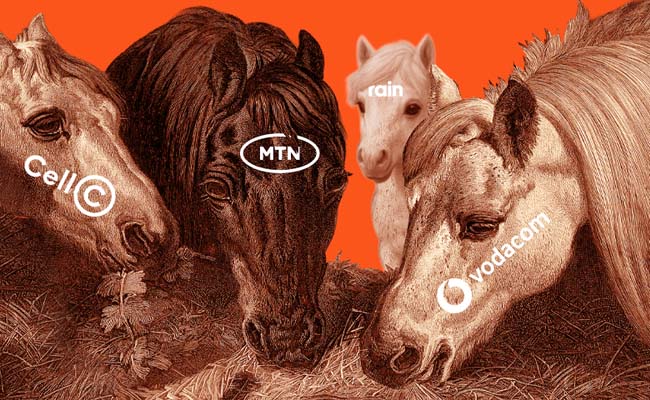
Today, if you think about data provision, you’ll think instead of rain’s main rivals: Vodacom and MTN. This is because, Mnguni explains, “South African prepaid is won at the till: spaza shops, taxi ranks, retailers, bank apps and street level airtime distribution.” Both MTN and Vodacom have hundreds of thousands of informal retailers. Even Capitec Connect, which operates on Cell C’s physical network, is successful in this aspect, with its 850-plus bank branches and 25-million bank app relationships where bundles are easily available.
In contrast, rain sells its sim cards via its thin spread of just 14 stores, or online with courier delivery or Pargo. “rain’s mobile products are structurally invisible to the customer they are priced for,” Mnguni points out.
Enter the Loop…
Which helps explain rain’s decision now to launch its own mobile device: the LoopPhone. Unlike a standard Samsung or iPhone, the LoopPhone works exclusively on rain’s unlimited mobile plans and 5G network. It’s not a completely novel idea, as Vodacom has done a similar thing with its Vodacom Kicka line of devices, but nothing this high-tech has been on the market yet. Leigh describes it as the latest product in their “integrated approach” to data provision.
“It is not an existing generic handset with a rain logo added afterwards,” he says. It was designed specifically to give rain greater control around making a device that suits the specific lifestyle needs of rain’s consumers.
“The simplest way to explain the thinking is that we did not want to create another bundle and then find a phone to attach to it. We wanted to design an unlimited mobile device,” says Leigh.
The plan options include unlimited data that is city, province, or countrywide, ranging in price based on the selected area. For unlimited countrywide coverage, the plan starts at R995 per month, month-to-month.
It’s not a bad deal, but Vodacom and MTN still offer plans for the latest smartphones for less, just with capped data options as opposed to unlimited. It’s a sleek looking device with all the necessary bells and whistles, but lacks the brand familiarity of other devices, and will likely take time to catch on.
Time, arguably, was always against it. Rain is still the smallest player in what Shapiro describes as a “brutally competitive” telecoms market. The company is up against giants who have “got the muscle, who have got the reach, and who have got the financial wherewithal, so I don’t think it’s a surprise that they’ve underperformed,” he says. Not to mention the headstart that Vodacom and MTN had on everyone else.
Small fish, small pond
In fact, most countries have just two or three dominant players, so “it’s a fairly saturated market relative to the rest of Africa,” explains Mish-Al Emeran, a portfolio manager at Abax investments. “And given that saturation, it is highly competitive, so it has been difficult for all incumbents to grow their top line.”
“As a new player, you’re sort of unproven, you have to get consumer confidence, you need all your systems to be working optimally, the customer experience needs to be good,” Emeran continues.
As for growth, the easy bit in South Africa, at least, “is behind us,” Emeran says.
Two decades ago, the market was booming as cell phone penetration and usage was still low. Today, a cell phone is almost considered “a utility” according to Shapiro. “It’s just something everybody has to have, and [they] want to get it at the cheapest price. People don’t care, they just want to know where they’re going to get the cheapest data, and lots of it.” And when you can go to your local Starbucks, say, and get connected for free, pricing data becomes a game of limbo: how low can you go.
In rain’s case, it sold a unique, high-speed product to a niche market of users. Indeed, Leigh argues that the company is “not trying to become a smaller version of Vodacom or MTN”, but a more focused company with a smarter network and the advantage of unlimited connectivity, useful for users who need good quality and high-speed internet.
“But that’s a very small group,” Shapiro argues. “People just want connectivity. 4G is good enough.”
In any case, “Vodacom, MTN and Telkom all now sell uncapped 5G home products at or below rain’s price points, with far larger networks and retail reach,” Mnguni says.
Strength in numbers
Telecoms have two main problems that affect them, and rain is no different: scale and cost. “It all comes down to growth rates,” Emeran admits. Being able to scale up your company and subscriber count is essential, and something rain has struggled to do. “Some people had quite aggressive expectations [about] how quickly they could grow in the market,” he says.
Both Shapiro and Mnguni fall into this camp, both slightly dismayed at rain’s lack of scale. When Currency asked, the company would not confirm independently, but Mnguni’s estimate of rain’s subscribers sits at between 1-million to 1.2-million, a number dwarfed by Vodacom and MTN, who are at 46-million and 40.6-million in South Africa, respectively.
“If you consider even Cell C, which has been struggling for many years, they’re probably sitting at just under 10-million subscribers,” Mnguni says. “The issue of scale caught up with [rain], and they haven’t been able to rise above that.”
Leigh disagrees with this assessment. “We are very deliberate in our actions and have built a substantial business in the fixed wireless market. Our move into mobile is equally deliberate, as is the timing,” he tells Currency.
Here Emeran acknowledges that while scale is supremely important, you also “can’t grow just for the sake of growing; you need to ensure that you have quality growth…there’s no disgrace in growing a bit slower if it’s going to ensure your returns are adequate.”
However scale is also inherently tied to cost, as “both capex and opex are relatively fixed” in the telecom market, says Mnguni. “So, you need to get your traffic volume above a certain line so you can actually become profitable.”
Relative to other companies, rain had a fairly lean cost base, as was its founding design. “The problem is the fixed cost per subscriber,” Mnguni warns. “Spreading a national network over 1.1-million [customer] services versus Telkom’s 23.8-million or Vodacom’s 46.7-million leaves rain carrying perhaps 20 to 40 times the network cost per customer of the incumbents. Scale, not frugality, is the missing variable.”
When market penetration was still low and growth rates high, capex could be spent on upgrading technology with the knowledge “you would get quite sharp growth because your usage was going to be increasing,” Emeran explains.
Today as a telecom operator, you are still forced to spend the required capital to keep up with changes, but returns on capital are much lower due to market saturation. As such, companies are having to find alternative ways to continue growing revenue.
For some operators, this comes in the form of expansion into the wider African and global markets; MTN has the largest footprint, operating in 19 countries and servicing 312-million consumers. Vodacom is not far off with a footprint of over 237-million customers in eight African countries. This in itself can be an expensive and risky endeavour, and some analysts understand why rain would choose to not undertake it. Still, it means the company is boxed into revenue streams where it is the smallest competitor by a wide margin.
The million-dollar question
The one thing on everyone’s minds is therefore, how to continue to compete in such an aggressive sector? Analysts are torn as to the answer. “They’ve got to have a product that either appeals at the top end of the market, an expensive product that is unique, [or] it’s got to be right across the spectrum, it has to be universally accepted,” says Shapiro.
“They’ve got to get a product that knocks Cell C out, that knocks Telkom out, and it competes with the other two. Otherwise, it’s just going to bumble along.”
Well, as Leigh sees it: “We have the network, the phone, and the tariff plan to make unlimited mobile not only feasible, but commercially successful.”
Mnguni thinks their offering as it stands is decent, but wonders how they will continue to afford it.
His argument is for them to “buy up some of the smaller mobile voice network operators (MVNOs) and chase some form of consolidation.” If some of the smaller players have localised fibre, rain could build scale from that to the point that they will either be viable to be bought out by Vodacom and MTN, or give them enough scale to effectively replenish their capex.
Easier said than done, though. “I don’t think they’ve got easy options,” he admits. But if these issues persist for the next two to five years, he reckons “they’ll become irrelevant.”
It’s clearly the most bearish outlook, and one that rain itself vehemently disagrees with. But until anything radical changes, the question remains – where does rain fit in?
Top image collage: Rawpixel; Currency.
Sign up to Currency’s weekly newsletters to receive your own bulletin of weekday news and weekend treats. Register here.