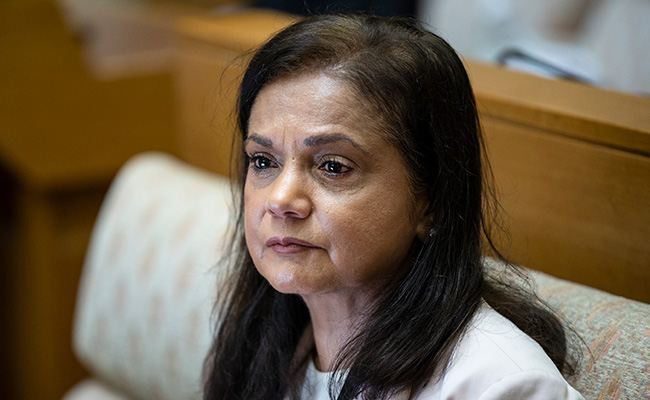

When Shamila Batohi leaves office this week, it will be with more of a whisper than a shout.
Hardly the kind of send-off you’d expect from someone welcomed into the top spot at the National Prosecuting Authority (NPA) with such fanfare in 2019. In her interview for the position of National Director of Public Prosecutions (NDPP), she’d referred to the institution as a “house on fire”, and later spoke of how it had been “hollowed out”.
She wasn’t wrong. The prosecutions service, like much during Jacob Zuma’s disastrous nine years in power, had been hollowed out.
There had been no fewer than six NDPPs in the previous decade – including such shining lights as Menzi Simelane, Nomgcobo Jiba and Mxolisi Nxasana. The service was factionalised, dispirited, lacking in resources, staff and skills capacity, subject to political interference and – as a result – facing a credibility crisis.
Batohi was supposed to be Cyril Ramaphosa’s great hope – another of his “new brooms”, set to sweep the institution clean. And she hoped to do as much, with plans to reform the NPA, clean out the corruption and build a fit-for-purpose prosecuting authority. And one that had the trust of South Africans.
Some wins
Ultimately, it came down to two things: stabilising the service and reeling in the big fish – securing convictions, in other words, for state capture and other high-profile cases.
“We are acutely aware of what the people of South Africa want, and how important it is for us to get those first cases to build confidence,” Batohi herself pointed out shortly after taking office. Or, as she put it in her interview for the position: “If we can ensure that the NPA has credibility and trust then I think we have come a long way.”
Evidently it hasn’t come nearly far enough.
To be fair, Batohi’s claim to success isn’t only that she’s the sole NDPP to serve a full term. She has also set in place the Investigating Directorate Against Corruption (an important addition to the criminal justice landscape, even if its potential has been far from realised), as well as establishing working partnerships with related institutions.
And things have improved: 86% of the service’s targets had been met in 2024/25 and staff ranks had grown by 20%, according to the NPA. Overall conviction rates are decent (of the dockets that are actually prosecutable); a new ethics unit came into being last year; an intelligence-driven prosecutorial framework has been introduced; and a corporate alternative dispute resolution mechanism has clawed back some ill-gotten gains from corporates.
And this in the face of underwhelming support from the state. Indicatively, the entire NPA budget in 2024/25 was R5.89bn. In that same year, the state spent R2.29bn on VIP protection services. It speaks eloquently to political priorities.
Victories, and defeats, reveal all
And yet. As DA MP and former prosecutor Glynnis Breytenbach told Daily Maverick last year: “In my view, she had one job and that was to get a conviction for a state capture case, and she hasn’t done that in six years.”
That’s not entirely accurate. As of July, there had been a grand total of four state capture convictions, but only one person sent to jail – Prasa’s former chief engineer charged with fraud for forging his qualifications and faking an offer of employment to drive his salary higher (a case curiously packaged by the authorities as a state capture conviction). Hardly a kingpin in the billions robbed from the fiscus.
That’s 10 years after state capture entered the public lexicon.
As for the Guptas: no sign of their extradition. Neither that of their henchman Salim Essa. The case against former Eskom CEO Matshela Koko was struck off the role. The defendants in the Nulane case were acquitted (the state recently won an appeal and will be able to reinstate charges).
Elsewhere, Shepherd Bushiri’s extradition failed. And Nigerian televangelist Timothy Omotoso was acquitted of the 32 charges against him. In that case, the judge was scathing of the NPA, saying, memorably, that: “It is inconceivable that a prosecutor with 14 years’ experience does not know what the definition of rape is.”
Meanwhile, Batohi has waved her hands helplessly at South Africa “not winning the fight against crime”. She has complained too that the prosecutions authority is being sabotaged by prosecutors colluding with criminals (she backtracked on her claim of the institution being “infiltrated” but, you know, potato potahto).
It’s no surprise the public is fed-up. Particularly given Batohi’s exhortation that her mandate on taking office was “to ensure that justice is not only done but is seen to be done”.
Tainted legacy
Of course, the biggest stain on her legacy will be her appearance at the Nkabinde inquiry into the fitness of Andrew Chauke, director of public prosecutions in South Gauteng, to hold office.
Batohi has been vague, evasive and unclear about the terms of reference of an inquiry she herself instigated. She has admitted to not being familiar with the details of the case and not looking at evidence presented to her. She was all but accused by Chauke’s counsel, Tembeka Ngcukaitobi of being complicit in defeating the ends of justice.
Under fire, she refused to return to be cross-examined by Ngcukaitobi. A Jacob Zumaesque moment, if ever there was one – refusing to be cross-examined at an inquiry of her own making.
It’s a taint on her legacy. An ignominious end to what has amounted to a more or less insipid tenure.
We can only hope that Andy Mothibi, when he starts as NDPP on Monday, will make more of a dent. With only two years to serve before he retires, the clock will be ticking. And the public watching.
ALSO READ:
- How the UAE stonewalled South Africa’s Gupta probes
- Three days, a thousand shivers: Inside Mkhwanazi’s explosive testimony
- How Bain & Co was run out of town
Top image: Shamila Batohi. Picture: Gallo Images/Brenton Geach.
Sign up to Currency’s weekly newsletters to receive your own bulletin of weekday news and weekend treats. Register here.