

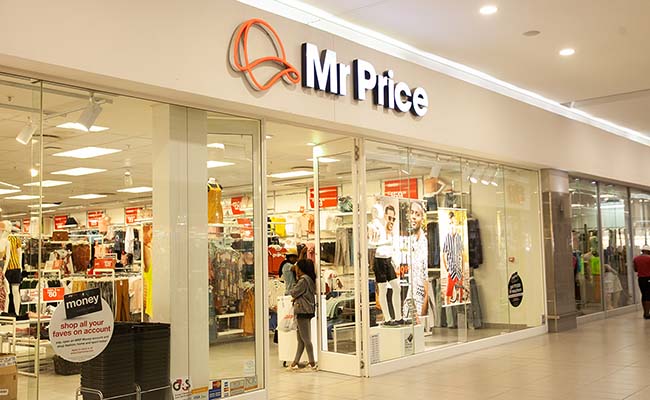

Has Mr Price just made a terrible mistake?
You’d be forgiven for thinking so, given the market’s reaction to its purchase of European value retailer, NKD, which may cost it as much as R9.6bn.
The retailer’s shares sank more than 13% after the announcement on Wednesday and remained there – even after CEO Mark Blair gave a rousing defence of the deal in a presentation to analysts.
“I’ve seen the comments, [but] guys, you don’t buy businesses on those kind of multiples,” he said, in reference to suggestions over the price. “We’ve always been good allocators of capital and so a bit of trust has to be placed in management that the capital is being placed wisely.”
Maybe so. But Mr Price has never been a particularly transparent company, heading for the hills at the merest hint of a request to speak to the media.
And the market has good reason to be sceptical: not only is the purchase price equivalent to nearly a fifth of Mr Price’s market cap, it will have to be funded by a big chunk of debt – where, for now, Mr Price is debt free and cash flush with more than R3bn on hand. It also invoked nightmarish memories of the many disastrous overseas purchases that have befallen almost every local retailer with a yen for expansion outside South Africa.
Think Woolworths and its R21.4bn Australian David Jones debacle; Spar and its Swiss and Polish purchases (now sold); Truworths and its only-recently profitable Office business in the UK; or Brait and the billions it wasted on British retailer New Look.
Mr Price, not shy of bravado, calls it “the most significant announcement we’ve made in the last 20 years”.
Questionable metrics
Yet one analyst Currency spoke to says that, on face value, “the financial metrics of the company and the valuation paid seem questionable, to say the least”.
Merchant West analyst Bianca Lakha tells Currency that though NKD shares Mr Price’s value-focused model, its role in the long-term strategy remains unclear. “The shift offshore raises new risks, particularly in a market where investors have witnessed several unsuccessful international ventures,” she says.
That’s putting it politely.
She’s also flagged the “limited disclosure on margins” that Mr Price has given on NKD – which is being bought from private equity group TDR Capital. The fact that Mr Price has to take on debt to fund its purchase was also a worry for most of the analysts on Wednesday’s call.
In line with the company’s attitude to transparency, Mr Price isn’t saying how much the company will borrow for this purchase; precisely the sort of thing you’d think the owners of the company would be entitled to know. Blair does say he is “comfortable” with a debt to earnings before interest, tax, depreciation and amortisation ratio of 1.5 times. And, to be fair, Mr Price has, in the past, frequently been accused of having a “lazy” balance sheet.
“[We are] very cash generative and so is NKD and we could bring that debt down quite quickly if we wanted to,” he said. He also promised that Mr Price would not sacrifice its dividends.
‘Short-term pain’
Blair’s central argument is that “to try and get into an asset like this, of this potential”, Mr Price has to take what he called “short-term pain”.
“We are quite accepting of the fact that it may not be earnings accretive in year one … We are known for being a conservative management team and nothing has changed.”
Well, until now maybe. So why wouldn’t Mr Price flounder like so many of its peers have before? After all, its own sallies into Australia and Nigeria were failures, too.
For a start, Blair says, “we don’t plan to integrate these businesses – we are not about to send teams across to Europe to integrate IT or tech or merchandise, so the South African management team will not be involved.”
Instead, NKD will keep on with its own managers, while Mr Price’s local operations will get the capital and management focus they need.
“We are absolutely not starving South Africa of capital and investment. We’re really well placed as a business and we’re not going to give up our competitive position by not investing” locally, he said.
‘A bit arrogant’
As for its previous offshore forays, Blair – who shut down the Australian operations in 2019 – told analysts that the company has taken its research on prospective acquisitions “to a different level”.
Previously, Mr Price sought to take its brand abroad, “which I suppose you could say was a bit arrogant”, he concedes. This time around it’s buying a chain that has a 60-year history in Europe.
Like Mr Price, NKD is a cash-based value apparel and homeware retailer, operating out of 2,108 stores across Germany, Austria, Italy, Croatia, Slovenia, Czech Republic and Poland. While headquartered in Bindlach, south of Frankfurt, the retailer’s main game is in small towns and rural areas.
For the year ended December 2024, it made €684.57m in sales, with sales growth of an average 3.4% a year over the past six years. But the company’s after-tax profit for the year was just €13m (R260m). More disturbingly, for the six months ended June, and due to what Mr Price calls “the cyclical nature of the business, once-off effects which relate to debt refinancing costs and the hedging derivative valuation”, NKD posted a loss after tax of €10.5m (about R209m).
Yet Blair was at pains to stress the strategic rationale of the deal, being the sheer size of market that NKD plays in. For starters, the value retail sector in Europe is worth about $1.8-trillion, compared to South Africa’s $109bn annual retail sales. It’s a dazzlingly different numbers game.
“You can see the scale and potential size that can deliver what we think is superior growth in the next 10, 20 years,” said Blair.
The rise and rise of value retail
And, critically, while European retail as a whole has produced anaemic growth rates of an average 1.5% over the past few years, the value segment has grown at multiples of that – at about 6%. NKD aims to double its store base in the next few years.
“The thing that I really like about this business is that it gives the Mr Price group an independent platform for offshore expansion across a continent that is underpinned by a move to value, and that’s absolutely critical for us,” said Blair on Wednesday.
Then there’s no hiding from the fact that South Africa is a small market with the opposite of robust economic growth, notwithstanding what Blair describes as “green shoots”.
Those investors who’ve enjoyed a total shareholder return of 32% compound annual growth over the past 39 years will be hoping that the transformation Mr Price sees in NKD isn’t the straw that breaks the camel’s back. It wouldn’t be the first South African retailer to be felled through its own vaulting offshore ambitions.
This article was produced in partnership with Stanlib.
ALSO READ:
Top image: Gallo Images/Luba Lesolle.
Sign up to Currency’s weekly newsletters to receive your own bulletin of weekday news and weekend treats. Register here.





I’m sorely tempted to start reffering to the company as ‘Herr Price’, going forward.
Ha! Now, now