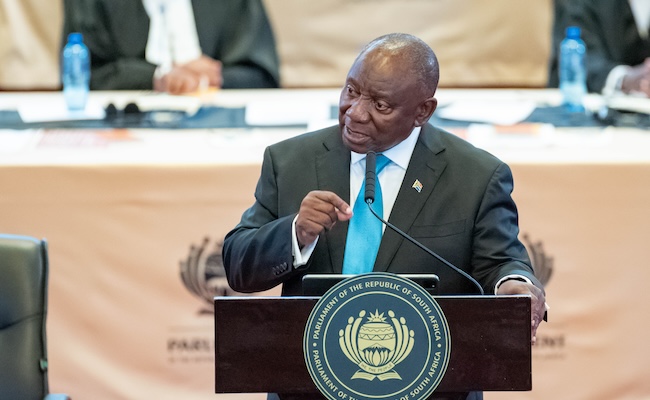

After the VAT debacle that nearly split the coalition government last year, Enoch Godongwana will get his first real break in what will be his fifth budget speech on Wednesday. Until now, the finance minister has had the most atrocious luck: the economic fallout from Covid, the riots of 2021, an economy choked half to death by Eskom’s blackouts, clogged ports and a collapsed rail network – and sky-high debt-service costs to boot.
This year, for the first time, Godongwana finally has some tailwinds at his back. Which augurs well for Wednesday’s speech — but watch for a quiet sting amid what is likely to be at least some relief for taxpayers.
The overall picture, analysts say, is pretty constructive. VAT hikes have been ruled out, and National Treasury’s success in containing costs means it is poised to deliver a wider primary surplus – meaning government is spending less than it collects before interest payments. There’s even a case for bracket creep relief – adjusting tax thresholds for inflation for the first time since 2023 – which would leave salary earners with slightly higher take-home pay.
But what has really moved the needle for Reza Ismail – who oversees a top-performing bond fund at Prescient Investment Management – is the decision to recalibrate the country’s economy to a 3% inflation target, give or take. This is a big deal because, until now, the South African Reserve Bank (SARB) had targeted a range of 3-6% inflation, which meant most South Africans had anchored their expectations at the higher end of that range.
This, says Ismail, is an underappreciated change that supports the economy in a number of unseen ways. “The full ramifications haven’t quite been completely absorbed,” he tells Currency.
First, this lower 3% target provides support to the rand. When South Africa’s inflation was running at 6%, compared to 2% in the US, this differential was automatically baked into the currency. This meant the rand was always going to depreciate by this difference every year, making our fuel and any imports automatically more expensive. Now, this gap has narrowed sharply.
Second, this lower target pushes down borrowing costs – not only for government, but eventually across the economy.
This change is starkly evident in our government bonds. A year ago, long-term government bonds were yielding around 11%, but they have since repriced to roughly 8.5%. While that doesn’t make the existing pile of debt cheaper overnight, every new bond the Treasury sells from here costs less to repay. The country is effectively taking on new debt at a lower rate – and, over time, that feeds through to a lower interest bill. Put simply, less of your tax money goes to pay debt, freeing up more for actual services (in theory, at least).
This creates a virtuous circle in which the lower cost of capital starts to unlock private-sector investment that has been moribund for years. Cheaper funding fuels the willingness of businesses to invest in new equipment, projects and factories. “That feeds through into higher aggregate demand and higher real growth,” says Ismail.
All of which sets up “the most bullish budget we’ve probably seen in years”, he says. What’s positive, he argues, is that the bond rally is being driven by a structural repricing after the new inflation target – not just a commodity windfall. “It has everything to do with the lowering of that inflation target.”
Slashing interest costs
For the government, the new environment creates an opportune moment to change its funding mix, Ismail says.
The Treasury has several tools at its disposal when raising – it can issue nominal bonds (where investors are paid a fixed interest rate, or coupon, typically twice a year), it can issue inflation-linked bonds known as linkers, it can sell Treasury bills (short-term instruments sold at a discount that pay the lender back at full value on maturity), or it can issue floating rate notes, where the coupon moves in line with interest rates.
At the medium-term budget policy statement in November, Treasury reduced the size of the nominal bond auction and began issuing more short-term instruments. Ismail thinks the smart next step is to lean further into the inflation-linked bonds.
Ultimately, this will cost the government far less. As it is, real yields in that linker market are around 3.7% to 3.8%. Add an expected inflation rate of 3%, and the all-in funding cost comes in around 6.7% to 7% – far cheaper than the 8.5% on nominal bonds. If Treasury believes the SARB will hold inflation around 3%, it makes financial sense to tap that market more aggressively.
But it’s about more than cost. If Treasury were to make this shift to inflation-linked bonds, the signal to markets would be absolutely clear: that Godongwana’s team believes the SARB will deliver on the inflation target – and is prepared to back that belief with their own funding strategy.
“The market would say, ‘hang on, there’s someone in there with a brain and a heartbeat that is actually thinking about these things… this is a Treasury I can get behind.’”
Mo’ money
For personal income taxpayers, the most likely piece of good news is that there will be more money in their pockets thanks to bracket creep relief.
Tax brackets haven’t been adjusted in three years, meaning that as people’s salaries rose with inflation, they were pushed into higher brackets without any real gain in earnings. According to Investec, not adjusting these tax brackets hands the South African Revenue Service (Sars) an extra R16bn to R18bn a year – and has reduced household disposable income by around R52bn over the past two years.
Micaela Paschini, team lead for legal tax at Tax Consulting SA, thinks some adjustment is likely. “The economy is under severe strain, and we do need to balance that with our general population – the poor are almost getting poorer at this stage,” says Paschini.
If Godongwana has room to move on this front, it is largely thanks to a windfall from soaring gold and platinum prices, which have been on an almighty tear in the past year or so. The additional tax paid by these mining companies has helped government revenue grow more than 10% during the first nine months of the fiscal year, while spending growth was held below 6% (which was far better than the 8.3% projected in November).
The Bureau for Economic Research (BER) expects a sizeable revenue overrun this time around, which will put Treasury in a very good mood.
Still, some things are sadly unlikely to move. The threshold below which companies don’t have to register for VAT, for instance, has remained at R1m since 2009. Yet, had that limit been adjusted for inflation over the years, it should really sit somewhere around R2.2m-R2.5m, as industry experts have pointed out for years.
But raising that threshold would probably reduce the number of small businesses in Sars’s net, so, in a constrained fiscal environment, Paschini doesn’t expect Treasury to go there.
Sting in the tail
Paschini and her colleagues at Tax Consulting SA expect the enforcement drive at Sars that followed last year’s VAT reversal to become more sophisticated.
“Most changes will come from more technical refinements to quietly increase the VAT base, as opposed to making a shock change that puts everyone up in arms – especially with our government of national unity,” she says.
As it stands, Sars is becoming far more tech-savvy, using artificial intelligence to run bank statement analyses that attempt to match deposits to declared income. Audits rely more on interpretation than hard numbers, with cross-border transactions and intra-group structures under particular scrutiny. Project AmaBillions, Sars’ multi-year collections drive backed by a huge ramp-up in both headcount and technology, is systematically hunting for tax leakages.
Paschini’s advice to clients is this: don’t enter a transaction unless you’re certain of your VAT position, and retain every document. “The burden of proof is on the taxpayer. Are you able to prove that the stance you took in a specific transaction is correct? That’s the question that should be on every taxpayer’s mind.”
But if it seems like this year’s budget is going to be the rosiest in many years, the BER strikes a word of caution as Godongwana prepares to take to the podium: things are looking up, yes, but debt service costs are still gobbling up around 5% of the country’s GDP.
The wage bill for civil servants is still the gaping mouth that demands to be fed; many state-owned companies, like Transnet, still need cash; and basket-case municipalities are going to need far more money — even though the political economy of the coalition government leaves little room for dramatic moves in either direction.
In other words, it may look like South Africa has the best chance of stabilising its debt in many years, but there remain plenty of execution risks around the country’s economic growth and government spending.
“The country finds itself in an uncommonly sweet spot,” the BER said in a research note. “The joie de vivre which is likely to characterise the 2026 budget should be taken with a pinch of salt. Things are looking up, but we are not out of the woods yet.”
Top image: Rawpixel/Currency collage.
Sign up to Currency’s weekly newsletters to receive your own bulletin of weekday news and weekend treats. Register here.