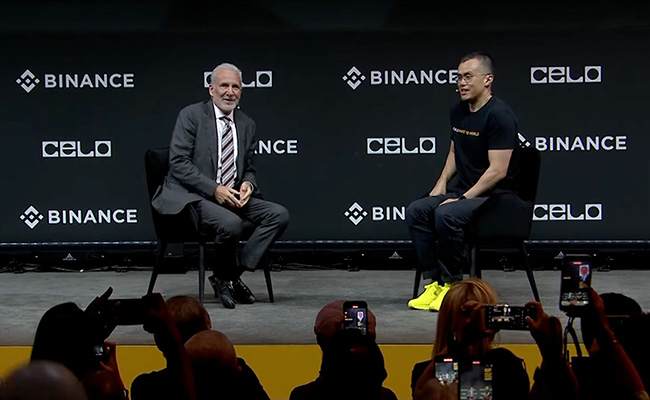

The grand philosophical, financial and ideological debate between gold and bitcoin got a rare, in-person airing on Thursday when Binance founder Changpeng Zhao (CZ) and metals evangelist Peter Schiff went head-to-head on the subject at the culmination of Binance’s Blockchain Week in Dubai.
So who won? Hard to say – winning and losing in this debate is relative and premature, but giving all the arguments a hearing was fun, enlightening exercise, and it’s to the credit of the bitcoin faithful that they were willing to countenance a gold bull in their midst.
For Schiff, participating in the conference was a bit like going to a church to argue for atheism. He certainly made his case with vigour – an enthusiasm in which South Africa has a vested interest as the eighth-largest global gold producer.
Some of the arguments will be very familiar. Schiff’s essential view is that gold’s advantage is geological and civilizational: “The gold that was mined 10,000 years ago is still here … and gold’s price today represents the present value of all its uses from now until the end of time.”
Bitcoin, by contrast, is simply a speculative digital asset. “When I transfer bitcoin to you … I’ve transferred nothing. It doesn’t do anything. Its value derives from confidence and faith.”
‘A lottery ticket’
Schiff also had a number to slap on the table: “Bitcoin today buys 40% fewer ounces of gold than it did four years ago,” he said. He claimed that despite the advent of crypto ETFs, corporate treasuries and unprecedented media exposure, bitcoin has effectively “lost value in real terms”.
This is, of course, a movable feast. A single bitcoin currently costs you about 22 ounces of gold, and it’s true that four years ago, you would have paid a lot more gold for your bitcoin, about 32 ounces. That’s because gold has shot up in value over the past four years, and bitcoin’s value has grown at a slower rate over that period.
But draw the line back further, and the pendulum swings massively in bitcoin’s favour: 10 years ago, an ounce of gold would have cost 2.45 bitcoin; that collapsed to 0.065 in 2020 and has stabilised at about 0.03-0.05 over the past five years. Gold has occasional rebounds (2018, 2022, early 2025), but the long-term trend is unmistakable: bitcoin has massively outperformed gold on a relative basis.
However, from Schiff’s perspective, gold is “money”; bitcoin is “gambling”. “All bitcoin does is transfer wealth from people who buy it to people who sell it,” he said. “It’s a lottery ticket.”
Bitcoin has value, Schiff conceded, but nothing, he pointed out at one point, is priced in bitcoin, and the only reason why people buy it is in the hope of selling it down the line for more. “Bitcoin does nothing,” he said.
Virtual value
CZ’s defence of bitcoin was not metaphysical – it was practical, and has to do with utility, portability and the network effects. First, he argued that value need not be physical. “The internet is virtual. Google is virtual. Yet they have tremendous value … Value isn’t associated with physical properties.”
He then reframed bitcoin as a tool, not a commodity: “Bitcoin is a new technology for money … It has utility. I can transport it; I can use it anywhere; I trust the technology itself.”
To underline the point, he told a story about a letter he got from a user in rural Kenya. The man said he would once walk three days to pay his bills. He can now do so in three minutes using crypto. “It materially improved his life,” CZ said. “This is utility.”
He also pushed back on Schiff’s portrayal of bitcoin as pure speculation: “You’re taking a small part of the ecosystem and generalising it … Developers, builders, long-term holders – they all exist. It’s not just speculators.”
At one point, he took out a gold bar he had been given by the president of Kyrgyzstan, and asked Schiff whether it was gold or not, and whether he could travel with it. You can validate bitcoin in seconds, while gold’s great downside is that you cannot take gold bars through most airports in the world. Bitcoin has no such constraints. “With this piece of gold, I can’t move around freely. With bitcoin, I can.”
He even brandished a Binance Visa card, showing that millions of users already spend crypto – even if the merchant ultimately receives fiat. “From the user perspective, they are using crypto for payments,” CZ said.
Welcome to the digital world
Outside the auditorium, real-world forces are now providing both sides with ammunition. Central banks have been buying gold at the fastest pace since the 1960s, a trend Schiff highlighted, arguing that “central banks know what they’re doing”.
But institutional investors have moved into bitcoin through ETFs, giving the cryptocurrency credibility, liquidity and regulatory legitimacy that once seemed impossible.
As the debate closed, CZ extended a diplomatic olive branch: “I do hope gold will do well … but I think bitcoin will do even better.”
Schiff replied with a surprise gesture of his own: Shiff has been punting tokenised gold, and he said: “I want to get my token listed on Binance.”
“Absolutely,” CZ answered. “Welcome to the digital world.”
Tim Cohen was a guest of Binance at Binance Blockchain Week in Dubai.
ALSO READ:
- Bitcoin bubble bursts – so it’s time to buy, says Africa’s first crypto treasury
- My terrible investment punt this year: Strategy Inc
- Gold’s FOMO moment isn’t over, yet
Top image: Peter Schiff and Binance’s CZ. Picture: Youtube.
Sign up to Currency’s weekly newsletters to receive your own bulletin of weekday news and weekend treats. Register here.