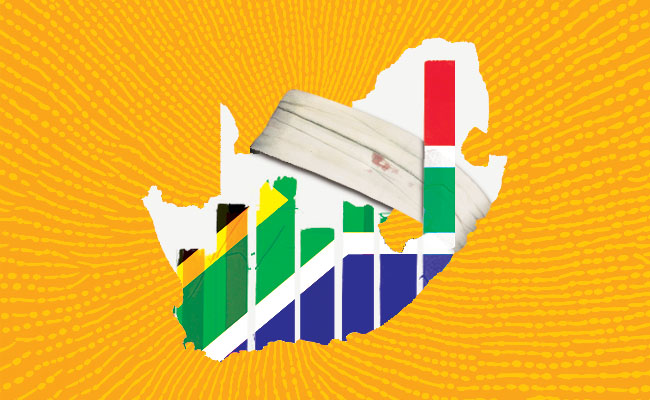

South Africa’s economy is on the mend. GDP grew by 0.5% in the third quarter, marking four consecutive quarters of expansion and the longest uninterrupted stretch since 2021. It’s not a boom – not even close – but it is progress, helped by fewer power cuts and gradual improvements to infrastructure.
The latest numbers from Stats SA point to a broad-based, if brittle, uptick across key sectors. For the first time since 2022, growth is on track to exceed 1%. That alone is noteworthy: after a decade of increasing at about 0.7%, this run feels less like statistical noise and more like the beginning of a trend.
It has arrived alongside other encouraging signals. S&P Global Ratings recently lifted South Africa’s sovereign rating by a notch and kept a positive outlook, citing firmer revenue collection and a clearer path to stabilising public finances. The optimism, however, comes with a sobering reminder of the fiscal squeeze: debt-service costs now absorb about 22c of every rand the government collects, leaving little space for error.
Cumulatively, GDP has grown 1.2% in the first nine months of the year, compared with roughly 0.5% in each of the previous two years.
That “is a very encouraging development, especially in the context of this year’s extreme uncertainty,” says Elna Moolman, head of South Africa macroeconomic, fixed income and currency research at Standard Bank. Her team expects growth to strengthen in 2026 as the effects of six rate cuts since last September filter through and reform efforts “continue to gain traction”.
Business confidence subdued
Some of those improvements are already visible. Transnet is moving more cargo through key freight corridors, and Eskom’s generation fleet has stabilised, sharply reducing interruptions to businesses and households. Both institutions have been at the centre of South Africa’s productivity decline since the late 2000s, after years of ignored warnings, corruption and neglect.
Investment is also stirring. Gross fixed capital formation – spending on buildings, machinery and other productive assets – rose 1.6% in the quarter, contributing 0.2 percentage points to GDP. But, camouflaged in those numbers is the reality that business is still hesitant. Almost all of that came from the public sector – private-sector investment edged up just 0.1%.
“There is only anecdotal evidence and a few green shoots” of stronger private appetite, Moolman notes, including rising corporate credit, higher imports of machinery and a growing pipeline of registered energy projects.
It is the speed of execution that is worrying business leaders. “While significant progress has been made in a number of key areas of the economy, with Operation Vulindlela phase 2 launched in May, business confidence remains subdued, with growth insufficient to drive sustainable job creation,” Investec economists wrote in a note. “The hastened implementation of essential reforms is imperative.”
Operation Vulindlela – a joint initiative between the presidency and the National Treasury – was created to push through structural reforms that often die in the bureaucracy of government departments. It helped scrap the 100MW cap to unlock private power generation, drove spectrum auctions over the line, and forced Eskom and Transnet to open parts of their networks to private operators.
Bursts of momentum
The economy still faces substantial risks. Electricity stability is real but fragile; a poorly timed maintenance cycle and a few breakdowns could undo months of gains. Transnet’s operational improvements haven’t brought it to historical volumes, and its financial health remains a concern. Manufacturing sentiment is bleak: the Absa purchasing managers’ index fell to 42 in November, well below the 50 threshold that separates expansion from contraction – and the weakest reading since April 2020, signalling a sharp pullback in new orders.
Until private capital is confident enough to commit – backed by reliable infrastructure, a predictable policy environment and evidence of sustained delivery (including massive reforms in the country’s ailing municipalities) – growth is likely to hover below 2%, with bursts of momentum rather than a durable upswing.
That is why the recent gains matter. Four consecutive quarterly expansions won’t solve South Africa’s unemployment crisis or rebuild the wealth destroyed over the past 15 or so years.
Whether this becomes a turning point depends less on sentiment than on reliability. If ports keep moving cargo, if the grid remains stable, and if constraints continue to be broken down rather than endlessly debated, private capital will eventually follow. And once businesses follow, the growth will last.
ALSO READ:
- GNU blow as South Africa’s GDP shrinks
- Why halting SA’s debt binge is a huge win for the GNU
- A turning tide – but can Treasury deliver?
Top image: Rawpixel/Currency collage.
Sign up to Currency’s weekly newsletters to receive your own bulletin of weekday news and weekend treats. Register here.