
What does it mean that US President Donald Trump ordered an operation that toppled the Venezuelan government and abducted its president, Nicolás Maduro – an act that would violate international law? Where does that leave international relations? Does it mean we now live in an anarchic, dog-eat-dog international order?
If we have lost any semblance of international law, it’s worth asking what we have lost and what is likely to have taken its place. And, just a general warning: this is all a lot more complicated than it seems – as it always is with Trump.
International law rests on two key events: the Holocaust and the Peace of Westphalia. We all know about the Holocaust – or at least we hope we do – but the Peace of Westphalia, you say? Remind me about that again?
The Peace of Westphalia was the culmination of the Thirty Years’ War, which began in Prague in 1618 and ended with the 1648 peace agreement. It began as a Catholic-Protestant battle after Protestant nobles in Prague, fearing the loss of their religious rights, threw two Catholic imperial officials out of a castle window (which is, by the way, where we get the word “defenestration” from).
Anyway, they survived. Europe did not. The Thirty Years’ War was not so much one war as four piled on top of one another, gradually becoming more disastrous – extending from religious disputes to constitutional issues to dynastic legitimacy to geopolitical rivalry. It was fought chiefly on German soil and paid for by everyone; some German cities lost 40% of their populations. It began as a quarrel about worship and ended by inventing the modern international order.
When war becomes permanent
The issue was really about that thing all states in the modern world – particularly those doing horrible stuff – now complain endlessly about: their precious sovereignty. Whenever a tin-pot despot complains about sovereignty, they are essentially harking back to Westphalia. Hard to believe, but true.
This is because the essential thing the Thirty Years’ War taught Europe was a grim truth: when everyone claims the right to intervene everywhere, war becomes permanent. The conflict never ended because successive leaders claimed the right to intervene in each successive dispute – and on and on it went – for three decades.
Westphalia’s solution was to de-emphasise the notional right of one state to intervene in the affairs of another. A key figure in that intellectual turn was the famous Dutch jurist Hugo de Groot – better known as Grotius – often described as the father of international law. Grotius argued that sovereigns were equals and that equality implied non-subordination, meaning no ruler could sit in judgment over another. The reason is simple: stability requires mutual restraint.
Grotius’ ideas were effectively implemented about 25 years after he wrote them as part of the Peace of Westphalia, which rewired how the world understands political power. Sovereignty, non-intervention and head-of-state immunity all flow from it, because immunity is the price you pay for a non-violent system.
And that brings us thumping back to the abduction of Maduro and Trump’s flagrant upending of the principle of head-of-state immunity.
State-sponsored hatred vs the US
But the problem with sovereignty, as we all instinctively know, is that flagrantly unjust regimes hide behind it – including, as it happens, Venezuela at this very moment. The economy has shrunk by as much as 80% after a succession of disastrous economic policies, weirdly supported by key South African leaders. These policies were introduced by Hugo Chávez, a former army officer involved in a coup attempt, and his chosen successor, former bus driver and union leader Maduro.
As the economy has imploded, around eight million Venezuelans have fled the country, which has descended into a kind of narco-oil state, with political support underpinned by state-sponsored hatred of the US – a paranoia that, ironically, has turned out to be hard to dismiss.
So, in these circumstances, isn’t there a kind of residual justice in deposing Maduro, founded, as you might expect, in the Nuremberg Trials that followed the Second World War? Didn’t Nuremberg implicitly claim – at least in principle – the right to judge individuals for crimes committed in the name of the state?
This is what Trump officials are essentially citing when they claim, as US Vice-President JD Vance said on Sunday, that the abduction was not a violation of international law. “Public service announcement” for everyone saying this was “illegal”: Maduro has multiple indictments in the US for narcoterrorism. You don’t get to avoid justice for drug trafficking in the US because you live in a palace in Caracas.
Maduro is accused of international crimes, both in terms of what is now called customary international law – because of crimes against humanity (part of the Nuremberg legacy) – and also transnational drug trafficking under the UN Convention against Illicit Traffic in Narcotic Drugs.
But to do this, you have to claim universal jurisdiction or extraterritorial criminal jurisdiction. There is precedent: the abduction of Adolf Eichmann (seized by Israel from Argentina in 1960) and Manuel Noriega (captured during the US invasion of Panama). Supporters argue that the illegality of a capture does not automatically void jurisdiction over the person once they are in court.
Sanctimony beyond parody
There is also an argument over whether Maduro is, in fact, the legitimate head of state, particularly since a whole bunch of countries recognised Juan Guaidó as Venezuela’s interim president, and the opposition – led by Machado – said vote tallies showed its candidate, Edmundo González, won the 2024 presidential election by a landslide.
The big problem with all these arguments is massive hypocrisy on all sides – which is our historical moment. The Russian government responded to the abduction, saying: “Venezuela must be guaranteed the right to determine its own future without destructive external interference, particularly of a military nature.” This is sanctimonious posturing at a level so extreme it is almost beyond parody.
Likewise, the Chinese government said it was shocked that a great power should menace a smaller neighbour and inflict regime change by military force. “It strongly condemns the use of force by the US against a sovereign country and the use of force against the president of a country.” This was just days after China engaged in military exercises that included surrounding Taiwan and firing missiles in the waters around the island.
And of course, there is hypocrisy on Trump’s side too – it almost goes without saying. Trump has previously shown little consistency on corruption and narcotics enforcement, including his December pardon of former Honduran president Juan Orlando Hernández, who had been serving a 45-year sentence on drug-trafficking charges.
And there are the multiple international law allegations levelled against Trump’s ally, Israeli Prime Minister Benjamin “Bibi” Netanyahu. Atlantic writer Tom Nichols cited the French nobleman François de La Rochefoucauld, who once said hypocrisy is the tribute vice pays to virtue. But the problem is that the hypocrisy is now so extensive – and so widely shared – it signals nothing less than the cancerous erosion of the international order.
So, do we, in fact, now live in a dog-eat-dog world? Not quite. International figures still cite international law even as they ride roughshod over it. But only the blind would not recognise where we are heading.
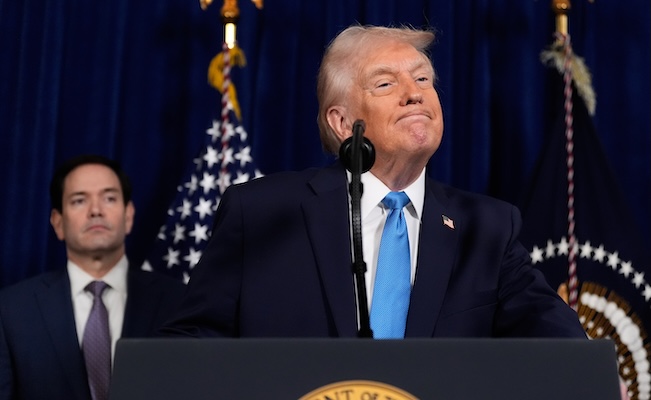
Top image: President Donald Trump listens to a question during a news conference at Mar-a-Lago on Saturday January 3 2026, as secretary of state Marco Rubio watches. Picture: AP Photo/Alex Brandon.
Sign up to Currency’s weekly newsletters to receive your own bulletin of weekday news and weekend treats. Register here.