
A decade ago, it was standard fare at the Shoprite Holdings results presentation to get a quirky statistic about how only a handful of shops in Nigeria were selling more Moët & Chandon than all of the retailer’s bottle stores in South Africa.
Then the champagne turned to pain, and as part of a pivot to opportunities at home, CEO Pieter Engelbrecht put the cork into Shoprite’s geographical footprint. When he took charge in 2017, the retailer was in 15 countries; it’s now in seven. And all of them close to South Africa.
The latest set of results suggests that the strategy is working. After accounting for the discontinued operations in Ghana and Malawi, as well as the sale of its furniture chains in Angola and Mozambique, the group’s revenue increased by 7.1% to R138.9bn for the half-year ended December. Diluted headline earnings per share grew 7.9% to 708.c and the dividend is 307c a share.
South Africa first
“The real proof that the South Africa-first strategy is working sits in the Supermarkets RSA numbers,” says Merchant West analyst Bianca Lakha. “Holding a 6.2% trading margin while running internal selling price inflation at just 0.7%, [which is] well below Stats SA’s 4.7% food inflation, is a statement about the depth of price investment this business is willing to absorb.”
The promotional activities of Black Friday and Christmas are included in these numbers. “That the group still grew trading profit 7.1% despite effectively choosing to deflate prices through the festive season tells you the volume response is real,” she adds.
In fact, taken as a whole, the products on Shoprite’s shelves were actually cheaper than a year before thanks to lower commodities prices and a stronger rand.
“We over-index on many of the commodities, and the prices of products such as potatoes, rice, maize meal have in some cases come down by as much as 40%,” says Engelbrecht.
A win for suppliers
What the price deflation also tells you is that the company grew volumes. And higher volumes, says Engelbrecht, is good news for suppliers. Not to mention consumers, who benefit from those bulk discounts.
But the competition is fierce. “Because the economy is not growing, we are all now scratching around in each other’s business,” Engelbrecht says.
And not just in retail, either. Though Shoprite is pushing deeper into financial services, so are the telecoms players. The banks, in turn, are creeping into mobile telephony and data sales.
Yet – and maybe Mr Price, now in the throes of a deeply unpopular German acquisition, should take note – South Africa has fewer headaches for Shoprite than the days when it had to deal with foreign currency restrictions, market turbulence and hyperinflation.
“We are basically now done with the rationalisation,” Engelbrecht tells Currency.
Lakha reckons the exit from Ghana, Malawi and the furniture businesses in Angola and Mozambique was well-timed. These would have been a drag on profits. The portfolio is now cleaner and more manageable on paper, she says.
Reaping the data
It means that Shoprite’s management team have been able to free up capital previously tied to “subeconomic returns” and put to better use at home, says Coronation portfolio manager and analyst Tumisho Motlanthe.
“Some of the other markets on the continent turned out to be much more capital intensive than expected,” he adds.
Its lekker local ventures mean that Checkers is treading ever deeper into the well-to-do waters Woolworths used to patrol so fiercely, aided in part by the Xtra Savings loyalty programme. This now boasts 34-million users – that’s more than half the country’s population – generating a trove of valuable data. Not to mention the success of the country’s largest motorcycle gang, the Doorbell’s Angels (officially known as Sixty60).
Management at Checkers and lower-income division Shoprite each have a sharp focus on their respective markets. Other retailers have learnt the hard way that you shouldn’t approach affluent and thrifty consumers with the same playbook.
No wonder the company keeps tweaking its international supplier base to stretch their rands the furthest. As recently as five years ago, the group still imported goods from 84 countries. That is now down to 20, says Engelbrecht.
As an aside, Engelbrecht mentioned 162 containers destined for its stores are now stuck in the Suez Canal due to the conflict in the Middle East. Thankfully not fresh produce, but glassware and similar goods from places such as the Czech Republic and Türkiye.
ALSO READ:
- 31 minutes, R18.9bn: Sixty60 is making Shoprite’s numbers sing
- Shoprite splashes R26.8bn to fill the gaps left by major multinationals
- Can Shoprite fill the small business funding gap?
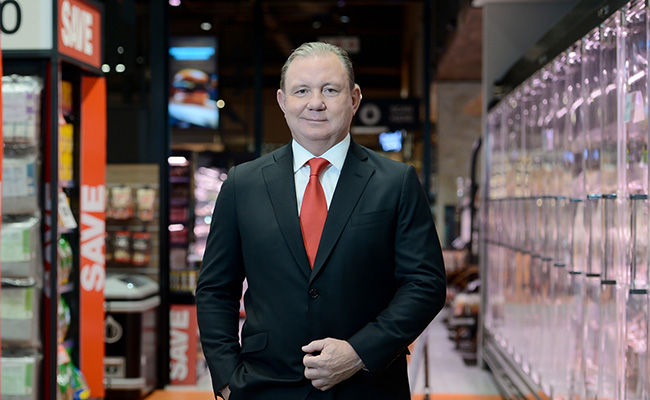
Top image: Shoprite CEO Pieter Engelbrecht. Picture: supplied.
Sign up to Currency’s weekly newsletters to receive your own bulletin of weekday news and weekend treats. Register here.