
Not that many people really noticed, but it was Human Rights Day on Saturday. It’s done and dusted now, but you know what I think might be a useful Human Rights Day exercise: rereading the constitution. There is stuff in there that is just absolutely wild.
Did you know, for example, that section 195 of the constitution – by the way, the highest law of the land – says public administration must be ethical, efficient, accountable, transparent and responsive to people’s needs. There has been lots of focus on the ethical part, which is understandable given South Africa’s huge public sector corruption. But what about the “efficient” part?
Section 195(b) says the public service “must” be governed in such a way that “efficient, economic, and effective use of resources must be promoted”. What does “must” mean in this context, since we have two of them in one section? Call me pedantic, but I think “must” in this context means an imperative obligation, notwithstanding the “must be promoted” bit. I mean, if you are not doing it, then you are certainly not promoting it, right? It’s not a “we tried our best” kinda thing. It’s more a “you have to do it” kinda thing.
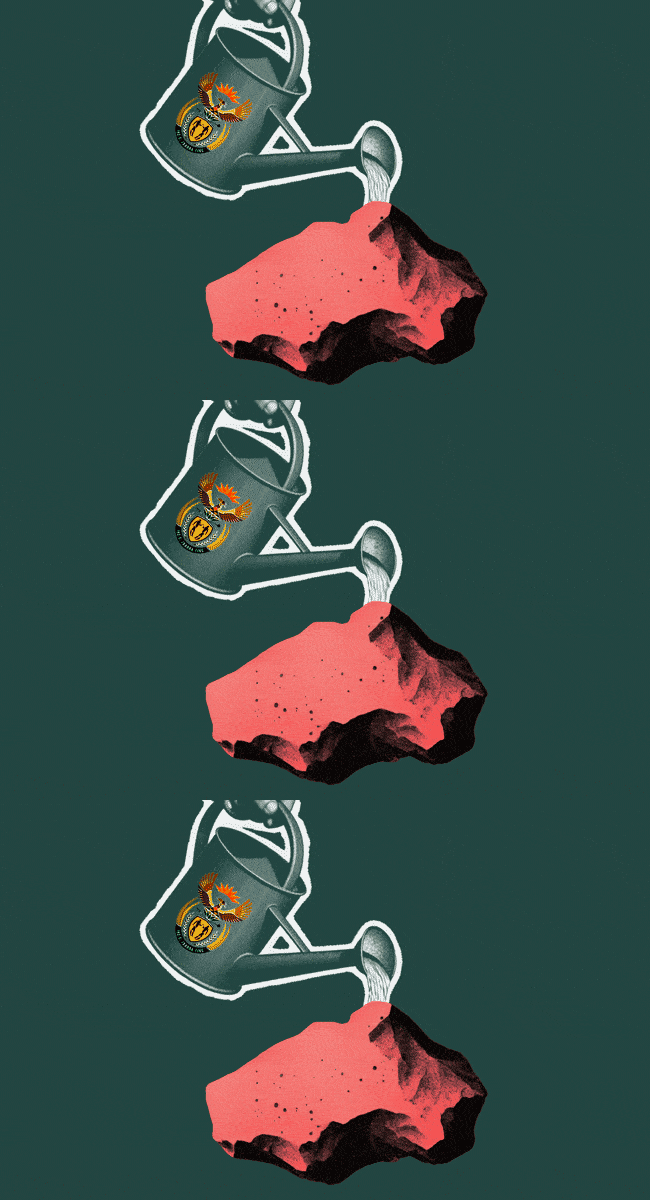
So how does that square with, I don’t know, the 2025 water report of the auditor-general, which said that 59 water-service authorities spent R2.32bn on water tankering in 2023/24, and R419.49m of that was irregular because of unfair or uncompetitive procurement. It also noted that tankers, supposed to be short-term relief, have become a long-term substitute for maintenance. In other words, instead of fixing the pipe, we have industrialised the bucket.
‘A document clamouring for change’
The one I particularly like is section 33. This is the section requiring administrative action that is “lawful, reasonable and procedurally fair”. But the thing that people don’t tend to remember, in my experience, is section 33(2), which says: “Everyone whose rights have been adversely affected by administrative action has the right to be given written reasons.”
Really? So if you get an electricity bill from the municipality that thumps you for thousands, you are perfectly entitled – more than that, legally entitled – to a letter explaining why. There are time limits and other limitations involved in subsequent legislation, but you don’t get the letter, well, you are presumably entitled to take the municipality to court, and state unequivocally that you want your letter. Sadly, I don’t think it will help. But did you know you had that right?
Then there is section 217. It says when the state buys goods or services, it must do so through a system that is fair, equitable, transparent, competitive and cost-effective. That is the constitutional basis for attacking dodgy tenders, cosy procurement and the ancient South African sport of tenderpreneurship.
There is so much of this kind of stuff in the constitution; it’s a reminder of those halcyon days when people seemed to just care more, and were more hopeful and less cynical. Former Constitutional Court judge Albie Sachs once said he saw it as “a document clamouring for change”: the text does not plead for complacency; it demands motion.
Verbs, not ornaments
After years of routine constitutional abuse, Human Rights Day in South Africa strikes me as a slightly awkward family reunion: we invite the constitution, the ghosts of Sharpeville, a brass band, several politicians, and the national conscience, then act surprised when the conversation turns testy.
It is not, after all, a day born of abstraction. It is tied to March 21 1960, when police opened fire on a peaceful crowd in Sharpeville, killing 69 people and wounding 180. And this year the symbolism is turned up to 11: 2026 marks 30 years since Nelson Mandela signed the democratic constitution into law in Sharpeville itself.
The South African constitution remains one of those extraordinary national objects that is at once overpraised, underused and routinely blamed for the sins of people who have plainly not read it past the nice bits.
Human rights, in the end, are not ornaments. They are verbs. A constitution is not self-executing scripture descended onto acid-free paper. It is more like a magnificent engine in a country that keeps mislaying the mechanics. On Human Rights Day, South Africa should celebrate that we built the engine at all. Then, with suitable seriousness and only moderate hymn-singing, we should ask why so many of its parts are still idling while the nation is parked on bricks.
Human Rights Day is usually treated as a patriotic memory exercise. But this year, with 30 years of constitutional democracy to contemplate, it might be better used as an audit: not of what politicians say about the constitution, but of what the constitution actually demands of them.
ALSO READ:
- Magnificently, vaguely right: An obituary for Clem Sunter
- Can Sakeliga force Ramaphosa to – finally – act?
- ANC hits ‘copy, paste’ on January 8 vows
Top image: Rawpixel/Currency collage.
Sign up to Currency’s weekly newsletters to receive your own bulletin of weekday news and weekend treats. Register here.