
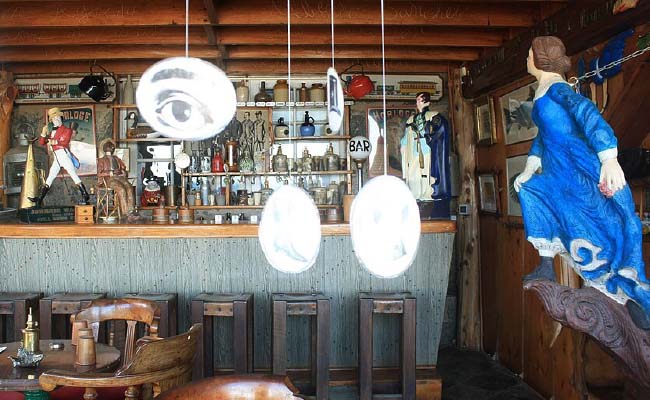
No bar could depress me more than this one. It was not the setting and not the decor. Come on, we had a stunning view of the Pacific Ocean and its grey, brooding waves. The room itself had spunk, having been saturated with memorabilia from across the globe – clearly the curator took the care of a poet shaping stanzas in selecting what to hang where. The problem was the people. There simply weren’t any. The bar at Pablo Neruda’s home was empty, and had been for decades, doomed to be a museum.
What makes it even sadder is that Chile is cocktail country. Tying one on at the end of a long day means ordering a pisco sour – that magical blend of brandy, lime, egg white, bitters and simple syrup. Not just any brandy, but pisco – hard tack that is not tacky at all. Made with aromatic grapes from the country’s arid north, this spirit gives you the same kick, but with a floral twist. If ever there was a place for a pisco sour, this bar – below the poet’s bedroom – was it. Like a dungeon with a dop and a view.
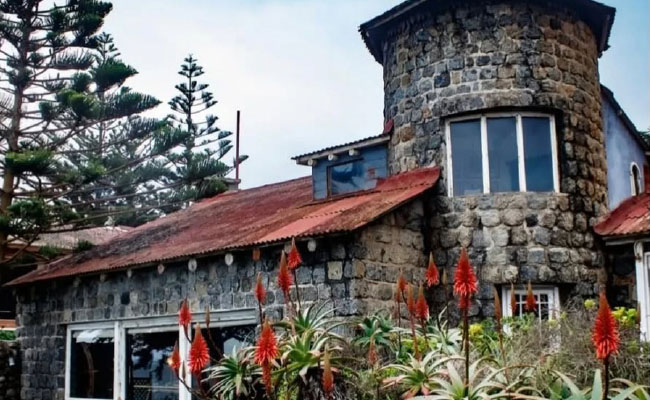
Neruda named the sprawling dwelling Isla Negra – his own “dark place of seclusion” some 100km west of the capital, Santiago. He acquired the property shortly before World War II and soon began, well, editing. What started out as a simple stone cottage was gradually transformed – with additions and embellishments – into any writer’s dream.
Building the dream at Isla Negra
By then a man in his 30s, Neruda was a well-known player on the literary scene. His celebrity was minted a decade earlier with the publication of a raunchy collection of 20 love poems (risqué for the day, but hardly Nicki Minaj-level stuff). Rhythm and rhyme, then as now, was just not enough to put salmon on the table, so he served as a diplomat in Asia and Europe. Imagine the exotic impression Neruda must have made at those drab embassy sundowner events as a poet and a communist from a country on the far end of the globe. In those years, he polished his networking skills into the smooth tool he would use to great effect later in life.
So great was his influence that in 1939 he pulled enough strings to allow the Winnipeg, a ship full of Catalan refugees, to dock in nearby Valparaíso. The more than 2,000 European exiles were a socialist injection into a highly conservative country. Their arrival had a lasting impact on Chile and might just be a greater legacy than Neruda’s writing.
By the time he was back on Chile’s Pacific Coast, the poet had friends from all over. Influential types, luminaries, big names, many of whom sent their literary friend gifts. They knew Neruda was a collector, and a strange one at that.
Collectors, figureheads and deadlines
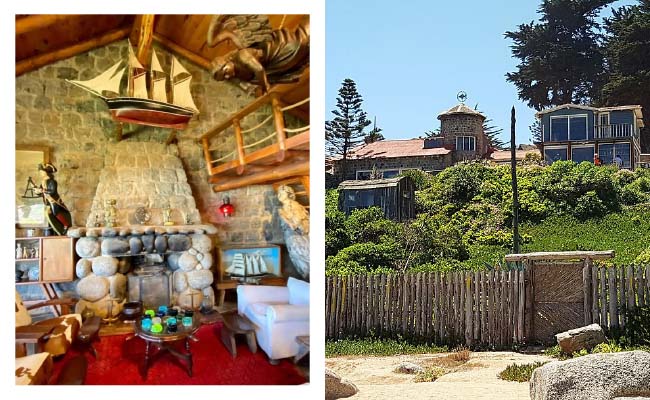
Most notable was Neruda’s almost morbid fascination with figureheads, those final glorious remnants of ships that had gone to ground. Every Isla Negra tour guide will tell you that the poet undertook several journeys up and down Chile’s nearly endless coastline in search of figureheads. His beachcombing rewarded him with dozens of finds. A handful of these treasures are still on display in the lounge, none more haunting than the melancholy carved lady that adorned the Cymbelina until it sank in 1847.
Pretty macabre stuff that, inevitably, makes you wonder how the busybody poet treated deadlines. All the perished-vessel decor must have been a handy reminder that you can’t tinker forever; in the end every writer needs to, well, ship.
The milieu would have been little excuse for a lack of productivity. For writing alone, Neruda had a train carriage-like wing appended to the house. Filled with artefacts, masks and souvenirs, it was a careful selection, not a clutter-fest, and in this way the poet’s home resembled a museum long before it became one. An odd collection … stirrups and foot warmers and even a giant Victorian globe, all lead you to a breathtaking fireplace in a stone-decorated corner.
From his desk he would have had a pleasing view of the ever-shifting surf. No wonder Neruda wrote: “The Pacific Ocean was falling off the map. There was nowhere to put it. It was so big, messy and blue that it didn’t fit anywhere. That’s why they left it in front of my window.”
Behind his chair, nailed to a wooden wall, hung portraits of his literary heroes: Whitman, Rimbaud, Poe and Dostoevsky. Co-working spaces and coffices be damned, this was the sort of place where you produce!
A writer at work
He shipped, alright. From Isla Negra, Neruda cast off hundreds of poems. So productive was his writing sojourn on this “island” that in 1971 he could add the Nobel for Literature to his eclectic collection. That day, the party at his bar would have been quite something.
At the time, however, the mood in Chile was becoming less festive. Only two years later, democracy was on the rocks. And Neruda himself was the figurehead of the country’s brief flirtation with hardcore socialism. The poet, you see, was also a politician. He had been a senator and some would say he anointed his old friend Salvador Allende to be the nation’s president. Allende was a Marxist and caused a stir in the West when he was elected in 1970. It opened up even deeper resentments at home and activated the country’s conservative establishment. Soon the Right, big business and the military were in agreement: the society Allende and Neruda wanted to create in Chile had to be scuttled. And their pals in the US government approved.
Politics, upheaval and an unquiet end
In September 1973, general Augusto Pinochet took power (to rule for nearly two decades). Sadly Neruda, no longer a healthy man, passed away in a Santiago hospital less than two weeks later, presumably at the hands of the military dictatorship. The poet’s remains were only returned to Isla Negra 19 years later, after the end of Pinochet’s brutal reign.
And so, this beautiful bar has been without patrons for too long. It will probably never see the quality of guests that had dropped in on the owner in his three glorious decades. Nope, the sort of visitors it gets these days are not people you drink with, but those that drive you to drink: tourists.
To celebrate Neruda’s productive paradise, I headed to Valparaíso, Chile’s second city, some 100 km up the coast, and promptly ordered the pisco sour that would have tasted so much better at the poet’s own watering hole. Pure poetry.
Chile: Notes for travellers
- Pisco sour is not the only cocktail on the menu. Try a calafate sour, made with a berry liqueur from the Chilean part of Patagonia. (If Liqui-Fruit had a mean, Latin-American cousin, his name would be Calafate Sour.) Another option is the vaina, a comforting drink aimed at an older crowd, made from port or brandy, crème de cacao, egg yolk and cinnamon. And if you miss home, order a piscola – the most satisfying take ever on brandewyn en coke.
- Fish is the thing to eat. Just about every restaurant knows how to cook you a good salmon or merluza (hake, but nicer than you’ve ever had it). With it you’ll get a typical ensalada Chilena, a salad of tomato, onion, coriander and olive oil, and every so often a bit of chili. And, of course, mashed potatoes with merkén, a smoked-chili spice that you’ll smuggle bags of back to South Africa. You can also order ceviche with confidence – the Chileans know how to marinate raw fish. Street food would mostly be empañadas, the best of which have a beef mince and hard-boiled egg filling, but bite carefully as you’ll almost always find an olive, pip and all, in your pie.
- On the wine front, sample as much carmenere as you can. This red varietal is not for everyone, but it is considered Chile’s natural grape and there are some good ones!
- Getting there: Fly to Sao Paulo in Brazil and connect to Santiago from there. Rent a car and drive the narrow bushy road to Isla Negra. After visiting Neruda’s pad, meander your way up the coast and look for a figurehead he might have missed.
ALSO READ:
- When in Rome … do as Currency says
- Get a room: Turbine Hotel & Spa
- At the edge of the world, tasting time on St Helena
Top image: Rawpixel/Currency collage.
Sign up to Currency’s weekly newsletters to receive your own bulletin of weekday news and weekend treats. Register here.