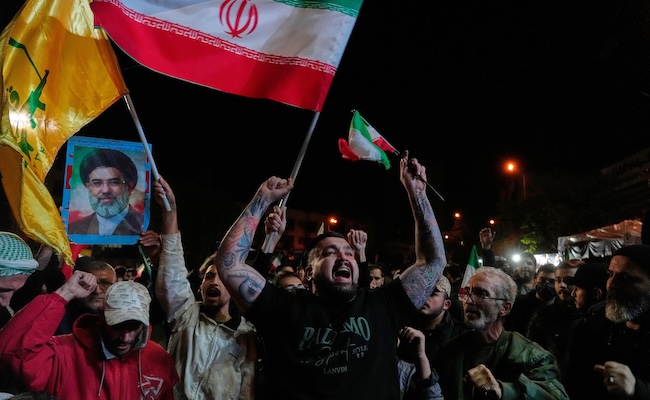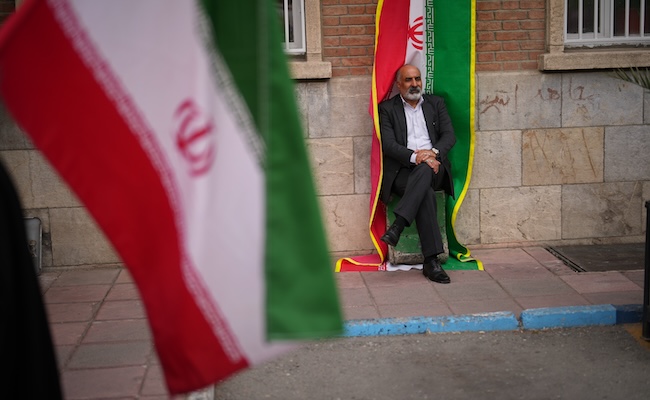

A ceasefire deal to pause the war in Iran appeared to hang by a thread Wednesday after the Islamic Republic closed the Strait of Hormuz again in response to Israeli attacks in Lebanon. The White House demanded that the channel be reopened and sought to keep peace talks on track.
The US and Iran both claimed victory after reaching the agreement, and world leaders expressed relief, even as more drones and missiles hit Iran and Gulf Arab countries. At the same time, Israel intensified its attacks on the Hezbollah militant group in Lebanon, hitting commercial and residential areas in Beirut. At least 182 people were killed Wednesday in the deadliest day of fighting there.
The fresh violence threatened to scuttle what US Vice-President JD Vance called a “fragile” deal.
Parliament speaker accuses US of breaking Iran’s conditions
The Iranian parliament speaker said planned talks were “unreasonable” because Washington broke three of Tehran’s 10 conditions for an end to the fighting. In a social media post, Mohammad Bagher Ghalibaf objected to Israeli attacks on Hezbollah, an alleged drone incursion into Iranian airspace after the ceasefire took effect and US refusal to accept any Iranian enrichment capabilities in a final agreement.
Iranian foreign minister Abbas Araghchi insisted that an end to the war in Lebanon was part of the ceasefire deal, but Israeli Prime Minister Benjamin Netanyahu and US President Donald Trump said the truce did not cover Lebanon. When the deal was announced, Pakistan’s prime minister, whose country served as a mediator, said in a social media post that it applied to “everywhere including Lebanon and elsewhere”.
Lebanon’s health ministry said Israeli strikes killed 182 people on Wednesday, the highest single-day death toll in the Israel-Hezbollah war.
“The world sees the massacres in Lebanon,” Iran’s Araghchi said in a post on X. “The ball is in the US court, and the world is watching whether it will act on its commitments.”
White House press secretary Karoline Leavitt said the closing of the Strait of Hormuz, reported in Iranian state media, was “completely unacceptable”. She repeated Trump’s “expectation and demand” that the channel be reopened.
US defence secretary Pete Hegseth said American and Israeli forces had achieved a “capital V military victory” and that the Iranian military no longer posed a significant threat to US forces or the region. The Iranian military said the country forced Israel and the US to accept its “proposed conditions and surrender”.
Much about the agreement was unclear, as the sides presented vastly different visions of the terms.
Iran said the deal would allow it to formalise its new practice of charging ships passing through the strait, a crucial transit lane for oil. The White House said Trump is opposed to tolls for ship passage through the strait.
Only 11 vessels moved through the strait Wednesday, roughly the same as in prior days, according to Windward, a maritime intelligence firm. Iran was requiring shippers to pay tolls of up to $1 a barrel for outbound oil, it said. The largest supertankers carry up to 3-million barrels of crude.
The fate of Iran’s missile and nuclear programmes – the elimination of which were major objectives for the US and Israel in going to war – also remained unclear. Trump said the US would work with Iran to remove buried enriched uranium, though Iran did not confirm that.
White House looks ahead to peace talks
Trump initially said Iran proposed a “workable” plan that could help end the war that the US and Israel launched on February 28. But when a version in Farsi emerged indicating Iran would be allowed to continue enriching uranium – key to building a nuclear weapon – Trump called it fraudulent.
Leavitt said a plan that Iran presented Tuesday could “align with our own” proposal for peace.
The White House said Vance would lead American negotiators at upcoming peace talks, which could begin in Pakistan as soon as Friday.
Iran’s demands for ending the war include a withdrawal of US combat forces from the region, the lifting of sanctions and the release of its frozen assets.
Meanwhile, Israeli chief of staff lieutenant-general Eyal Zamir said Israel will continue to “utilise every operational opportunity” to strike Hezbollah. The Israeli military said it struck more than 100 targets within 10 minutes Wednesday across Lebanon, the largest wave of strikes since March 1.
Arab League chief Ahmed Aboul Gheit accused Israel of “persistently seeking to sabotage” the ceasefire deal.
Hezbollah has not confirmed if it will abide by the ceasefire, though the group has said it was open to giving mediators a chance to secure an agreement.
Early on Thursday Hezbollah said it had fired rockets at northern Israel and would continue doing so “until the Israeli-American aggression against our country and our people ceases”.
Iran and Oman could collect shipping fees in Strait of Hormuz
Iranian attacks and threats deterred many commercial ships from using the strait, through which 20% of all traded oil and natural gas passes in peacetime. That roiled the world economy and raised the pressure on Trump both at home and abroad to find a way out of the standoff.
The ceasefire may formalise a system of charging fees in the strait that Iran instituted – and give it a new source of revenue.
That would upend decades of precedent treating the strait as an international waterway that was free to transit. Such a shift would likely be unacceptable to the Gulf Arab states, which also need to rebuild after repeated Iranian attacks targeting their oil fields.
Iran’s nuclear and missile threats survive
US-Israeli strikes have battered Iran and its leadership, but they have not eliminated the threats posed by Tehran’s nuclear programme, its ballistic missiles or its support for regional proxies, like Hezbollah. The US and Israel said addressing those threats was a key justification for going to war.
Trump said the US would work with Iran to “dig up and remove” enriched uranium. There was no confirmation from Iran.
Hegseth told a Pentagon briefing Wednesday that the US would do “something like” last June’s joint strikes with Israel on Iranian nuclear sites if Iran refuses to surrender its enriched uranium voluntarily.
Netanyahu warned in a televised address that Israel was “ready to return to fighting at any time. Our finger is on the trigger.”
Tehran has insisted for years that its nuclear programme was peaceful, though it has enriched uranium up to 60% purity, a short, technical step from weapons-grade levels.
Airstrikes reported despite ceasefire announcement
Shortly after the ceasefire announcement, Bahrain, Israel, Kuwait, Saudi Arabia and the United Arab Emirates (UAE) all issued warnings about incoming missiles from Iran. That fire stopped for a time, then hostilities appeared to restart.
An oil refinery on Iran’s Lavan Island came under attack, according to Iranian state television. A short time later, the UAE’s air defences fired at an incoming Iranian missile barrage.
More than 1,900 people had been killed in Iran as of late March, but the government has not updated the toll for days.
In Lebanon, more than 1,700 people have been killed and 1-million people have been displaced. Twelve Israeli soldiers have died.
In Gulf Arab states and the occupied West Bank, more than two dozen people have died, while 23 have been reported dead in Israel, and 13 US service members have been killed.
Reporting by Bassem Mroue, Jon Gambrell, Samy Magdy and Sam Metz, with Edith M Lederer, Natalie Melzer, Abby Sewell and Sarah El Deeb, Mike Catalini and Michelle L Price, Aamer Madhani, Zeke Miller, Michael Biesecker and Josh Boak.
ALSO READ:
- Iran has been threatening to close the Strait of Hormuz for years – it’s a key part of Tehran’s defence strategy
- Trump expands threat ahead of deadline
- Trump gives Iran till Tuesday to open Hormuz
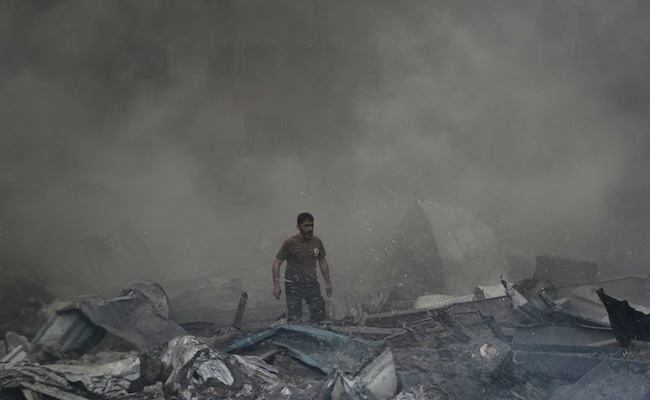
Top image: A first responder emerges through the smoke at the site of an Israeli airstrike that struck an apartment building in Beirut, Lebanon, on April 8. Picture: AP Photo/Bilal Hussein.
Sign up to Currency’s weekly newsletters to receive your own bulletin of weekday news and weekend treats. Register here.