

South Africa’s state broadcaster, the SABC, took the nation live to a press conference by Iran’s ambassador to the country, Mansour Shakib Mehr, last Wednesday evening.
After a minute’s silence for the assassinated Ali Khamenei, the former supreme leader of Iran, Mehr attacked the “child-killing regimes of the US and Israel” and called on members of the non-aligned movement and Brics to condemn the assault on Iran.
He described this as “a dangerous and unprecedented violation of international norms” and added: “Western powers … have created a media hegemony. Break this hegemony.”
His broadcast was followed by what can only be described as psychopathic commentary, which essentially attempted to outdo the ambassador.
Absent was any effort to present a serious, independent analysis of what was going on, and how South Africa ought to approach the complicated subject of the US and Israeli attacks on Iran to best advance its national interests.
What was on display was evidence that it was, in fact, Iran that had “created media hegemony” in South Africa.
A history of negotiation
This Iranian hegemony in public commentary extends to the headquarters of the department of international relations and co-operation (Dirco), which acts as a chapter for Iran and its Hamas and Hezbollah proxies, raising breaches of “international law” when it comes to them but ignoring the flagrant breaches of Russia in Ukraine or across the Sahel.
By opting to realign South Africa, a state whose foundations are democracy, free expression and human rights, with the malign regime of Iran over the past several years, Dirco has denuded the country of its most powerful cachet in foreign affairs: its negotiating history.
South Africa did not become a democracy by accident. It took the leadership of Nelson Mandela and FW de Klerk to initiate negotiations between foes who had been at war for decades.
Their vision was that the conflict must end. But not only that. Both accepted that, to prevent the demons of this conflict from rising from the dead in the future, the country needed to be placed within the rails of a constitution that protected democracy and the freedoms that were denied under apartheid.
This was leadership.
What South Africa is doing in its fawning over Iran is destroying the value of the country’s history of seeking peace and democracy where there is conflict.
Undermined diplomatic credibility
President Cyril Ramaphosa earlier this month said from the sidelines of an energy conference in Cape Town that “South Africa is always ready to play a contributing role, either in mediation or whatever. If a gap opens or if we are asked, we always live up to our obligations.”
The “or whatever” slip is evidence that this glib rhetoric lacks substance. There is a peace process under way between Israel and Gaza, yet South Africa has chosen not to participate or assist. The South African government appears unable to entertain any negotiated compromise other than one which results in the victory of its allies in Hamas.
South Africa has no bona fides in this conflict, none at all. How might it convince Washington or Jerusalem that it is not a partisan player when it has shut down diplomatic relations with Israel and declared its chargé d’affaires persona non grata?
The US and Israeli assault on Iran is complicated, and countries such as the UK and France question whether it is justifiable in terms of international law. There are grave concerns that this war lacks an overarching strategy to achieve its goal of regime change, and of the risks of state fragmentation and failure, with associated problems of migration, criminality and radicalism.
But these concerns should not obscure the extent to which South Africa has undermined its diplomatic credibility, since there can be no gainsaying that the Iranian regime that is under assault is a grievous violator of everything that South Africa holds dear. It is undemocratic, it has slaughtered many thousands of protesters, it sponsors terrorism and is at the heart of much of the continued conflict in the Middle East.
The loss of moral standing
The argument against apartheid South Africa was one based fundamentally on morality. South Africa appears to have lost sight entirely of this determination in its foreign affairs.
Yet South Africa has preferred to side with an Iranian regime that is coldly distant from its people’s struggles and inept at anything save killing its own people, a soulless anathema to everything that South Africa’s liberation struggle was about. Echoing Jimmy Kruger’s infamous observation that the death of Steve Biko left him “cold”, Ayatollah Ruhollah Khomeini, on his return from 15 years of exile on February 1 1979, replied hichi (nothing) when asked by a journalist what he felt about returning to his native land.
And South Africa has not restricted its love of autocratic and repressive regimes to Iran. It’s failure to condemn the Russian invasion of Ukraine – as clear a violation of “international law” as you could hope for – has confirmed its drift away from its core values.
In a curious twist, South Africa now finds itself in the company of Donald Trump, whose ambassador to the UN joined South Africa and a coterie of balefully undemocratic nations in refusing to support the latest resolution on Ukraine.
There is no hope of South Africa recovering its stature and returning to its core values until something is done about the willful determination to realign the country with autocracy that emerges from the engine-room of this disastrous posture, Dirco.
The hypocrisy
In a verbatim Q&A (cf media hegemony) with the Daily Maverick, Dirco director-general Zane Dangor said: “It’s not just a question of belief. I think belief is in the realm of politics … Article 2(4) of the UN Charter, firstly, is very clear and it’s very deliberate that all states shall refrain from the threat [or] use of force against the territorial integrity of another state. So, that lays the basis for what is permissible.
“The same charter then says that only the UN Security Council has the capacity … to authorise the use of force. So, if another state believes that they are under threat or that there’s a duty [or] responsibility to protect civilians, the only way they can attack another state is with the go-ahead of the Security Council. That is if another state has not attacked them.”
If Dangor was vaguely serious about making this case, South Africa would have unequivocally and without hesitation condemned Russia’s attack on Ukraine on the same grounds. It would have driven an international coalition to stop the invasion through the international courts and on the global diplomatic stage. We did the opposite. Perhaps it was the anticipation of the flow of millions into the party coffers from Russian sources that did the trick.
Either way, Dirco helped to create the very global conditions about which it now complains. The default to double standards is clear, too, in the labelling of the state of Israel as “Zionist” when Islamist regimes, even those such as Iran with the moniker preferred in its official name, are spared the same scorn.
Retreat – or get bitten
For South Africa, international relations positions are, in fact, deeply embedded “in the realm of politics”. And it is not the politics of seeking to expand and protect democracy. It is a politics that seeks to build a “new world order” in which transactions, not values, are foundational. Trump would be proud.
“War, war until victory” was the slogan of Ayatollah Khomeini during the eight-year Iran-Iraq War, which ended in 1988. And yet the nihilism of war itself was the goal, his regime’s ultimate victory and contribution.
South Africa helped to set the stage for what has manifested in Iran today, and nearly five decades of violent, obscurantist, death-worshipping theocracy intent on eliminating Israel (among others) from the region. In its unquestioning support for Iran and its proxies, South Africa has wittingly – or not – blundered into a wider geopolitical play between the US on the one side and this new world order led by China, a key ally of Russia and Iran, on the other.
Like a yapping dog on the margins of a bigger fight, South Africa will have to choose its moment to retreat wisely, or get bitten.
Ray Hartley and Greg Mills are with the Platform for African Democrats.
ALSO READ:
- South African foreign policy: Vrot with contradiction
- South Africa’s hypocrisy is not just laughable – it’s Trumpian
- Real Politics: What Iran reveals about South Africa’s GNU problem
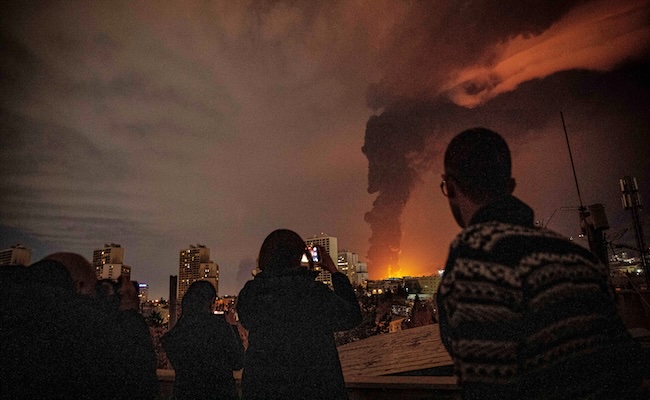
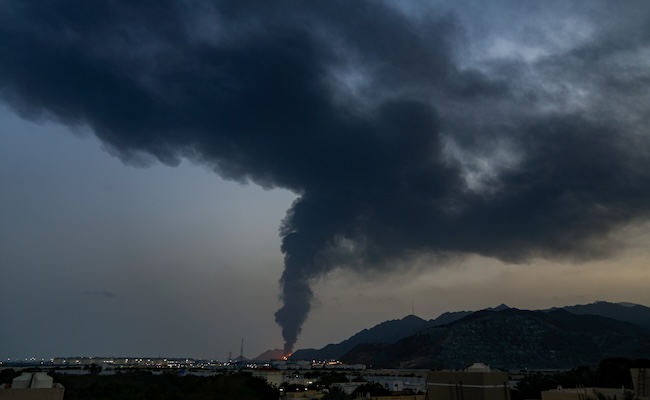
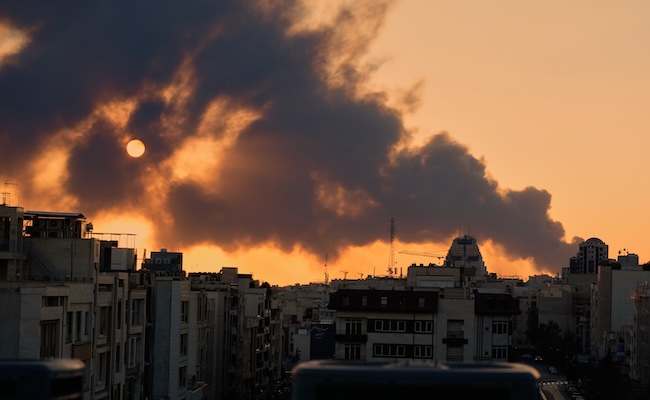
Top image: A plume of smoke rises following a US-Israeli military strike in Tehran, Iran, on March 3. Picture: AP Photo/Vahid Salemi.
Sign up to Currency’s weekly newsletters to receive your own bulletin of weekday news and weekend treats. Register here.