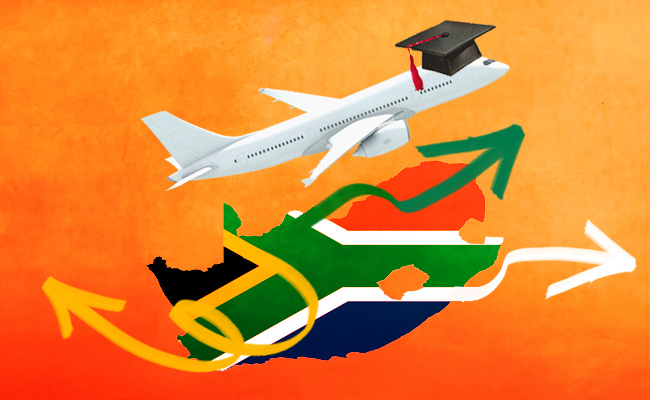

It’s well known that South Africa has seen an exodus of experienced and highly skilled workers. But its brightest students are increasingly leaving, too.
A 2024 study by the South African Academy of Family Physicians found that about 11% of South Africans with higher education indicate that they are seriously considering emigrating.
This sentiment isn’t much different among South African matriculants – including the freshly graduated class of 2025, who received their results this week.
According to some of the most prestigious schools that Currency spoke to, the highest achievers are being cherrypicked by overseas universities, while others are doggedly applying to institutions across the US, Europe and the UK.
Arguably, it’s as much a feature of the obsession with higher education as it is South Africa’s desperately thin jobs market. At certain academically rigorous schools, university isn’t really seen as a choice. And then there’s the shortage of places in South African universities, relative to the number of applicants. Last year, for example, the University of Johannesburg received 693,990 applications; it had just 10,500 first-year places to offer.
‘University obsessed’
At Joburg’s prestigious girls’ school, Roedean, the 2025 matric class achieved 4.21 distinctions per candidate, and more than half the grade achieved an 80% and above average. It was the second-highest-performing Independent Examinations Board school in the country.
“This kind of environment is very university obsessed. I would say we almost have 100% [of students] going to university,” says Roger Bourquin, head of the department of mathematics at Roedean.
Wealthy parents see these prestigious schools as the gateway to offshore education and opportunities. “One of the main reasons people come to a school like this is for that reason,” says Bourquin, who reckons about 15% of each grade applies to study further overseas. “And nearly all of them get into somewhere.”
Nearly 100 Roedean girls have been accepted to a range of international schools in the past 10 years; this year, one of its pupils has just been accepted into the Ivy League University of Pennsylvania.
Ita Collins, Roedean’s head girl in 2025, tells Currency she’s applying to the States. “I’m actually a US citizen which means I can get really good financial aid there, which is great.”
Collins has applied to Harvard, MIT and a range of other universities in the US, but says Stanford would be the dream.
Natural ‘solution’?
Such a high percentage of students not only applying but being accepted into international schools is troubling in the context of South Africa’s steady brain-drain. Yet, especially at wealthier private schools, it is seen as the natural “solution” to crushingly high levels of unemployment and an economy that has limped along for the past 15 years.
At St David’s Marist Inanda, principal Mike Thiel reckons the percentage of boys going to study overseas is between 15% and 20%, split between undergraduate and postgraduate study.
“We encourage them to complete job-specific degrees or diplomas here at home, though, as that builds their professional network for their working life,” he says.
Still, the allure is very real, as overseas study is seen as “an integral part” of their high school experience, with many international tours and trips offered. International universities also visit the school regularly in the hopes of attracting the top academic performers to their study programmes.
At Kingsmead College, an all-girls private school with a distinction average of 3.92 per candidate, the trend seems to be shifting slightly, though the demand for higher education is still strong.
“Tertiary education is very much the norm. I’m almost going to say 95% of our students go on to do something in terms of tertiary education,” says principal Lisa Palmer.
But, in Kingsmead’s case, the number of students going to study overseas was higher pre-Covid and has fallen slightly since; this year only three students have applied to overseas institutions.
Both Palmer and Bourquin say the greater trend is to study undergraduate degrees locally and then pursue postgrads overseas.
‘Bigger than a brain drain’
While South Africa doesn’t actively track its emigrants, a UN report from 2020 found that more than 900,000 citizens had emigrated, a figure that has likely spiked in the past five years.
This cuts across all demographics, too. And, what’s more, it’s a continental issue; a survey of young Africans aged 18-24 found that more than half were considering emigrating as a means to secure their future.
Carried out by the South African Ichikowitz Family Foundation in 2024, the report found that a depressing 74% of the South African youth surveyed think the country is headed in the wrong direction. Furthermore, 31% of respondents stated they intended to emigrate permanently.
“It’s bigger than a brain drain,” Ivor Ichikowitz told the BBC. “This group of people, 18- to 24-year-olds in Africa, are saying: ‘We are going to improve our lives, even if it means having to up and leave and go somewhere else.’”
ALSO READ:
- Say no to ‘political economic empowerment’!
- One sunny day for jobs doesn’t make a summer
- How Brazil’s classroom-to-cockpit vision shows what South Africa has lost
Top image: Rawpixel/Currency collage.
Sign up to Currency’s weekly newsletters to receive your own bulletin of weekday news and weekend treats. Register here.