
South32 has announced the effective closure of the Mozal aluminium smelter near Maputo, a decision that will leave a thumping great hole in Mozambique’s industrial base, cut more than R5bn a year from Eskom’s revenue, and raise uncomfortable questions about Southern Africa’s long-stated ambitions to support mineral beneficiation.
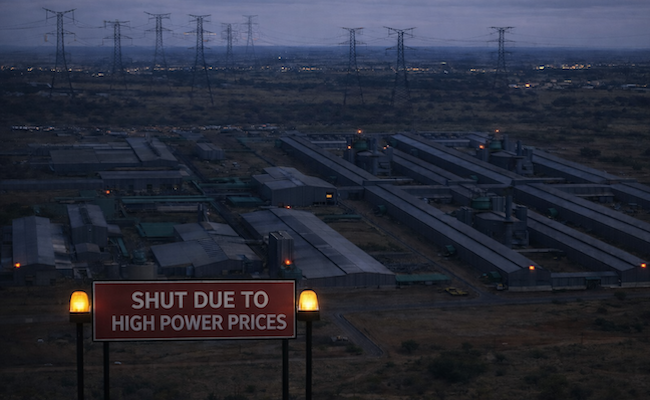
The Australian-listed mining group said on Tuesday that Mozal will be placed on care and maintenance from around March 15, 2026, when its current electricity supply agreement expires, after years of negotiations failed to secure power at a price that would keep the smelter internationally competitive.
South32 CEO Graham Kerr, speaking alongside COO Noel Pillay, stressed that the decision was not the company’s preferred outcome.
“Our objective has always been to find a solution that would allow Mozal to continue to operate,” Kerr said. “Unfortunately, the parties remain deadlocked on an appropriate electricity price.”
Mozal, one of Africa’s largest aluminium smelters, has long been anchored by access to relatively cheap hydroelectric power from Mozambique’s Cahora Bassa dam. But prolonged drought conditions have sharply reduced hydro output, forcing South32 to seek alternative supply – primarily from Eskom, which in recent months has been carrying most of Mozal’s roughly 940 megawatts of continuous electricity demand.
That proved to be the breaking point.
Aluminium smelting is among the most electricity-intensive industrial processes in the world, requiring uninterrupted, 24-hour power. Kerr noted that globally, only a handful of smelters operate at power prices above $50 per megawatt-hour.
“The prices we were looking at would have made Mozal one of the most expensive power contracts in the world,” he said, adding that the operation would have been “losing money every single day of the week”.
Economic hammerblow
While South32 had hoped for a temporary arrangement until Cahora Bassa’s output recovered – something experts expect could take another two to three years – the cost of Eskom power, shaped by years of tariff hikes and coal-fleet recovery costs, ultimately proved prohibitive.
The closure is a severe blow to Mozambique’s economy. Mozal accounts for an estimated 3% of national GDP, employs around 5,200 people directly and through contractors, and supports a broader employment footprint of roughly 22,000 jobs once multiplier effects are included. About 97% of its workforce is Mozambican, and the smelter provides around 25% of manufacturing jobs in Maputo city and 10% across Maputo province.
In the 2024 financial year alone, Mozal spent about $435m with Mozambican suppliers, reinforcing its role as one of the country’s largest industrial anchors. Although Mozal does not pay corporate income tax – a concession dating back to Mozambique’s post-civil-war reconstruction period – it pays a 1% royalty on revenue. Kerr said South32 had previously indicated a willingness to move to full taxpayer status if a viable long-term power solution could be secured.
The impact will also be felt sharply in South Africa. South32 estimates Eskom will forgo about R5bn to R5.5bn in revenue each year, at a time when the utility is still trying to stabilise its finances.
Paradoxically, Mozal has been one of Eskom’s most desirable customers: a large, constant load with a near-perfect load factor, providing grid stability rather than strain.
“The question now,” Kerr said, “is where does Eskom place those 940 megawatts, and if it can’t place them, who pays for that power?”
There are spill-over effects for South African industry, too. Around 269 South African companies supply goods and services to Mozal, with contracts worth roughly R1.3bn in 2023, all of which now face an uncertain future.
No end to China dependency
The closure comes at an awkward moment for governments increasingly worried about over-reliance on China for critical industrial processing. The US, Australia and parts of Europe are actively reconsidering policies that allow aluminium smelting capacity to migrate to regions with cheaper energy, notably China, Indonesia and the Middle East.
Kerr acknowledged the irony. “If you don’t have line of sight on these critical commodities, you really are at the mercy of those who do,” he said. But he added that governments can only subsidise power-hungry industries for so long.
“The real question is how countries produce competitive power – not just whether they want beneficiation.”
In practice, Mozal’s closure is unlikely to move global aluminium prices. New smelting capacity continues to come on stream in the Middle East, fuelled by cheap gas, while Chinese firms – despite domestic capacity caps – are investing heavily in Indonesia.
What will shift, Kerr suggested, is geography: “Jobs move from Mozambique to Indonesia or the Middle East.”
South32 will incur about $60m in once-off costs to place Mozal on care and maintenance, with ongoing annual holding costs of about $5m. The smelter is expected to produce around 240,000 tonnes of aluminium in the final nine months of operation through March 2026.
The decrease in production will not be hugely consequential for the company’s revenue and profit, and it did flag the production decline earlier in the year. South32’s share price is down 4% so far this year.
Restarting a smelter after shutdown is notoriously tricky and capital-intensive, requiring frozen pots to be rebuilt almost from scratch – a reality that makes “temporary” closures feel permanent.
For Southern Africa, the lesson is uncomfortable but increasingly familiar: beneficiation ambitions collide with the hard arithmetic of electricity pricing. Without abundant, reliable and genuinely competitive power, even flagship industrial projects struggle to survive.
Mozal’s lights going out will not just dim Maputo’s skyline – they illuminate the fragility of industrial policy built on energy promises that can no longer be kept.