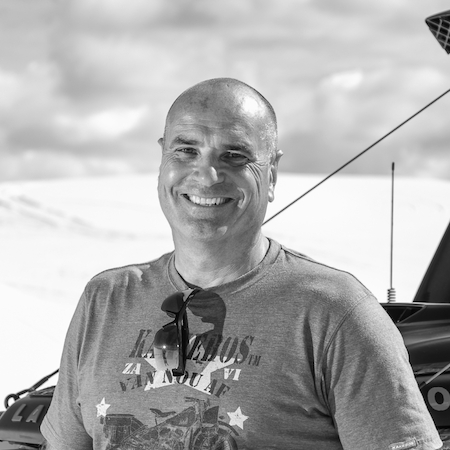
In ‘Overlanding Through the Boardroom’, Johan de Villiers turns bush lessons into business ones. In this edited excerpt from the book’s fourth chapter, he explores how sudden crises unfold, why hindsight distorts our judgment, and what leaders can learn from extreme experiences – both in the mountains and in the marketplace.
A black swan event is something rare and unexpected that has a significant and often dramatic impact and which, once it has happened, suddenly appears as if it should have been obvious all along. The expression comes from the way European thinking was overturned when explorers, arriving in Western Australia in 1697, discovered actual black swans. For centuries, Europeans believed swans were only white, and every painting, record and cultural reference confirmed it. The existence of a black swan was viewed as impossible – until it stood in front of them.
This is why the notion still has such force today. What we consider impossible tends to be based on what we know or think we know. And when reality suddenly contradicts a deeply held belief, the shock forces us to reconsider our assumptions. Nassim Taleb’s book, The Black Swan, popularised this idea in a much broader context, particularly in finance and global risk, by identifying the three elements of a black swan event: that it is genuinely unexpected, that it has a substantial impact, and that afterwards people convince themselves that the signs were there all along, even if they ignored them.
Retrospective reasoning
There are plenty of examples: the dot-com bubble, the terrorist attacks of 9/11, the global financial crisis of 2008, Fukushima, and the Covid pandemic in 2020. The events had some warning signs, but few imagined they would unfold in the way they did. It is only after they occur that analysts return to obscure indicators, overlooked patterns or minor developments and suggest that everything was predictable. The truth is usually very different.
These characteristics are not abstract ideas. I have experienced how they unfold in real time. One example comes from our expedition on Mount Elbrus, the highest mountain in Europe, nestled in the Caucasus mountains of southwestern Russia, near the Georgian border. It was here that two events occurred that fit this exact pattern. The first was a sudden snowstorm. The forecast gave no indication of such conditions, particularly in summer, yet within a short time, the weather changed so drastically that our visibility and orientation were compromised. Overnight, the landscape seemed to vanish. Even if one intellectually accepts that the weather in the mountains can be unpredictable, experiencing that level of volatility in the moment is quite different. Looking back, one is tempted to say there were signs in the wind or in the temperature drops. But the storm was unforeseen.
The second incident was the death of a climber ahead of us on the route. Everyone who climbs at altitude understands the dangers. However, witnessing someone being lifted by sudden wind and swept away remains deeply shocking, and the mind instinctively attempts to rationalise something that simply cannot be rationalised. Afterwards, people will say the conditions were dangerous, that everyone was aware of the risks, and that it was always possible that something terrible might happen. But this retrospective reasoning is precisely what characterises black swan thinking.
Extreme impact
Black swan events creep up slowly. What begins as a minor concern is often dismissed, minimised or ignored until the underlying danger can no longer be overlooked. In agriculture, people may hope the rains will come next season. As for finance, investors may insist markets will recover. In business, leadership teams convince themselves that the problem is temporary. And in adventure, a slight change in weather seems unimportant until it isn’t.
The impact of such events is often extreme. In overlanding and adventure, they may directly threaten life and physical safety: storms, unexpected hazards and abrupt environmental changes that cut off escape or force decisions under pressure. In business, the consequences may not be immediate in a physical sense, but the disruption can be just as severe: economic shocks, demand collapses, bankruptcies, massive write-downs, market volatility, regulatory upheaval and uncertainty that filters through entire industries.
At heart, the similarity lies in the scale of the disruption. A storm on a mountain may affect only those present, but its severity is no less real for them. Meanwhile, a financial crisis might affect tens of millions of people and change the course of economies. Both involve circumstances beyond control, both trigger cascading consequences, and both require rapid adjustment in unfamiliar and unsettling conditions.
The retrospectiveness of prediction is equally fascinating. In the mountains, small signals – a subtle shift in cloud formations, a change in wind direction, a softness in the snow underfoot – may later seem like warning signs. But in the moment, they do not necessarily mean anything concrete. In markets, slight changes in consumer behaviour or data patterns might be interpreted only afterwards as early signs of deeper disruption. Businesses, like adventurers, operate with incomplete information and are forced to make choices in real time, not with the benefit of hindsight.
Humility in the face of uncertainty
It is only human to look backwards and draw lines between what we now know and what we believe we should have noticed then. But this tendency is itself part of what makes black swan events so difficult to anticipate. The very characteristics that define them ensure we underestimate their arrival.
What matters more is how we respond to black swan events when they occur, and what we learn from them afterwards. In adventure, risk management becomes a matter of survival: evaluating decisions, reconsidering assumptions, improving planning for future expeditions and remaining alert to conditions that might previously have been ignored. In business, retrospective analysis can strengthen strategic planning, enhance risk assessment and force leaders to consider events previously regarded as too unlikely to plan for.
The most important lesson may be this: while we cannot predict black swan events with precision, we can be better prepared for the fact that unpredictable events will occur. That requires humility in the face of uncertainty. We can plan, prepare and anticipate various scenarios without assuming we know exactly what form they will take. In both adventure and business, resilience is built not on the belief that we have foreseen every possible threat, but on the acceptance that some threats will appear suddenly, from directions we do not expect.
A changing approach
Uncertainty is not a flaw in the system; it is part of its essence. When we acknowledge this, our approach changes. We take decisions that leave room for adaptation, we create systems designed to absorb shocks, and we recognise that our assumptions might be wrong. A storm in the mountains, or a crisis in the global economy, may be impossible to predict at the level of specific timing and form, but we know enough to accept that storms and crises do happen.
That is the paradox at the heart of black swan thinking: knowing that we don’t know is the beginning of wiser preparation. Whether on a summit ridge buffeted by winds or sitting in a boardroom facing financial turbulence, the mindset required is surprisingly similar. We cannot eliminate uncertainty, but we can learn to face it with clearer eyes, stronger preparation, and a more flexible understanding of risk.
‘Overlanding Through the Boardroom: Using Adventure Principles for Success in Business’ is published by Rockhopper Books.
Johan de Villiers is the leader of First Technology Western Cape, an award-winning IT provider in South Africa.
ALSO READ:
- Chapter 3: The Dunning-Kruger effect
- Chapter 2: The Swiss cheese effect
- Chapter 1: The mindset factor
Top image: Rawpixel/Currency collage.
Sign up to Currency’s weekly newsletters to receive your own bulletin of weekday news and weekend treats. Register here.