

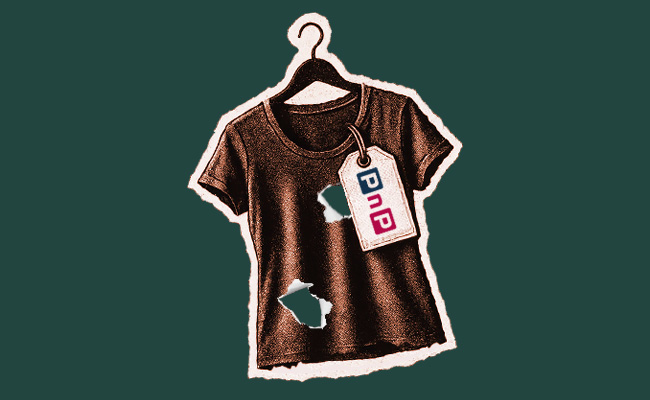

“Saying Pick n Pay is in a bad place is not revolutionary,” Richard Cheesman, fund manager at Urquhart Partners, tells Currency. But for investors, it still stings.
Take this week’s profit warning, in which the retailer warned investors to brace for a full-year headline loss that will be at least 20% worse than a year ago. It was enough of a surprise to slice off a 10th of Pick n Pay’s market cap.
Disturbingly, Pick n Pay Clothing, usually a high performer for the brand, is struggling: like-for-like sales shrank 6.8% in the second half of the 48-week period monitored in the update.
The big question for investors is whether Pick n Pay – under the dogged turnaround efforts of Sean Summers since 2023 – is failing to flay the demons of its own making, or whether the entire retail sector is in far worse shape than anyone thought.
“This is a two-pot hangover,” says Cheesman, referring to the windfall that retailers enjoyed in 2024 when savers were first allowed to withdraw a chunk of money from their pension funds.
Two-pot hangover
“Now it’s out of the base you’re seeing the impact. I don’t think Pick n Pay blew up their clothing business in the last six months – and I think you’ve seen the same kind of numbers with Mr Price and TFG,” he says.
It’s clear that much of the damage took place in the second half of the group’s financial year, with Black Friday – unaided by the two-post boost of 2024 – clearly not delivering the goods. Until the end of August, for example, the growth in Pick n Pay’s clothing business had been 7.5% year on year.
“Across the South African and international retail landscapes, clothing retail broadly is under pressure,” says Umthombo Wealth’s Alexander Duys.
But, he adds, Pick n Pay’s trading update is “a disappointing outcome for investors and a reminder of the difficult task management faces in driving a turnaround amid weak economic conditions”.
Intriguingly, value investing guru John Biccard has taken a large punt on Pick n Pay; the retailer makes up a roughly 5% share in his value fund, and he believes it’s not a Pick n Pay problem but “a market problem”.
“If you’re the weakest player in retail, and there’s a slowdown, you’re going to feel it the most,” the Ninety One portfolio manager tells Currency.
Though the slowdown in growth for Pick n Pay clothing is still concerning, as “they’ve been growing so much quicker than everyone else for years”, Biccard points to the fact that Truworths, Foschini and other clothing retailers are equally taking strain from the sluggish economy.
Overall sales have decreased 3.6% for Truworths in the half-year ended December 2025, driven by a 5.8% fall in cash sales. Its headline earnings per share are down 8% for the full year.
Foschini barely grew, with like-for-like sales rising only 1.2% in the third quarter of its 2026 financial year.
The Shein factor
And then there’s the relentless onslaught from online fast-fashion stores Shein and Temu. “Their rapid rise has reshaped competitive dynamics in the apparel sector, especially in the lower-price fashion segment where local physical retailers like Pick n Pay compete,” says Duys.
According to a 2025 report by the Localisation Support Fund, Shein and Temu collectively achieved R7.3bn in sales in 2024, accounting for 3.6% of the South African retail market and 37% of total online retail sales.
“This rapid growth has come at a notable cost to the local economy,” the fund says, with an estimated R960m lost in local manufacturing sales.
Even Shoprite, “the leader in the sector [which] always does the best, had a significant slowdown over the past two months”, notes Biccard.
Still worth a punt?
Luckily for Pick n Pay, Boxer, in which it maintains a 65.6% stake, is still doing well. The discount retailer grew sales 11.9% in total for the 48 weeks to February 1, and 3.9% on a like-for-like basis.
The difference in performance means that Pick n Pay’s 65.6% stake in Boxer is worth R21bn, while its own market cap is just R16bn.
“When the market value of a business is -R5bn, it basically means that, in perpetuity, Pick n Pay is going to lose money,” says Biccard.
Says Cheesman: “The market is valuing the core Pick n Pay business at less than zero.”
So, should investors throw in the towel? On the contrary, argues Biccard.
“It’s terrible right now, but that’s actually when you buy,” he says. “You have to say: ‘Is there a chance things will get better?’”
Both Cheesman and Biccard are relatively optimistic of a slight upturn in growth, from 1% closer to 2%. Petrol prices are going down, inflation is settling and interest rate cuts will help with consumer debt.
“I lean slightly optimistic here. Pick n Pay is finally taking the tough steps, closing underperforming stores and tackling its cost base,” Cheesman says.
In any case, Pick n Pay has at least two years of cash runway to turn things around, Biccard notes. “I have no doubt that it will go down some more, but then we will just buy some more.”
ALSO READ:
- Pick n Pay’s vibe shift
- A first-half fist-bump for Boxer
- 31-minutes, R18.9bn: Sixty60 is making Shoprite’s numbers sing
Top image: Rawpixel/Currency collage.
Sign up to Currency’s weekly newsletters to receive your own bulletin of weekday news and weekend treats. Register here.






Betwixt golf weekends at Fancourt and public posts about online gambling affecting retail, not sure Sean Summers is anything but window dressing.
Until they do something about the serious bad attitudes of many of their staff, there will be np turn around
Pick n pay clothing walked away from their loyal customers and started chasing a younger market and fast fashion.
Clothing assortment favours females, and no longer feels like a family store.
Gavin rajah collabs, designer colabs – what a joke!! Ugliest clothing and not practical for the everyday.
Pick n pay clothing will NEVER be cool, a top management structure change is needed.
Store layouts, VM looks dated. yuk!!
The rot starts from the top! CHOP CHOP.
PnP sizing has become a huge problem. Before I was buying xl now xxxl doesn’t come near fitting me. I still have large tshirts pure cotton from 20 years ago, but am unable to find clothes that fit in the last year. A very sad customer.