A powerful faction inside the ANC is gaining confidence and pushing hard against President Cyril Ramaphosa’s unity government. Its goal is to move the party away from its partnership with the DA and towards a new coalition with the EFF and the MK Party.
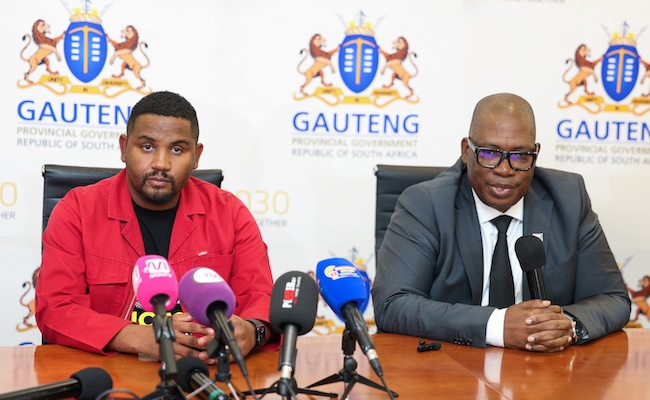
Gauteng premier Panyaza Lesufi brought the EFF into the provincial government by appointing the party’s Gauteng chair, Nkululeko Dunga, as the MEC for finance. This move replaced Lebogang Maile, who was moved to education, adding to a tally of portfolios he has led since 2010, ranging from sports to human settlements.
The new coalition in Gauteng now includes the ANC, EFF, IFP, Patriotic Alliance and Rise Mzansi. Together, they hold a slim majority in the provincial legislature.
Talks are also under way to bring in the MK Party, which would further strengthen this majority left-leaning bloc, and complete the province’s break from the DA.
Deputy President Paul Mashatile has signalled support for broader coalitions with the EFF and the MK Party.
After the 2024 general elections, when the ANC dropped to about 40% of the vote, Ramaphosa formed a government of national unity (GNU) with the DA and other parties to stabilise the country. The aim was to restore investor confidence, rebuild state institutions and grow the economy after years of state capture. But not everyone within the party agreed.
Lesufi rejected working with the DA in Gauteng from the start. Instead, he chose smaller parties and later opened the door to the EFF.
‘Saving South Africa’
Political dynamics in KwaZulu-Natal are shifting as well. The MK Party, which won strong support in that province, believes it should be in government – preferably with the ANC and the EFF. For the ANC, such an arrangement could restore the influence it has lost in the province; for the MK Party, it would mean real power.
Mashatile has added weight to this realignment. Speaking to the media after a Good Friday service at Ellis Park stadium in Joburg, he said the party is willing to work with any group “committed to saving South Africa”. If he becomes party leader at the 2027 conference, such a shift could become policy.
The consequences would be significant. The DA has made clear that it will not share government with the EFF or the MK Party. Party leader John Steenhuisen built the DA’s entire 2024 election campaign around warning voters against a “doomsday” coalition of the ANC, EFF and MK Party – and the party has not softened that position since. If it left, the GNU would lose its majority in parliament, creating acute uncertainty at a moment when South Africa is attempting to recover economically.
Since the GNU’s formation in 2024, the rand has strengthened and bond yields have dropped. After an initial hiccup, National Treasury also pushed through a budget that earned South Africa its first credit rating upgrade in more than 16 years, with S&P citing an improving fiscal trajectory and Eskom’s reform progress – conditions the GNU’s relative stability has helped sustain. A coalition that includes the EFF and the MK Party – both of which support nationalisation and radical land reform – could dent confidence, reverse currency gains and push up borrowing costs.
The risk extends beyond markets. An ANC divided between GNU supporters and opponents could struggle to provide coherent leadership, with knock-on effects across government and the public service.
Labour allies are also shaping the debate. Labour federation Cosatu and the SACP have both criticised the partnership with the DA as a “betrayal” of workers and a shift towards “right-wing” neoliberal politics. This strengthens the hand of those inside the ANC who oppose the unity government.
The anti-GNU faction is no longer marginal. It is shaping decisions in key provinces and building alliances that could define national politics. The real test comes at the ANC’s 2027 conference. If this faction prevails, South Africa could find itself at the start of a very different political era.
Catch more viewpoints from Real Politics at Scrolla.Africa, a mobile-first news site covering breaking stories fast from communities across South Africa, with no paywalls, in English and isiZulu.
ALSO READ:
- Real Politics: Why Ramaphosa has to depend on flawed alliances
- How Malema, the most talented politician of our generation, chose the dark side …
- Zille at 39% for Jozi, ANC voters want Motsepe
Top image: Nkululeko Dunga, the new Gauteng MEC for finance, and Gauteng premier Panyaza Lesufi at Dunga’s swearing-in ceremony on April 2. Picture: Gallo Images/Luba Lesolle.
Sign up to Currency’s weekly newsletters to receive your own bulletin of weekday news and weekend treats. Register here.