Social media is ablaze with white-hot schadenfreude over the apparent demise of the world’s most fêted talk shop, the World Economic Forum (WEF) in Davos. It’s not hard to see why.
The event begins today in earnest in the Swiss Alpine town, and the subject matter is as sanctimonious and worthy as you’d imagine. “How Can We Invest Better in People” is one stream, with panels including “An Honest Conversation on the Hopes and Anxieties of the New Economy”, “Data Against Modern Slavery”, “Radical Stillness” and “The Business Case for Nature”.
Move over quantum computing. Were this a novel, you’d half expect the reviews to breathlessly laud the WEF as an “urgent and powerful voice in global change-making that must be heard”.
Oh, but critically in its quest to tilt against the notion that this is just an elitist talk-shop, it’s also got a wealth of representatives from the Idiocracy too: Donald Trump himself, his treasury secretary Scott Bessent and secretary of state Marco Rubio will be there, as will “urgent and powerful new voices in authoritarianism” like Argentina’s President Javier Milei.
In other words, no longer is Davos the exclusive home of the “woke banks” and “lab-grown meat”, as the creepy Florida governor Ron DeSantis put it. With all those populists in tow, you’d almost be forgiven for thinking that Davos wasn’t finished.
Until, of course, you remember that Trump is the headline act of a gathering whose raison d’être is globalisation and liberalised trade – the very concepts against which he has railed. How, in other words, do you square this year’s event against its 56 predecessors without invoking a Dallas-style “Well, I guess we were all dreaming for those five decades” trope.
Davos decoded
Certainly, Davos’s authority is unlikely to be enhanced this year. When you’re reminded of all the earnest handwringing over recent years, reiterating the quaint importance of nice-to-haves like free trade and international law, and then you consider where we are, it becomes clear this is nothing less than an expensive junket for egotistical CEOs, with handy TV exposure.
What to do, then, but mock it mercilessly. On this front, the Financial Times published a fantastic guide on how to interpret the windy ruminations of the Davos attendees.
So, when someone says “My sense is that leaders are ready to deliver the benefits of this reimagined moment”, what they’re trying to say is “I work for McKinsey”.
When they say “In a change to our previous schedule, the president will be joining us by video link”, what they’re really saying is “He was worried about being abducted by US special forces”. And when they say “President Trump set out an innovative vision for America’s relations with fast-growing economies”, what they really mean is “The president gave a rambling speech in which he appeared to confuse Cameroon and Cambodia”.
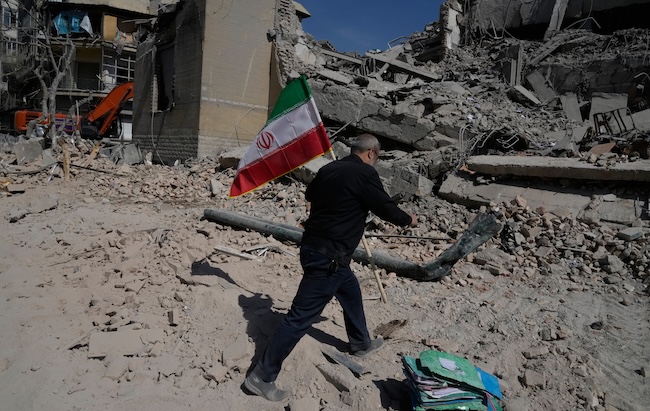
All of which shows how Davos fits neatly into the category of events for which the utility has been, at best, hugely overstated. Think the World Trade Organisation, the G20 or the UN, immobile as Trump tries to gobble Greenland as if the country were a prize corner shop in a competing mob district, and as Iran’s brutish Ayatollah Ali Khamenei mows down 5,000 citizens.
A shape-shifting fiction
The New York Times was on the mark when it spoke of the conceit that Davos is in any way able to carry through on its mission of improving the state of the world. “People with the greatest stake in the status quo – billionaire executives who run the largest banks and technology companies – are cast as change agents, uniting with world leaders to pursue the betterment of humanity,” it wrote.
If you’re looking for a sign of just how “bravely” the WEF aims to tackle the “state of the world”, consider that for the first time in ages, its press release announcing the event noticeably failed to mention climate change or the energy transition. “Buzzwords that once got a strenuous workout – fair taxation, anti-corruption, sustainability and social justice – were largely absent from the forum’s official pronouncements,” the newspaper said.
This is why, on social media platforms, normal people are revelling in this forum being exposed for the shape-shifting fiction it really is, bereft of ideological coherence.
Which doesn’t mean, of course, that there won’t be sprinklings of intriguing conversations, snappy quotes, and the illusion of epiphany. You’ll be able to hear Nvidia’s Jensen Huang and Microsoft’s Satya Nadella on the potential of AI, for example, even as Oxfam provides sad but immoveable new statistics on global inequality.
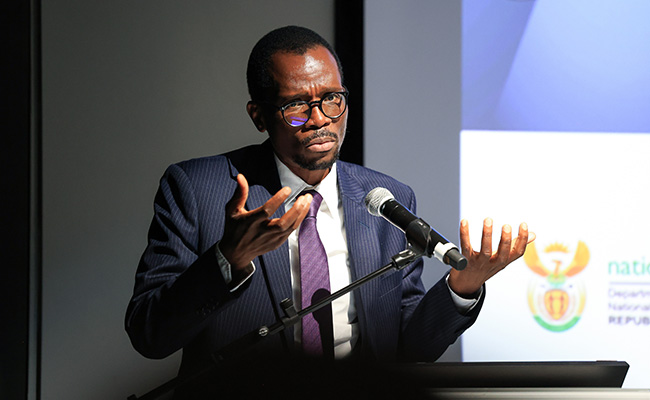
South Africa’s own delegation, including finance minister Enoch Godongwana and others who pitch to sell the country to the sceptical allocators of capital and attention-deficit survivors, will do their best to underscore the importance of the event. Trump himself, no apprentice to the spotlight, will ensure it is headline worthy.
Just don’t expect ideological coherence or progress. Davos always has been about overpriced sandwiches, and self-deception. It’s just that the veil has slipped so far that you’re able to see BlackRock’s tatty underwear.
ALSO READ:
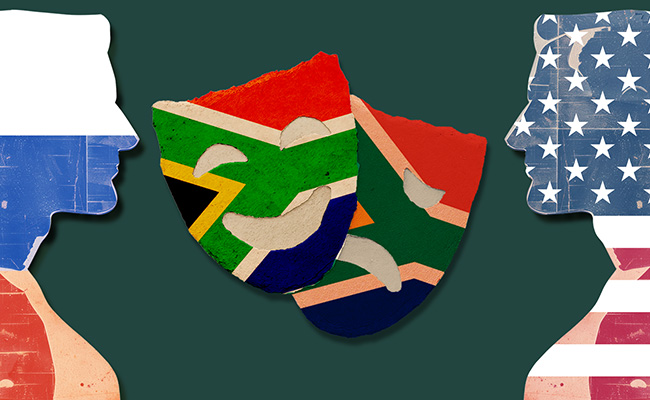
Top image: Rawpixel/Currency collage.
EMAILS AWOL? HAVE YOU CHECKED YOUR SPAM?