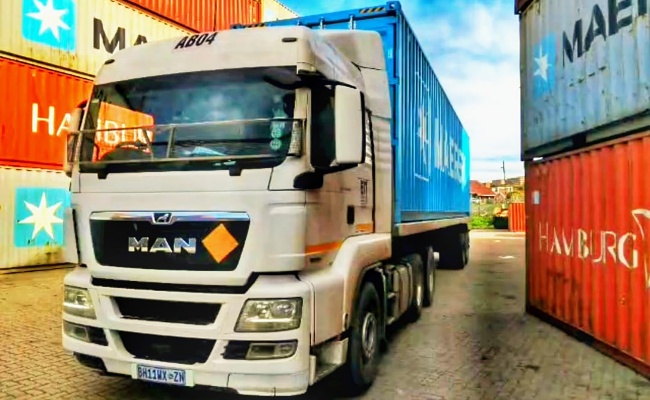

KwaZulu-Natal’s best kept secret – a fully operational intermodal freight village modeled on highly successful European facilities – is not only already addressing the inefficiencies and congestion along South Africa’s busiest road freight corridor, but is on the brink of expanding into a multibillion-rand operation that will cut costs and increase competitiveness for local exporters and importers.
Strategically located in the small town of Estcourt, the c represents a long-overdue marriage between road and rail that addresses two of South Africa’s largest logistics conundrums: an inefficient and rundown rail network (expected to take more than 10 years to repair at a cost of about R80bn) and an ever growing army of trucks that are not only a safety hazard but damaging road infrastructure.
Right now, about 7,000 trucks operate on the Durban-Gauteng freight corridor daily, moving about 27.5-million tons of road freight annually. Road transport accounts for more than 85% of all freight moved along this vital economic link, with rail accounting for less than 14%.
‘Not pie-in-the-sky’
The Estcourt EIT Freight Village is the first of its kind in South Africa and, according to EIT Group chief executive Wessel Jacobs, it reflects the value of taking action while others are locked in planning. The proposed Cato Ridge inland port has been on the drawing board for decades, while the recently announced Gauteng inland port is still at feasibility stage.
“Our freight village is fully operational. It’s not a pie in the sky dream. We are actually running trains and trucks in and out of here. We’ve been operating for 18 months. We didn’t want to make a big noise until we were happy that all was fully functional. We acquired the old masonite board manufacturing facility in 2023 and repurposed it into a freight village. It was the perfect facility because it already had a rail line connection, so we didn’t have to install one and get rail safety regulator approvals which can be very cumbersome,” explains Jacobs.
The model is to truck cargo between Joburg and Estcourt and switch to rail for the remaining 180km between Estcourt and South Africa’s busiest container port in Durban. It is this stretch that adds the most cost, delays and congestion, accounting for up to 50% of the overall transport outlay between Gauteng and Durban.
EIT’s first test train ran in November 2023, and operations officially began in March 2024. Negotiations with Transnet Freight Rail delivered three slots to run trains on the main line to Durban each week with well-advanced plans to increase this to three trains daily in the near future.
“We have finished phase one, which was the proof-of-concept phase. We are now moving on to further expansion plans. We are going to enlarge terminal one. We’ve also taken an option to expand to the other side of the rail line. This will provide a 500-hectare site on which we will build a second terminal. We want to use terminal one for clean cargo and terminal two for minerals and other dirty cargo,” he adds.
Mitigating the impact of trade tariffs
Perhaps the most critical aspect of these expansion plans is that Jacobs and EIT Group chief financial officer Manka Sebastian see it as the first of a number of freight hubs that will be run by the company, as well as an important link in a chain of both privately and publicly owned freight villages that will ultimately make South African companies more competitive both regionally and internationally.
“When you look at Europe, transport costs make up 10% of imports and 8% of exports. In Asia, logistics accounts for 19% of imports and 16% of exports. In Africa, 45% of our import costs come from transport and 35% of our export costs do too. If we now play our part and make logistics between 30% and 50% more cost efficient, we could nullify the punitive tariffs imposed by the Trump administration,” Sebastian points out.
She adds that she does not believe that the different inland ports that will ultimately emerge along key freight transport corridors will be cannibalistic. Instead, they will support each other, creating a network of freight hubs that will work best when they work together.
Jacobs agrees that terminals will not compete with each other: “We can refer customers to various freight villages. We can work off the same shared platform. In Europe, there are quite a few. One group runs over 40 of these terminals doing over seven trillion tons of cargo a year. What this achieved in Eastern Europe could be achieved here. We are well on the way to redesigning the local logistics landscape.”
Sign up to Currency’s weekly newsletters to receive your own bulletin of weekday news and weekend treats. Register here.