
The first thing Sanell Aggenbach and I discuss in her serene Woodstock studio, as soft early autumn light warms the space, is whether the British or American version of The Rest is Politics podcast is better.
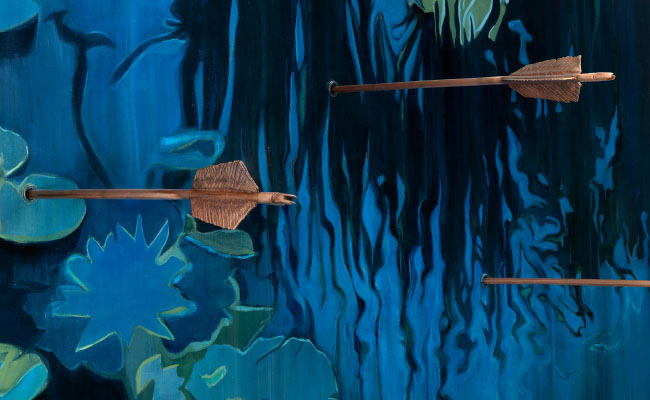
We’re standing in front of her glorious new painting of waterlilies. The modern Monet-esque scene is pierced by metal arrows, which the artist is attaching as we talk.
A conversation about Tory politician-turned-media personality Rory Stewart and his Stateside counterpart Anthony Scaramucci is perhaps not how you’d expect a discussion of her work to begin. (For the record, Aggenbach gives the US version her vote.) But, and this may surprise those less familiar with the acclaimed Cape Town artist’s practise, global politics, opinion and news is never far from the surface of her work. The real world always seeps through her paintings of mid-century ikebana and sculptures of bananas.
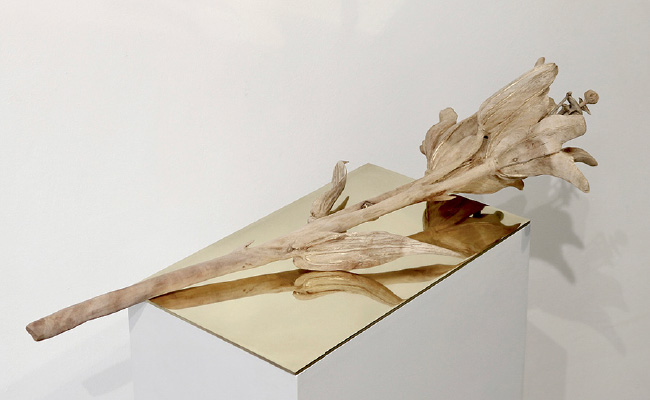
And now for the news
Aggenbach is, by her own admission, a news junkie. Podcasts play constantly in the background of her studio; global events filter in almost by osmosis. “What’s happening … comes through in my work tremendously,” she says.
And right now, there is a lot to absorb.
She speaks openly about the sense of global instability. The Trump era and its aftershocks, the erosion of press freedom, the unsettling rise of competing narratives of truth. They’re a constant low-frequency hum beneath her life and work.
Spend time with this new body of work on display for NeoNature, her solo show that’s just opened at Everard Read Joburg, and that undercurrent begins to surface.
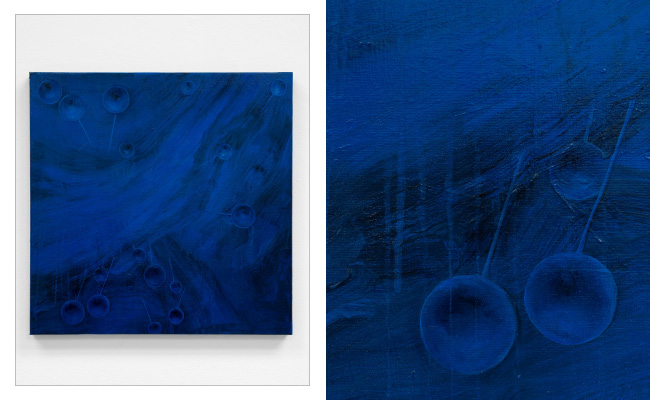
At first glance it’s seductive stuff: all blues and aquas and curving botanical forms. But look again, and something is off. Beauty is interrupted, even violated, and scenes are unsettled. That painting of the pristine 1960s flower arrangement looks more like a jarring negative image than the real thing.
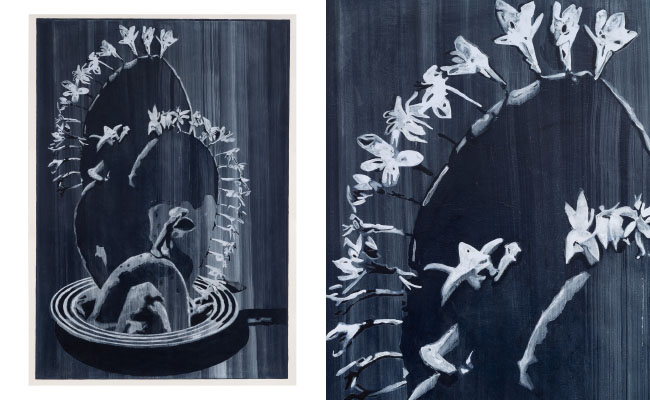
Tell us the truth
Aggenbach has long drawn on art history. Here, the lily pond motif nods gently towards the impressionist marvel Water Lilies – but she is less interested in homage than in disruption.
“I wanted to do something that invited some form of conflict into an idyllic setting. And I could not have foreseen that this was going to be during a war that [I] would be showing these works,” she explains.
Those small ruptures – like the arrows through a canvas, unnatural colour and forms that don’t quite behave – begin to echo something much larger. This is work preoccupied with the instability of truth: how it is constructed, manipulated and, increasingly, doubted.
This anxiety extends too, to the present moment in image-making itself. The rise of AI hovers in the background, impossible to ignore.
“Manipulation has become part of how we consume images, so much so that when anyone sends anything, you first ask: ‘Is this AI? Is it real? Is it truth?’ What level of truth are we at when we consume or see these images?” she says.
It’s particularly a clear and present challenge to people in her field, and it’s a topic that runs neatly alongside her reading of and reference to ancient Roman author Pliny the Elder. His writings on the natural world famously blurred the line between observation and myth.
“He would look at scientific things … and then also draw from myths … and write them down as fact,” Aggenbach says.
Then, as now, reality was something cobbled together – part evidence, part belief, part storytelling. It’s less about truth versus fiction, and more about the coexistence of both. Parallel realities, each convincing in their own way.
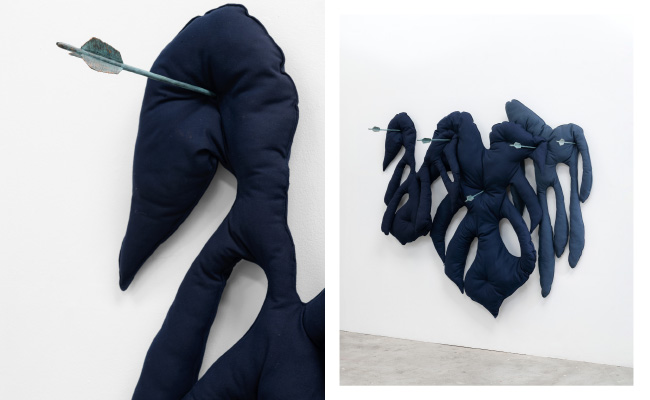
Visual distortion
Visually, tension plays out across deliberately varied materials. Paintings sit alongside sculpture, photography and soft textile works. Botanical imagery runs through them all, but is constantly being manipulated, inverted, distorted and reimagined.
“The botanic is where it starts,” she says, “and then how does one manipulate it and take it into a different story?”
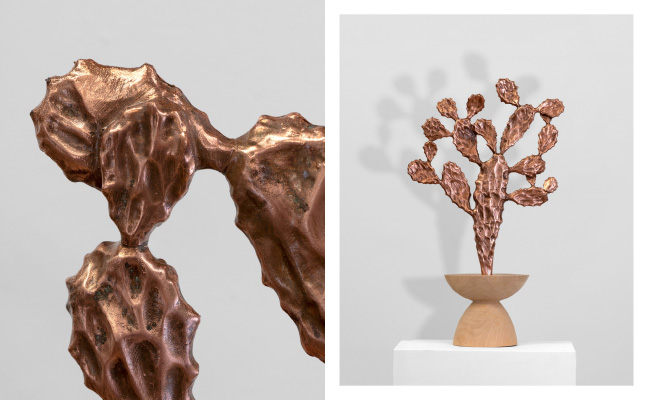
There is also a persistent push and pull between the organic and the artificial. Wooden plant forms are plated in copper and oxide, creating what she describes as “a different skin … a strange mix of futuristic and botanical”.
Colour, too, refuses to behave. Aggenbach has returned to her signature blue – “my default colour” – but here it is heightened and slightly surreal. The inky hues, the high-shine metallics, “none of them look like natural colours”, she notes.
Dynamic tension
And yet, for all of this – the politics and dread included – the work retains a strange sense of calm and softness (large, squishy softness, to be exact).
“I find it very soothing,” she says of her creation process. “It’s my way of thinking, my kind of therapy.”
Which may be why this body of new work is so appealing. It’s not raging about the state of the world in shouty headlines and outrage in “all caps”. Rather, its beauty, allure and technical sophistication mean you can easily imagine one of the Aggenbachs on a wall in your home.
For those of us equally hooked on the news cycle, this lands like arrows in the bullseye. Beneath the cool, beguiling surface is a considered and clever absorption and interpretation of a crazy damned world.
‘NeoNature’ runs at Everard Read Joburg from April 9-May 3.
ALSO READ:
- Eight questions for the interested and interesting: Sanell Aggenbach
- Word! Inside CIRCA Gallery’s new group show
- Alma Thomas, NASA and the legacy of space art
Top image: Neo Nature, 2021. Picture: supplied.
Sign up to Currency’s weekly newsletters to receive your own bulletin of weekday news and weekend treats. Register here.