

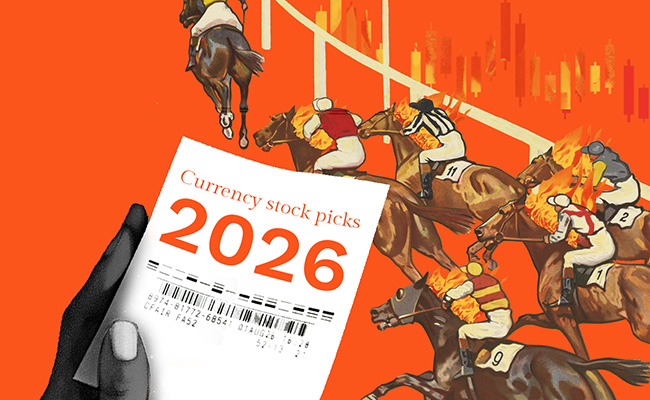

The Chinese calendar, that great celestial prankster, has declared 2026 the Year of the Horse, which is either a profound insight into the coming shape of global markets or merely an excuse to deploy an overworked metaphor until it whinnies for mercy. Still, markets love symbolism almost as much as they love pretending not to, and so here we are, brushing down the stable door and peering inside to see what sort of beast is likely to emerge at the starting gate.
These are our local stock picks for 2026: we have decided once again to split our predictions into South African, international and wild cards, which you can read here and here.
For the staff of Currency, 2026 is a particular dilemma because last year’s portfolio outperformed ridiculously, returning 44% over the year. We thrashed the global index, the S&P 500, the JSE all share and the Magnificent Seven, so we have an absurdly high bar to jump over this year. We were hardly alone in being amazed at the stock market returns for the year; we entered 2025 very cautiously and ended it elated.
In any event, our wild cards are our “bucking broncos”, since they are inclined to fling off overconfident riders with an air of moral superiority, even though for Currency staff, they were the best performers of our three categories; such are the vagaries of high-risk investing. Our international stocks might well be described as “thoroughbreds” for their overall tendency to be expensive, bred for speed, generally admired from a respectful distance. Yet they too showed their mettle in 2025, so perhaps they will again?
Bred for speed
How do you describe the South African category in terms of our analogy? It’s so hard. Show ponies: immaculately groomed, endlessly photographed, but fundamentally decorative? And yet last year they outpaced almost everyone and everything. Perhaps the more accurate horse breed would be saddle horses, bred for high speed in short bursts to keep the herd under control. Not that they typically do in South Africa.
Warren Buffett, who has spent a lifetime reminding us not to bet on animals we do not understand, once remarked that markets exist to transfer money from the impatient to the patient. In horse terms, that is the difference between backing the jittery favourite at odds that imply immortality, and sticking with the slightly dull gelding that finishes every race. Howard Marks, another connoisseur of restraint, likes to say that cycles are not defeated by enthusiasm. Horses, too, do not respond well to shouting.
Sensible as it may be, this is not our approach. We are looking for one-year winners, so please don’t take these suggestions as investment advice. But in one sense, 2026 will be appropriate for our analogy, if investment advisers are to be believed. It will, almost without question, be a year of uneven terrain, and it’s a racing certainty that some horses are going to be badly tripped up. The US may yet canter. China may stumble, then trot, then rear unexpectedly. Europe will plod, nobly. Emerging markets will buck. Occasionally violently. Crypto will neigh from the sidelines. Loudly.
This will be a year for checking the saddle, tightening the girth, and asking a very old question: is this animal built to run, or merely to be admired? Hang on, it’s going to be a “rode hard and put up wet” kinda year.
Without further ado, here is our local selection:
Absa (ABG: JSE)
“The banks look cheap” is a refrain that regularly pops up. We hear it so often because the sector seems perpetually priced for a weak South African economy, political missteps and the next global shock. Yet the domestic recovery is finally inching forward and – if Trump doesn’t knock the world off course – the big lenders should see more customer transactions, stronger deal flow, firmer credit demand and better asset quality, even as rate cuts gradually squeeze lending margins.
Absa’s appeal lies in its re-energised leadership plus a valuation that still reflects some investor scepticism. Kenny Fihla took over as Absa CEO in June 2025 after being poached from Standard Bank, where he helped build a formidable corporate and investment bank.
He moved quickly after taking the hot seat, signalling a focus on regaining momentum in South Africa through improved customer service and pushing harder into the rest of the continent.
Absa trades at roughly eight times forward earnings and about 1.23 times price to net asset value (NAV), with a dividend yield of about 6.35%, according to data on Moneyweb’s website. Standard Bank and FirstRand command higher price-to-book multiples – roughly 1.85 and 2.34 times – reflecting steadier track records. If Absa starts delivering, that valuation gap can narrow. Nedbank is also cheaply priced, but seems to lack any significant spark for a rerating. Vernon Wessels
Anglo Teck (AGL: JSE)
It’s a tediously boring pick, I know, but this is not the Anglo American of 2024. It’s not even the Anglo of 2025.
This is a company that, thanks to CEO Duncan Wanblad, has pivoted sharply to become perhaps the most exciting copper prospect globally. Copper, the red metal required to build the data centres underpinning AI, is all the rage right now in mining circles, and was a central justification for Anglo American’s merger with Canada’s Teck Resources.
As analysts at SBG Securities put it, Anglo Teck will be “highly exposed to the very compelling copper theme” and, “on all measures, Anglo Teck will be the ‘go-to’ and in effect, becomes one of the world’s pure play copper [companies]” – a radical overhaul from its previous status as a ho-hum diversified miner.
The copper price has risen 37% in a year, and demand is thumping. This week, consultancy S&P Global warned of a looming copper shortage of 10-million tons – a third of global demand right now – that could pose a “systemic risk” to global growth. Demand for copper to be used in data centres is set to grow from 1.1-million tons to 2.5-million tons by 2040, it said.
Now, Anglo’s share price has risen by 24% over a year, but the prospect of a special dividend at the end of its 2026 financial year, and the breathless copper forecasts have breathed new life into a once-moribund company. Rob Rose
Purple Group (PPE: JSE)
This should have been my local pick last year and, in truth, I did spend actual money on it in my own real-life portfolio: Purple Group, the owner of the increasingly financially robust EasyEquities platform.
The shares doubled in value last year, after starting 2025 at 108c. On Friday they closed at 240c, a jump of more than 6% this year already, so maybe any further spectacular gains are truly wishful thinking.
Yet I am happy to own a company where the economics of scale and effort are so demonstrably working, not to mention the broader good it has pulled off in truly making share investing cheap and accessible to anyone. If it does the same thing in the Philippines, which now looks tantalisingly a real prospect after a fraught and fitful start, then the potential for growth is vast. Purple has also paid its school fees and so, hopefully, is sharper and wiser in this new venture. I can’t but think that it may be a takeover target, too. Giulietta Talevi
Resilient Reit (JSE: RES)
South Africa’s property sector really shone last year, and its investment case is obvious and logical; property stocks shine in periods of interest rate cuts. After languishing for so long, property stocks had a lot of catching up to do, and last year they did it in spades, with the major players in the sector up 35% on average. Since more interest rate cuts are likely this year, even though they are unlikely to be as significant, why not stay with a winning horse?
I’m going to stick with Resilient Reit, though many of the other players are as good, on the basis that it declared a dividend of 12.2% in June last year, which is frankly thumping. People forget how much the end of load-shedding helps property companies, and how meaningful self-supply of power, now all in place, is a defence against administered-price increases. Tim Cohen
Richemont (CFR: JSE)
Richemont is my emotional and sensible pick. Luxury and pleasure are core Currency beats, and as a devoted admirer of high jewellery, this is as close as the stock market gets to owning Cartier jewelled cats and Van Cleef zip necklaces.
It also fits our Year of the Horse theme rather beautifully, as the Ruperts are one of South Africa’s great horse families, and Richemont is all about discipline, heritage and playing the long game. This is my safe harbour: elegant and global. Sarah Buitendach
Shoprite Holdings (SHP: JSE)
Shoprite continues to demonstrate why it remains South Africa’s most profitable food retailer. From the R5 meals at Shoprite and Usave – a critical lifeline for low-income consumers – to its value-driven loyalty programme and the market-leading Checkers Sixty60 delivery service, the company’s execution remains unmatched.
Despite stiff competition, including from the likes of global giant Walmart, Shoprite is still a juggernaut in the sector: for the full year to end-June, its revenue topped R250bn, a gain of 8.6%, and it parlayed that into a headline earnings increase of 15.8%.
On the negative side, the group’s November sales update was a bit of a worry – coming in just below 8%, which the market took as evidence that sales are going backwards; that would certainly appear the case given that sales were still in double digits in 2024.
Its shares, like most South African retailers, had a year to forget. But its commitment to affordability and its extensive national store footprint mean a hugely loyal customer base. If there is a whiff of better-than-expected GDP growth this year, Shoprite should benefit. Nelisiwe Shomang
… and the one to actively avoid: Truworths (TRU: JSE)
Fairtree Asset Management is a savvy operator so you have to wonder why in heavens name did it recently build up a 10.11% stake in Truworths.
Fairtree isn’t on the most recent (end-June 2025) list of investors holding at least a 3% of the company, which means most of the 10.11% stake was acquired after a grim trading update covering the 18 weeks to early November. The stake makes Fairtree the second-largest investor, after the Public Investment Corporation, which has 18.9%.
Does Fairtree know something the rest of the market doesn’t know, or does it have a plan? And if it has a plan, does it include a role for CEO Michael Mark?
Mark has been critical to Truworths’ fortunes ever since it was unbundled out of Wooltru back in the early 90s. He was CEO at the time and remarkably, 36 years later, is still CEO. For much of that time Truworths did well. However, there have been lots of times it performed poorly – mostly in recent years. It really is time for him to move on.
The problem is his departure will inevitably leave a vacuum. There’s some suggestion this could be resolved by Mark assuming a consulting role with the group after he retires. This is the management equivalent of taking a few shots of whiskey to sort out a hangover.
A related issue is that Mark has dominated management for so long it’s difficult to imagine that any of the top layer of executives would be able to function effectively in an independent role.
But without a change of CEO Truworths is likely to continue to underperform, which makes it a share to avoid in 2026. Unless of course Fairtree has a plan. Ann Crotty
ALSO READ:
Top image: Rawpixel/Currency collage.
Sign up to Currency’s weekly newsletters to receive your own bulletin of weekday news and weekend treats. Register here.







Sanlam owns 30% of EasyEquities. With PPE, Insiders own around 14%, and retail investors own around 49% ….. How would a takeover happen?