
In August 2021, Sim Tshabalala set new targets for Standard Bank from the wreckage of a pandemic. On Thursday, he reiterated another against the backdrop of war in the Middle East, a volatile oil market, and a world that looks far less predictable than it did even a month ago.
Whether he hits them this time may do more than shape Standard Bank’s next three years – it may define the final chapter of his tenure before he is expected to retire towards the end of 2027.
Tshabalala has earned the right to ask investors for patience. Standard Bank comfortably met the 2021-2025 objectives. Last year, headline earnings rose 11% to R49.2bn, return on equity improved to 19.3%, near the upper end of its target, while the dividend payout ratio reached 56%, compared with a goal of 45%-60%.
The new targets, first outlined in March 2025 and reiterated at Standard Bank’s results presentation on Thursday, are for headline earnings per share to grow at a compound annual rate of 8%-12% until 2028, with return on equity within a range of 18%-22%.
The bank says it expects revenue growth from fees in the mid to high single digits in 2026, a slightly lower cost-to-income ratio, and a return on equity above that achieved in 2025. It warned, though, that an escalation in the conflict involving Iran could affect the macro assumptions underpinning that guidance – sentiment, trade, inflation and growth.
“It is too early to be definitive about what the impact is,” he tells Currency. “We are working through the various scenarios and will position ourselves accordingly.”
The benign one sees a 1.5-million-barrel-per-day supply disruption, with prices settling at about $80 and global growth shaved by 0.2 percentage points. The severe one: a 3.5-million-barrel-per-day shock, prices above $100, and a 0.6-percentage-point hit to global GDP – a number that would cut through South Africa’s fuel-import-dependent economy.
The problem for Standard – as with everyone else – is that “you can’t say with confidence that it’s going to be one or the other”, Tshabalala adds.
A small hedge on oil
Higher oil prices would hurt importers such as South Africa and parts of East Africa, but benefit exporters such as Angola and Nigeria, where the bank also has strong businesses. A sustained $10 rise over a full year would trim South African growth by about 20 basis points – and if it feeds into inflation, it delays Reserve Bank rate cuts. Standard Bank economists had anticipated three reductions totalling 75 basis points in 2026, but have already revised that to two cuts, in May and in the second half of the year, with a third pushed out to early 2027. South Africa accounts for 51% of group earnings, so any shift in the growth outlook carries outsized weight.
Yet with operations across 21 countries and four distinct business lines – from personal banking and insurance to corporate banking and infrastructure finance – the group also has some structural capacity to “stomach shocks”, as Tshabalala puts it.
“Given the diversification benefits of the Standard Bank portfolio, it should weather any adverse impacts from the ongoing volatility associated with the Middle East,” says Radebe Sipamla, portfolio manager at Mergence Asset Management. However, if higher oil prices weaken some African sovereigns by pushing up inflation and slowing growth, that could hurt local currencies and reduce the rand value of earnings from the group’s rest-of-Africa operations.
“The scale and geographic diversification of the Standard Bank portfolio will be extremely difficult for any competitor to replicate and will continue to place Standard Bank miles ahead of its peers across the continent,” Sipamla says.
There is one place, though, where Standard Bank would like a bigger foothold: East Africa.
In 2025, East Africa generated R4.7bn in headline earnings – the smallest of the group’s three Africa Regions clusters, well below West Africa’s R7.5bn, and South and Central Africa’s R7.4bn.
East Africa is “consistently the fastest growing region in Africa”, Tshabalala explains, and the East African Community is becoming an increasingly integrated economic bloc.
He is quick to point out that Standard Bank owns Uganda’s largest bank and has operations in Kenya, Tanzania and South Sudan. The group has consistently emphasised that it is comfortable with organic growth, and that acquisitions will remain opportunistic and subject to strict capital-allocation rules.
Sipamla says Standard Bank has become more disciplined in how it allocates capital and less tolerant of underperforming businesses, fraud and IT failures. If that continues, the valuation gap with FirstRand – South Africa’s most profitable bank by return on equity – could begin to close.
“These results highlight that the valuation premium on price-to-book value that FirstRand has historically commanded over Standard Bank will likely narrow as it continues to deliver higher returns that are increasingly converging towards FirstRand,” he adds.
Before running through the numbers, Tshabalala opened with a VIX chart – a benchmark used to illustrate market volatility – tracking from 2020 to this week, with the latest spike labelled simply: the Middle East conflict.

“We announced our targets in the aftermath of the most disruptive and uncertain period in living memory,” he said, referring to goals the lender set in August 2021 for 2025. “Things have hardly been quiet since then.”
Still, the results give the bank a strong platform. Insurance and asset management – which includes the Liberty business the bank took full control of in 2022 – was the fastest-growing division, with earnings up 26% to R4.1bn. Africa Regions grew 9%, contributing R19.7bn, or 40% of group earnings. The corporate and investment banking unit grew earnings 18% to R24.1bn, benefiting from financing energy and infrastructure projects across the continent, and from strong trading activity driven by clients hedging currency and commodity risk. Credit charges rose from a low base.
The business and commercial banking division had a harder time of it as lower interest rates compressed margins. Growth in card payments and digital transactions helped, but not enough to fully offset the squeeze. Personal and private banking, which handles home loans, car finance and everyday banking for individuals, grew earnings a modest 3% to R11.4bn. Mortgage payouts rose 11%, and new car lending recovered as rates eased – but the interest income on those books eased in line with lower borrowing costs.
“As things stand, we see no reason to modify our commitments and our targets,” Tshabalala told investors, analysts and journalists. He has proved he can set goals in a crisis and deliver on them. His final challenge, ahead of his expected retirement, is to do it again – but in a far more fraught world.
ALSO READ:
- Why Standard Bank is betting big on the Middle East
- Sim Tshabalala: Two years left to hit Standard’s targets
- The bank deal that isn’t. Really. But what if …?
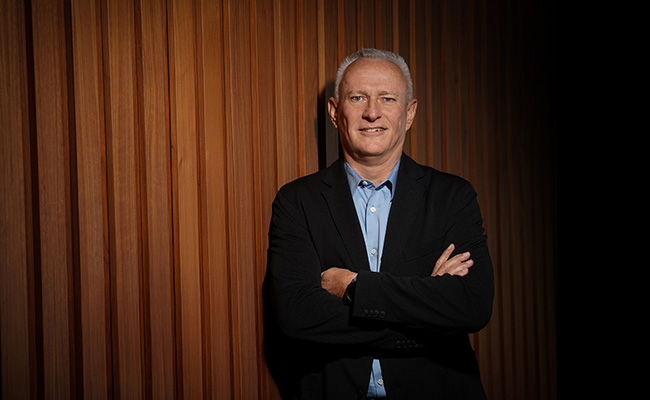
Top image: Standard Bank CEO Sim Tshabalala. Picture: supplied.
Sign up to Currency’s weekly newsletters to receive your own bulletin of weekday news and weekend treats. Register here.