
Dawie Groenewald – convicted in the US in 2010 for smuggling a leopard skin into the country, and facing 1,600 charges in South Africa related to rhino poaching, trafficking, racketeering and money-laundering – has been ordered to leave a lucrative trophy-hunting concession in Botswana’s Okavango Delta by the community whose ancestral land it is.
The San’s ultimatum came after it emerged that Groenewald had been operating on the concession near Shakawe since October 2024 without consulting the roughly 2,500 San residents of Tobere. A Botswana High Court order, issued in November, had already told his company – DK Superior (Pty) Ltd, registered in Polokwane – to cease hunting and vacate. Groenewald is ignoring that, too.
Asked for his response, he shifts responsibility. “All these problems and stupid resolutions are Leon’s work,” he says in an online interview, blaming Leon Zille, the director of rival operator Old Man’s Pan, whose lease was terminated to make way for his own. “But let’s wait, get the popcorn and watch the movie. Just wait and see.”
The dispute is the latest chapter in a saga that Currency has been following since January, when it reported that the community had accused Groenewald of allegedly using the political influence of former Botswana justice minister Machana Ronald Shamukuni to secure the concession over the objections of community members who cited his criminal record.
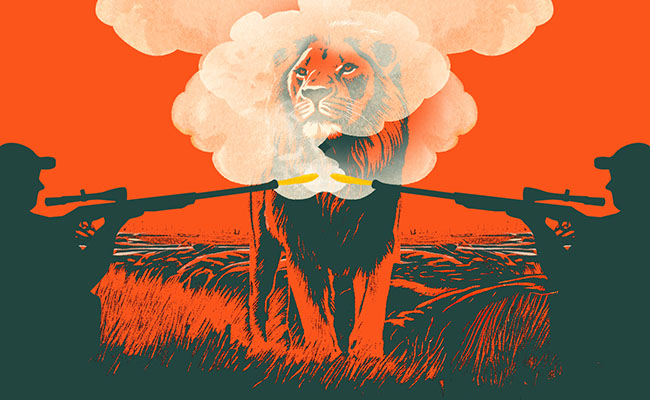
Set deep in the Okavango, the NG13 concession has a hunting quota that includes lions, leopards, buffalo and 25 elephants – with elephant hunts marketed at about $90,000 per kill. For a remote community where formal employment is scarce, it is one of the few significant income streams tied to the land. That community has now gone two consecutive seasons – 2024 and 2025 – without receiving the benefits it is owed.
A ‘provocation’
In February, the Tcheku Community Trust – which holds the concession on behalf of Tobere residents – convened a special general meeting, elected a new board, and issued an unambiguous demand.
“His presence is a provocation and a direct challenge to our resolutions,” reads a copy of the meeting’s resolutions obtained by Currency, seemingly confirming that Groenewald had remained on the concession without the community’s consent or authority.
The new board accuses him of far more than withholding payments. The resolutions allege that Groenewald imposed preferred candidates on the community board, manipulated trust structures to secure decisions in his favour, and funded lawsuits against board members who refused to do his bidding – all to maintain his grip on the concession and block an arbitration process that could restore Old Man’s Pan’s rights or secure it compensation.
The trust also warns that fresh legal challenges are being prepared from within the community, funded by unnamed parties “operating behind the scenes”, aimed at returning it to a state of paralysis and derailing the arbitration process before it can begin.
Efforts to obtain comment from Botswana’s environment and tourism minister, Wynter Mmolotsi, were unsuccessful.
The clock is ticking
The 2026 hunting season has not yet begun – which means Groenewald’s eviction, if enforced, would arrive at the worst possible moment for him and the most opportune for the community.
If he vacates, the hunting quota reverts automatically to its rightful owners: the Tcheku Community Trust. The new board has already resolved to reallocate it to Old Man’s Pan, which would, for the first time, give the company a clean, board-sanctioned mandate to operate NG13.
Zille dismisses Groenewald’s counter-accusations as false and says he is ready to proceed. “Groenewald is misinformed to think he will ever hunt on the NG13 again,” he tells Currency. “The arbitration process will bring clarity.”
He reserves his sharpest words for the officials who are supposed to be refereeing the dispute: “They are not attending to community concerns, probably because they are too conflicted and have questionable personal relationships with the same hunters they are supposed to be regulating.”
If Groenewald is still on the land when the 2026 season opens, a third consecutive season without community benefits may follow. The new board has said it will request intervention from the UN special rapporteur on the rights of indigenous peoples if the government moves to undermine its decisions.
Groenewald, for his part, says he is going nowhere.
ALSO READ:
Top image: Jan van der Wolf/Pexels; Rawpixel/Currency collage.
Sign up to Currency’s weekly newsletters to receive your own bulletin of weekday news and weekend treats. Register here.