

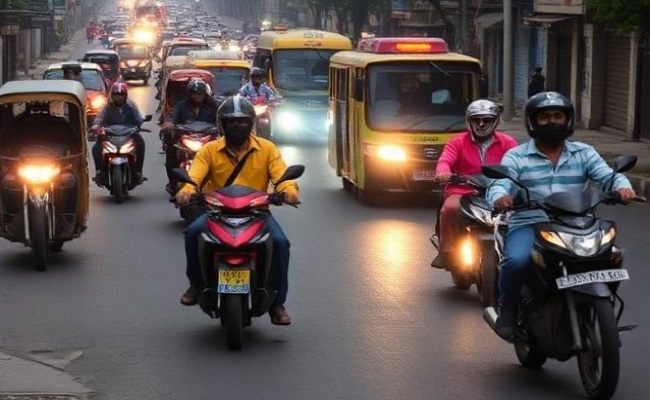

The first time you face a major junction in an Indian city at rush hour, your brain protests.
Pedestrians, bicycles, scooters, rickshaws, cars, trucks, buses, and the occasional cow, goat and dog all move at once, often inches apart. Horns blur into a continuous soundtrack. Lane markings are suggestions. Indicators, if used, are aspirational. From a distance, it looks less like a transport system and more like improvisation with consequences.
And yet, it moves.
Not perfectly – India’s accident statistics are sobering – but far better than the surface chaos would suggest. Underneath, there is a kind of rough choreography: a self-organising system that somehow avoids gridlock most of the time.
For leaders and strategists, this can be more than a travel anecdote. It can be a vivid metaphor for the environments many organisations now inhabit: dense, volatile, politically messy, digitally accelerated and full of actors who follow rules selectively. In other words, Indian traffic is a live tutorial in complexity.
So what can this teach us about strategy and leadership?
The motorway fallacy
Most mainstream strategy tools were conceived in contexts that look more like a well-regulated motorway than an Indian intersection. They assume stable, enforced rules, predictable behaviour, lean separation of formal and informal and linear planning: set a three- to five-year direction, cascade targets, expect convergence. Only that’s not how it works in a complex world.
The real world is increasingly more like the Indian traffic. Drivers and riders operate in a state of ongoing, acute vigilance. Every move is based on small signals – a change in speed, a tiny wheel angle, a glance in the mirror, a horn pattern. Very little is decided by formal signals alone. Progress is made through thousands of micro-negotiations and the overall “flow” is the emergent outcome of these tiny bargains.
While rules, road markings and traffic lights exist, they coexist with, and are often overridden by, informal norms. In this context, rules are treated as contextual, to be interpreted rather than obeyed literally. There is a culture of jugaad: inventive workarounds to get through today’s constraints. And because behaviour is only loosely rule-bound, people carry low expectations of predictability and compensate accordingly.
To outsiders it looks random; to insiders it is patterned enough to be navigable.
Lastly, formal enforcement on Indian roads is patchy. Real consequences are mostly social and physical: embarrassment, anger, damage, injury. The feedback loop is direct and embodied. Misjudge a gap, and you feel it in steel and bone. Over time, this produces drivers who are, in a peculiar sense, highly skilled at surviving the very conditions that make the system dangerous.
Breaking out of strategic self-deception
In such a situation why bother to plan at all? Five-year strategies age quickly. Detailed processes are quietly bypassed by WhatsApp groups and personal networks. Key performance indicators give a comforting illusion of control in systems where the true drivers are informal power, infrastructure constraints and political bargains.
The problem is not that planning is useless, but that treating a complex, negotiated system as if it were a tidy, controllable machine leads to strategic self-deception.
Operating in this kind of “organised chaos” calls for a different profile of leadership; specifically, it requires an unusually advanced set of strategic and cognitive capabilities, including the ability to read environments in real time and a disciplined bias to keep moving – however incrementally – without waiting for perfect conditions or perfect information. To successfully pursue your own agenda without “hitting” anyone else involves being able to continuously update your understanding as new information appears, rather than clinging to last week’s picture, making and reading fine-grained offers, requests and signals, and understanding how your moves ripple through the wider system.
In short, it demands leaders who can stay acutely present to context, keep moving, while minimising harm to others – advancing their agenda in ways that are intelligent, ethical and system-aware.
There are strategic toolkits you can adopt to help you. For instance, run small, safe-to-fail experiments – in policy, product, process or partnership. Pay attention to how real people respond, not how they were supposed to respond. Watch for emergent patterns then amplify what works, dampen what doesn’t, and iterate.
Shaping norms, not rules
The improvisational talent so evident on Indian roads has a strategic analogue in effectuation and frugal innovation. Start with the means you have – people, knowledge, relationships, small budgets. Then ask, “What can we do with this, with these partners, in this context?” rather than waiting for ideal resources. Then, let goals evolve as you learn.
The trick is to be disciplined in how you do this. The primary task of a leader is to encourage creativity and local problem-solving while embedding non-negotiable guardrails around safety, ethics and financial integrity, and then capturing learning so that improvisation becomes cumulative, not endlessly repetitive.
Lastly, embracing the reality that no one actor “owns” the process is vital. Direction emerges from the interactions of many. In business and policy, strategy is not only what is agreed in the boardroom; it is the pattern in what the organisation actually does, repeatedly. Relationships – with regulators, suppliers, communities, unions, platforms – are core strategic infrastructure, not soft extras.
Leaders need to understand and shape norms, not just rules: what people like us believe is “how we do things here”. The leader’s role shifts from heroic architect to curator of an ecosystem: tuning conditions under which better patterns can emerge.
Making reality your friend
All of this is not to romanticise chaos. Indian traffic works “well enough” only if you ignore the human cost. High levels of ingenuity and adaptation do not excuse poor infrastructure or weak enforcement; they compensate for it.
The same is true in organisations and societies. We should not glorify our ability to “navigate chaos” if it becomes an alibi for not fixing the underlying system. The strategic lesson is not that anarchy is good. It is that we need a hybrid approach.
The ideal system would have a disciplined spine (serious governance, clear standards, ethical red lines, long-term commitments – especially around safety, equity and sustainability) and flexible limbs (adaptive processes, local discretion, relational strategy and space for intelligent improvisation).
Leaders who insist on a neat, motorway-style world will find the majority world, and the 21st century more broadly, endlessly frustrating. Leaders who make reality their friend, who cultivate hyper-contextual awareness, continuous movement without collision, and a disciplined spine with flexible limbs will move, progress, arrive – and be far better placed to navigate whatever junction comes next.
Jon Foster-Pedley is associate pro vice-chancellor of the University of Reading and dean of Henley Business School Africa.
Sign up to Currency’s weekly newsletters to receive your own bulletin of weekday news and weekend treats. Register here.









Great article Jon. Duke Ellington’s orchestra comes to mind reading this. One of my favourite albums is Live at Newport Jazz Festival. Duke was very good at giving his musicians the leeway to play to the audiences response which they could only know in the moment. Paul Gonzales’s saxophone solo still stands out as one of the all-time greatest. This was improvisational talent on the highest level, as is the case on the roads of India.