
Can’t you just picture Donald Trump yesterday, scowling into the unfortunate mirror while mimicking Robert Duvall’s legendary line as the bare-chested Lt-Col Bill Kilgore on a hazy Vietnam beach: “I love the smell of napalm in the morning – it smells like victory.”
In the White House bathroom, you can almost imagine Trump absent-mindedly ad-libbing while fiddling with his Insta-Tan: “You know, we make the best napalm in this country, the best. Nobody makes napalm like we do. Before I was elected, we never had napalm because Biden sent it all to China. We’re bringing it home.”
What’s clear is that Trump’s past 48 hours have irrevocably changed the Middle East.
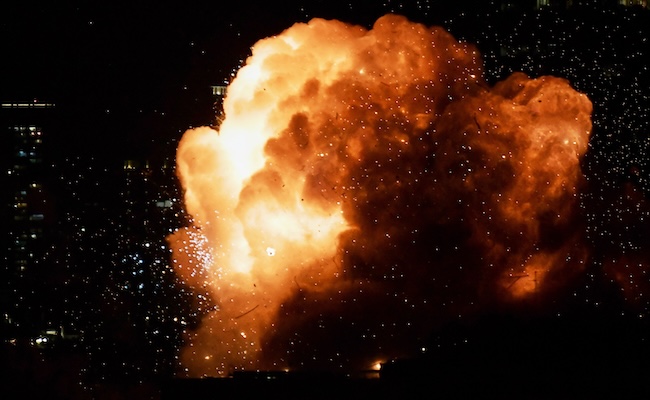
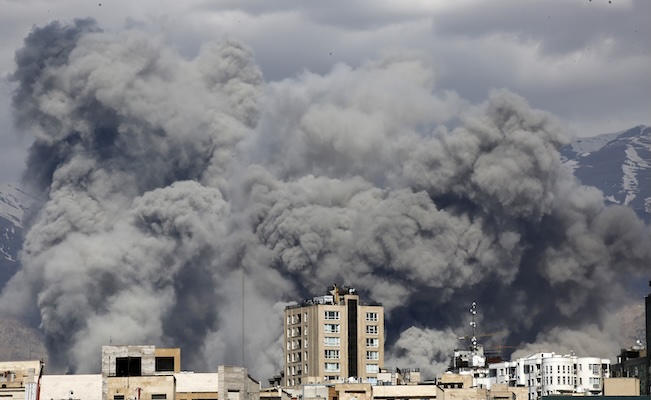
Yesterday, the haze of missile smoke hung heavy over the region as Iran – fresh from the death of its Supreme Leader, the 86-year-old dictator Ayatollah Ali Khamenei, who was killed in Saturday’s air strike by Israel and the US – sought to salvage its dignity by bombing just about everyone else nearby: Bahrain, Dubai, Kuwait, Doha, Jordan, Saudi Arabia and, of course, Israel.
Today, expect the oil price to spike as the Strait of Hormuz, through which a fifth of global supply is transported, remains closed. On Sunday, the price of Brent Crude rose 10% to $80 a barrel, with analysts fretting that it could hit $100 soon. Gold, which is prone to spiking at the suggestion of conflict, will continue rallying beyond $5,200 an ounce.
A ‘mortal blow’
The lethal strikes represent “the bloody climax of nearly half a century of enmity between America and Iran’s clerical regime”, The Economist wrote yesterday. Trump, it said, “may have dealt a mortal blow to Iran’s theocracy”.
Leave aside the dubious justification for attacking Iran at this particular point (to “prevent this very wicked, radical dictatorship from threatening America”), Khamenei’s death is no great loss.
Having taken over from Ayatollah Ruhollah Khomeini, who led the revolution that overthrew the shah and created Iran’s Islamic Republic in 1979, Khamenei ruled for 35 years – a period marked by a flood of religious fatwas, increasing repression of women and brutal suppression of dissent.
This past December, Khamenei’s regime slaughtered at least 7,000 people who had protested against the ailing economy – though some put the number at more than 36,000 – as the Supreme Leader said the “rioters must be put in their place”.
One of those whom Khamenei’s regime declared must be put to death was the writer Salman Rushdie, whose “sin” was to script The Satanic Verses, which included “blasphemous” descriptions of the Prophet Muhammad and his followers (“bums from Persia”, it calls them). If you believe writing words is cause for death, you have no business running any country.
But as much as this was not a gentle regime, and the recent descriptions by student protesters of Khamenei as a “tyrant” weren’t wrong, there’s no guarantee that Iranians will now “rise up” and “take your government”, as Trump urged them to do this weekend.
The son of Iran’s late shah, Reza Pahlavi, said that with Khamenei’s death, “the Islamic Republic has effectively come to an end and will soon be consigned to the dustbin of history”.
The start of a new chapter
But to think that any swift recalibration to a shah-like monarchy, or even a democracy, will be that simple, would be hopelessly naive.
“This is not a monarchy in which the shah is gone and you take out all of the male heirs,” said Trita Parsi of the Quincy Institute for Responsible Statecraft, a think-tank in Washington, in The Economist. “This is a system – not a particularly popular system – but nevertheless one with a security establishment that is not dependent on a single person or a single family.”
Iran has prepared for this for months, expecting another strike after last year’s 12-day war ended prematurely. It’s not as if Khamenei, at 86, was long for this world anyway.
It’s a sign of how non-linear Iran’s path will be that contrasting video clips from the country were juxtaposed on news services: first, individuals in Tehran wildly celebrating Khamenei’s death in a show of cathartic relief, but then, also, thousands of others in Tehran’s Enghelab Square, mourning Khamenei’s death and chanting “Death to America”.
Trump, characteristically untroubled by cognitive dissonance, declared that the bombing will continue “as long as necessary to achieve our objective of peace throughout the Middle East and, indeed, the world”.
Which is sort of like the ANC convening a cadre deployment meeting to end corruption. Or Gauteng premier Panyaza Lesufi checking into the nearest Radisson to demonstrate empathy with Joburg’s poor.
We’re only at the beginning of this chapter, and we have no clue what the plot twists will be.
ALSO READ:
- Iran protests are not just about economics – they’re a full-blown ideological crisis
- Operation Wilt for Peace
- Iran-Israel ‘threshold war’ has rewritten nuclear escalation rules
Top image: Smoke rises in Tehran after a series of explosions on March 1. Picture: Fatemeh Bahrami/Anadolu via Getty Images.
Sign up to Currency’s weekly newsletters to receive your own bulletin of weekday news and weekend treats. Register here.