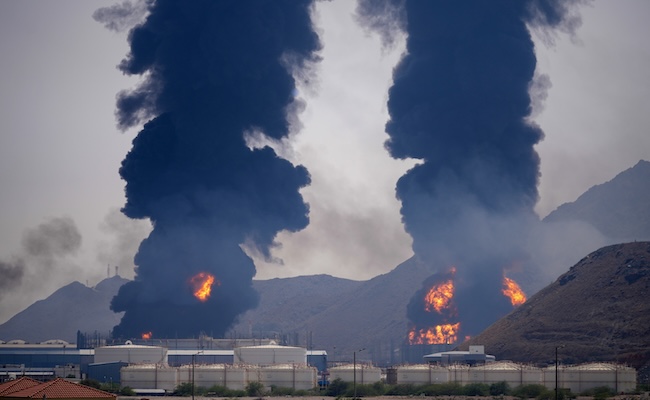
With an escalating war in Iran, fuel price shocks on the cards and rand weakness, all eyes will be on the monetary policy committee on Thursday, when it announces its March decision on interest rates.
Here’s what else you need to know this week.
Politics
By-elections
Two by-elections will be contested in the Western Cape on Wednesday. The ANC will be defending ward 104 in the City of Cape Town and an exceptionally marginal ward 5 in Oudtshoorn.
Ward 104 covers the Dunoon area, which traditionally has delivered very strong ANC support. The DA is contesting the ward and the by-election will be a useful data point ahead of the local government election. Notably, the DA is sitting out the contest in Oudtshoorn.
Parliament
It’s another busy week in parliament as the Easter recess approaches. On Tuesday, the National Assembly will consider the 2026 fiscal framework and revenue proposals, together with the report from the standing committee on finance. Electricity and energy minister Kgosientsho Ramokgopa will also be making a statement to the house on the “eradication of load reduction”.
It’s a packed schedule for the portfolio committees: on Thursday, the minister of health will brief the health portfolio committee on the recent suspension of top officials and, on Friday, the joint standing committee on defence will receive a joint briefing from the South African National Defence Force (SANDF) and the police on the planned domestic deployment of the SANDF announced during Cyril Ramaphosa’s state of the nation address last month.
World Tuberculosis Day
On Tuesday, Deputy President Paul Mashatile will deliver the keynote address at the world TB commemoration in Caledon in the Western Cape. South Africa still faces one of the highest TB incidence rates, driven by TB-HIV co-infection.
Mashatile, Zheng drive South Africa-China trade and investment
Mashatile and Han Zheng, vice-president of the People’s Republic of China, will co-chair the ninth South Africa-China Bi-National Commission in South Africa on Thursday. This comes the day after the 13th South Africa-China Strategic Dialogue, also hosted by South Africa.
Since 2023, there has been co-operation and growth in the higher education, tourism, and arts and culture sectors. New projects include a South Africa-China scholarship programme and investments by Chinese-owned private sector companies such as Huawei and Yalong Intelligent Equipment Group.
Economics
PPI (February)
Producer price inflation kicks off this week’s run of domestic data on Thursday. Headline PPI is expected to ease from 2.2% year on year in January to about 1.7% in February, largely reflecting lower fuel prices. Average fuel costs fell by about 3.1% during the month as the rand strengthened and global oil prices remained relatively stable, contributing to a sharp decline in inflation for coke and petroleum products.
Food price pressures are also expected to moderate further, with inflation easing to about 5.3% from 5.7%. Lower crop prices following a strong summer harvest are likely to have offset still-elevated meat prices linked to foot-and-mouth disease, though these have been gradually easing from earlier highs.
Inflation across most other categories, including metals, machinery, electrical equipment and transport equipment, is expected to remain subdued, supported by softer domestic demand and a firmer currency.
Monetary policy committee meeting
The week concludes with the South African Reserve Bank’s monetary policy committee (MPC) decision on Thursday at 3pm. The MPC meets against a more uncertain global backdrop, with the escalation of the Iran conflict pushing oil prices higher and weighing on the rand. This has complicated the policy outlook and sharpened the trade-off between supporting growth and anchoring inflation around the 3% target.
Prior to the recent shock, there were signs that inflation expectations were becoming better anchored, with longer-term expectations drifting closer to target. However, the combination of higher fuel prices and currency weakness is likely to reverse much of that progress. Inflation is now expected to rise in the near term, with a risk of breaching the upper end of the target band, at least temporarily.
Even so, the policy response is not straightforward. The shock is largely supply-driven, and monetary policy typically looks through temporary cost pressures. In addition, the real policy rate remains relatively restrictive, giving the MPC some room to assess how the situation evolves. As a result, rates are still likely to be left unchanged for now.

This article is published courtesy of The South Africa Brief, a political newsletter published on Substack which is a collaboration between Paul Berkowitz and Jonathan Moakes. It provides analysis and insight into the new, uncertain era of South African politics heralded by the 2024 general election. Including a specific focus on municipal politics, it will provide full analysis in the run-up to this year’s municipal polls.
Top image: Rawpixel/Currency collage.
Sign up to Currency’s weekly newsletters to receive your own bulletin of weekday news and weekend treats. Register here.