President Donald Trump hasn’t minced words about the larger message he’s trying to send the world with the US military raid to capture Nicolás Maduro and spirit the deposed Venezuelan leader and his wife to the US to face federal drug-trafficking charges.
“American dominance in the western hemisphere,” Trump declared following Maduro’s capture, “will never be questioned again.”
In the days since the audacious raid, Trump and his team have doubled down on the notion that the new focus on American pre-eminence in the hemisphere is here to stay. He also held up Maduro’s capture to make the case to neighbours to get in line or potentially face consequences.
Trump’s rhetoric hearkens back to the muscular talk of the late 19th and early 20th centuries, when American presidents deployed the military for territorial and resource conquests, including to Cuba, Puerto Rico, Hawaii, Honduras, Panama, Nicaragua, Mexico, Haiti and the Dominican Republic.
“There’s been periods, Vietnam and Iraq, which have evoked questions about a return to American imperialism, but the US leaders’ messages in those periods were cloaked in talk of democracy,” said Edward Frantz, a historian at the University of Indianapolis. “The way Trump is talking about it is something we haven’t seen in a very long time.”
In the aftermath of the operation, Trump’s tough talk has been directed at titular allies in Greenland – where he renewed calls for the US to take over the Danish territory for national security reasons – and Mexico. Trump says America’s southern neighbour needs to “get their act together” in fighting drug cartels.
Trump has also warned that longtime adversary Cuba is “going down” now that Maduro, who has provided deeply discounted oil to the economically isolated government in Havana, has been deposed. And the president has heightened anxiety with Venezuela’s neighbour, telling reporters that a military operation in Colombia – the epicentre of global cocaine production – “sounds good to me”.
‘Start making money’
The Republican president has also said his administration will “run” Venezuela policy and threatened the country’s new leader, interim President Delcy Rodríguez, with an outcome worse than Maduro’s if she does not “do what’s right”. He’s made plain that he expects Caracas to open its vast oil reserves to US energy companies, further igniting speculation about American overreach.
“We’re going to have our very large United States oil companies, the biggest anywhere in the world, go in, spend billions of dollars, fix the badly broken infrastructure – the oil infrastructure – and start making money for the country,” Trump said over the weekend.
The Venezuela incursion has split Latin America, with Trump-aligned leaders mostly from the right applauding the ouster, and non-aligned leaders condemning it on sovereignty grounds. It’s sharpened concerns that Trump might actually be serious about his desire to annex Greenland as well.
Danish Prime Minister Mette Frederiksen warned on Monday that Trump would mark the undoing of the transatlantic military alliance, Nato, if he attempts to follow through on his assertion that the US “absolutely” needs to take over Greenland for national security reasons. The alliance, which includes the US and Denmark, has been a linchpin of post-World War II security.
“If the US chooses to attack another Nato country militarily, then everything stops,” Frederiksen told Danish broadcaster TV2.
‘Gunboat diplomacy’
In the early part of the 20th century, American leaders repeatedly turned to the Monroe Doctrine, a foundational US foreign policy document authored by the nation’s fifth president, aimed at opposing European meddling in the western hemisphere.
Now, Trump too is leaning on the doctrine to justify US intervention in Venezuela and threaten action around the hemisphere in the name of protecting the safety and welfare of Americans.
“Trump’s rhetoric conjures up images of Teddy Roosevelt and gunboat diplomacy. The rhetoric is a return to a pre-Great War era,” Frantz said, referring to the 26th president’s interventions in unstable Caribbean and Central American economies as well as his backing of Panama’s secession from Colombia in the name of the US national interest.
Just weeks before the ouster of Maduro, Trump rolled out a long-awaited National Security Strategy that included disparate elements that seemed at odds with each other.
On one hand, Trump, who has long eschewed America’s role in foreign wars, asserted that the administration would have a “predisposition to non-interventionism”. But the strategy document also made clear that the administration would push “to restore American pre-eminence in the western hemisphere”.
With the ouster of Maduro, the administration has clearly doubled down on the latter.
“This is the western hemisphere,” secretary of state Marco Rubio said in an appearance on NBC’s Meet the Press on Sunday. “This is where we live – and we’re not going to allow the western hemisphere to be a base of operation for adversaries, competitors and rivals of the US.”
Anger at the UN Security Council
The capture of Maduro and Trump’s rhetoric could certainly be a level-setting moment for global leaders as they consider what may lie ahead in the final three years of Trump’s second term.
At an emergency UN Security Council meeting on Monday, Colombian ambassador Leonor Zalabata Torres said the raid in Venezuela was reminiscent of “the worst interference in our area in the past”.
“Democracy cannot be defended or promoted through violence and coercion, and it cannot be superseded, either, by economic interests,” said Zalabata Torres, whose country requested the meeting.
At the same time, Democrats are questioning whether Trump’s actions have created a permission structure for Russian President Vladimir Putin, who has designs on capturing further territory from neighbouring Ukraine, and Chinese President Xi Jinping, who has vowed to annex the self-ruled island of Taiwan.
“What the president’s done in this case has essentially given Putin and Xi Jinping a hall pass,” said independent senator Angus King in an appearance on CNN.
The Russians, for their part, have condemned Trump’s action in Venezuela. Ambassador Vassily Nebenzya, the country’s UN envoy, said the world body “cannot allow the US to proclaim itself as some kind of a supreme judge” to the world.
Reporting by Aamer Madhani. AP writers Jennifer Peltz and Farnoush Amiri at the UN contributed to this report.
ALSO READ:
- Has Trump de-fenestrated international law in Venezuela?
- How cocaine and corruption led to Maduro’s indictment
- PODCAST: Trump’s Venezuela gamble
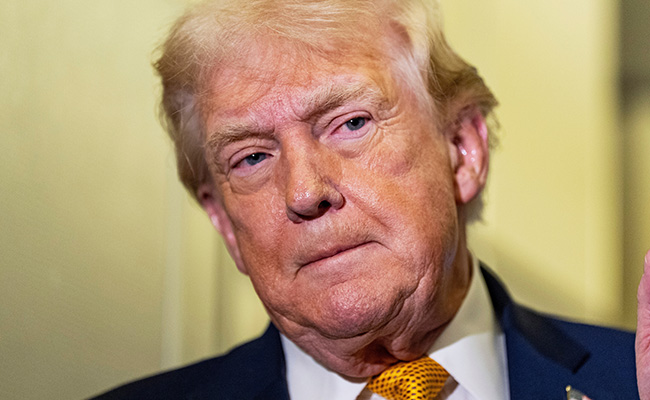
Top image: President Donald Trump speaks with reporters while in flight on Air Force One on January 4. Picture: AP Photo/Alex Brandon).
Sign up to Currency’s weekly newsletters to receive your own bulletin of weekday news and weekend treats. Register here.