
It’s fair to say that almost no-one saw DRDGold as a multibillion-rand-market-cap miner over a decade ago. Back in 2015, at R2.45 a share, most had written it off as a weird mining has-been, eking out small amounts of gold from the historic mine dumps around Joburg. Fast-forward to 2025, and thanks to the rampant gold price, DRDGold now sits on a market cap of R47.6bn and was the JSE’s fifth-best-performing stock last year.
The mania has quietened down somewhat lately and the stock is up about 6% for 2026 so far against gains, year-to-date, of 25% for Pan African Resources, 5% for Sibanye-Stillwater, 17% for Gold Fields, and a 0.1% increase for Harmony. But the going is great: over the six months to end-December, DRDGold’s margins rose to 53% – a record for the company. On revenues of R5bn, at an average gold price of R2,114,227 a kilogram, DRDGold made R2.7bn in operating profit and will pay shareholders a 50c-per-share dividend. Currency spoke to CEO Niël Pretorius.
What do you need to sustain these margins, or is it completely unrealistic for investors to expect more of the same this year?
Our investors hopefully understand that we take full exposure to the gold price. The one thing we can manage is our costs, but the margin’s going to be a function of whatever the gold price is at a point in time. So because we’re unhedged, we do provide an opportunity [for investors] to make money on either side of the cycle. If there’s free cash we’ll be paying that out as a dividend, but then there’s nothing stopping you from trading the stock on either side of the cycle.
In terms of margin, that’s the expectation we’re trying to create around “Vision 2028”, which is to extend Ergo’s life of mine to beyond 2040 and Far West Gold Recoveries to beyond 2040. In order to do that we are investing the better part of R10bn.
But when the infrastructure is in place your factory is there – so then it’s a matter of working your way through stockpiles. You see very high initial capital outlay, but then beyond that your ongoing sustaining capex is maybe 5% of cash operating costs. So we are building infrastructure that’s capable of monthly throughput of 3-million tonnes, as opposed to 2-million currently. In other words, 36-million tonnes a year.
That then takes gold production from just below five tonnes, to six tonnes. So suddenly you’re not spending $120m of capital every year but your revenues are very significantly higher and your unit costs are pretty much still the same. So that should give you an indication of what the margin could potentially become. At R2.5m per kilo, multiply that by a thousand – that’s the additional revenue per year.
Are you under pressure from shareholders to pay bigger dividends?
We didn’t really get any strong message from shareholders in that regard. Obviously analysts opine on the adequacy of the dividend, but we try to follow a balanced approach. We will distribute our free cash; we want to keep a bit of a capital buffer and a cost buffer, but we’re not going to sit on surplus cash.
This interim dividend is the highest we’ve ever declared, and what we decided is that if things stay attractive for the foreseeable future in terms of gold price and revenues and margins, let’s rather wait for the final dividend and not get ahead of ourselves.
It has been a bit strange to see the lull in your share price notwithstanding gold punching through $5,000 an ounce this year …
I think it ran hard last year, and in 2023 and 2024 when we were really battling with the commissioning of new sites and our production numbers were not consistent with guidance, I think the market said: “It’s time for us to wait and see if they get through this – maybe they won’t.” And once it took off it really took off handsomely.
I think you also need to interpret [the share price] in the context of Pan African Resources’ stellar performance. They have pretty much hit that sweet spot we are hoping to hit over the next two to three years when “Vision 2028” starts kicking in. And that’s that two of their projects have now come into commission at exactly the right time. We’re hoping to see that sort of jump at least in the foreseeable future.
But in the meantime, I can understand if there’s a wait-and-see period to see where the gold price is going to go. Nothing that we do at DRD in the next few months is going to move the share price; we’re going to be producing, hopefully, another 75,000 ounces of gold through to the end of the year and we hopefully hit our guidance of 150,000 ounces.
The only movement you’ll see is what happens to the gold price. To give you an idea, I sat in the Denver gold conference in September and saw our market cap, in dollar terms, creep over $2bn for the first time and we went from small cap to mid cap. Earlier this week it was $3.3bn. That sort of makes me nervous, given that our production profile hasn’t changed. It does change, though, next year, when we get to 200,000 ounces a year.
You’ve been at DRDGold since 2003, and CEO since 2009. There was a time when everyone had just written DRD off … How do you feel about things now?
Remember I’ve got a legal background, so I took this on as a brief, and my brief wasn’t: “Here’s a platform, go and grow it.” We were just trying to hold things together and the mandate was: “These are your assets, try and do something with them.” It meant completely repositioning the business and what you see now does not remotely resemble the DRD of 2005, for example. We don’t have a single deep-level underground mine.
People used to buy the share for the resource base, but the company’s focus is completely different: unhedged cash flow, and we only mine waste. So it’s sort of become a circular-economy model.
In 2014 our market cap was R400m, now it’s R47bn. At one stage we joked that DRD was worth less than the transfer fee of an average European soccer player. But make no mistake, it was a slog.
Is it fair to say you wouldn’t be in the position today if you hadn’t spent R3bn building a solar farm at Ergo?
I think the profile would have looked a lot different. Ergo was supposed to close from 2020 onwards. And when we got to that point we thought, well, we had fantastic infrastructure and we had vast resources left, so we didn’t really want to close it. However because the remainder of our resources were lower grade, the revenue per tonne was going to be lower. The only way these lower-grade tonnes were going to be sustainable in the long term was if we dropped the unit costs, and electricity is a massive part of Ergo.
So the solar farm was built as a means to flatten the future cost profile of Ergo while at the same time securing reliable, constant electricity. And it fits perfectly within our strategy of sustainable development. Ergo’s carbon footprint has shrunk by 35% and its electricity costs for the period are down 38%; the group’s costs are down 23%. Electricity is the reason we could build a second phase for Ergo and take its life beyond 2040.
What about new miners looking to tap this new gold rush? Is the cost of power the thing that will keep them out?
If you have a low-quality asset that you’re going to mine with loads of electricity and you have to source it from the grid, it could be the reason your feasibility study fails.
Do you have enough waste to mine still?
Remember, we acquired Far West Gold Recoveries from Sibanye, and it had 250-million tonnes of resource – we’ve mined about 50-million tonnes of that and there’s now an additional 67-million tonnes that has been transferred from Sibanye. So at a rate of 1.2-million tonnes a month it’s got many years of production left.
The infrastructure we’re building is scalable – the regional tailings storage facility is 800 hectares just outside of Fochville and we’re going to be depositing 1.2-million tonnes a month onto that initially, but eventually it could take 2.4-million tonnes. There are loads of dumps in the area but with the gold price where it is, everybody suddenly thinks it’s a gold mine.
This story was produced in partnership with Stanlib.
ALSO READ:
- Gold pierces $5,000 – what’s next?
- Harmony’s game-changer(s)
- Riding the gold wave: Why Sibanye is in it for the long haul
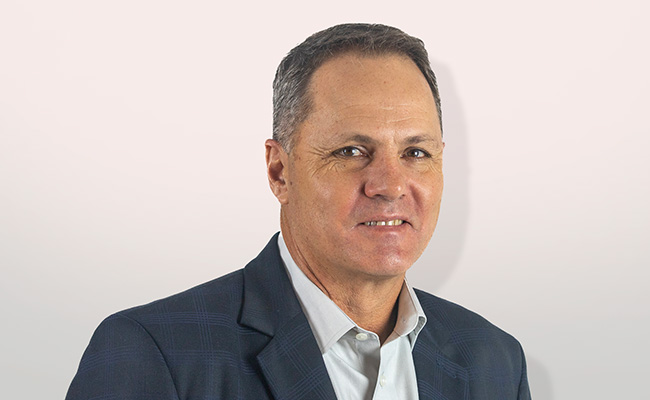
Top image: DRDGold’s Niël Pretorius. Picture: supplied.
Sign up to Currency’s weekly newsletters to receive your own bulletin of weekday news and weekend treats. Register here.