

It seems difficult for many to separate their personal animus towards this US administration from any likely outcomes.
This year’s state of the union address was a particular low point if you prefer the urbane over the boorish, and the intellectual over the visceral.
During Trump’s one hour and 47 minutes at the podium, the longest state of the union in history, the plodding tone was one of “grievances”, including attacks on political opponents and perceived victimhood. Riffing on crime, election integrity and transgender issues, he claimed that “crazy” Democrats were destroying America. “But we’ve stopped it, just in the nick of time.”
“Our nation is back – bigger, better, richer and stronger than ever before,” he started. “We’re winning so much that we really don’t know what to do about it,” he declared, announcing a “war on fraud” led by Vice-President JD Vance.
It was quite something to behold, making one wistful for the eloquence of George W Bush, among others.
Iran being ‘successfully degraded’
Now the great peacemaker has turned his military’s attention to Iran. The four stated aims of Operation Epic Fury, now three weeks old, are nuclear disarmament of Iran, the neutralisation of current and future missile capability, the destruction of Iranian naval assets, and ending Iran’s ability to arm, fund and direct “terrorist armies” outside its borders, such as Hezbollah and Hamas.
So how is he doing?
If one reads the Western press, the view is almost universally negative. Washington, under the influence of Israel, recklessly embarked on a war without a plan, as Trump’s rhetorical oscillation between unconditional surrender and negotiations infers. Oil will reach $200 a barrel. Inflation will spike and markets are resetting for lower growth. Another Iraqi-type forever war is in the making.
This much is predictable.
More interestingly, Muhanad Seloom, an assistant professor of international politics and security at the Doha Institute for Graduate Studies, recently published an article on the Al Jazeera website in which he suggests that the US strategy towards Iran is working, given that “every aspect of Iran’s ability to project regional power is being successfully degraded”.
He argues that the narrative of US and Israeli failure is “wrong. Not because the costs are imaginary, but because the critics are measuring the wrong things. They are cataloguing the price of the campaign while ignoring the strategic ledger.”
He writes: “When you look at what has actually happened to Iran’s principal instruments of power – its ballistic missile arsenal, its nuclear infrastructure, its air defences, its navy and its proxy command architecture – the picture is not one of US failure. It is one of [the] systematic, phased degradation of a threat that previous administrations allowed to grow for four decades.”
Iran is an “adversary whose capacity to project power is collapsing in real time”. Its airpower arsenal, which was “built over decades”, he says, “has been dismantled in days”. The steep decline in missile and drone launches in the first two weeks of the war is a clear metric of this degradation. Today, launches are being timed for political effect rather than to maintain an “operational tempo”. It no longer apparently possesses a navy or an air force worthy of the name.
“This is a force managing decline, not projecting strength.”
With the US assault in a second phase, Iran’s defence industrial base is being methodically targeted: “Missile production facilities, dual-use research centres and the underground complexes where remaining stockpiles are stored”, ensuring “what has been destroyed cannot be rebuilt”.
‘Economic pain is real’
Before the bunker-busting strikes under Operation Midnight Hammer last June, US intelligence estimates said Iran was only weeks away from being able to produce enough fissile material for one bomb, though that’s not the same as having a deliverable nuclear weapon. There was no justifiable, peaceful, civilian purpose for possessing 440kg of uranium enriched to 60% purity unless one wanted to create a nuclear weapon.
“But the critics’ implicit alternative,” Seloom says, “continued restraint while Iran inched towards a nuclear weapon, is the policy that produced the crisis in the first place.”
Again, while limits to the effectiveness of military means against nuclear intent exist, the facilities capable of enrichment and the delivery systems have been knocked back years, if not decades – though by how much and for how long remains contested.
On Hormuz, while the current “economic pain is real”, shutting down the strait was always Iran’s most visible retaliatory card, and always a wasting asset. About 90% of Iran’s own oil exports pass through Kharg Island and then the strait … Every day the blockade continues, Iran severs its own economic lifeline and alienates the one major power (China) that has consistently shielded it at the UN. The closure does not just hurt the global economy; it accelerates Iran’s isolation,” he explains.
China bought more than 80% of Iran’s shipped oil in 2025, at an average of 1.38-million barrels a day, or about 13.4% of its seaborne crude imports, Reuters cited global data and analytics company Kpler as saying. Almost half of all of China’s imports – from Saudi Arabia, the United Arab Emirates, Kuwait, Qatar and Iran – have to transit the Strait of Hormuz.
In the circumstances, Iran would seem to lack any capacity to contest the reopening of the strait. Seloom: “You do not need to escort tankers through a strait if the adversary no longer has the means to threaten them. That is the operational trajectory.”
And if the aim is to pinch China, then Hormuz offers a (high-risk) means to do so, one that might appeal to the showman-cum-salesman.
‘Strategic disarmament’
Finally, Iran’s proxy network, including Hezbollah and Hamas, is fragmenting, not expanding.
For Seloom, the “dynastic” transfer of power to Mojtaba Khamenei, following the assassination of his father, Supreme Leader Ali Khamenei, signals institutional fragility, not continuity.
Similarly, the decapitation of the leadership of the Islamic Revolutionary Guard Corps is likely to have undone the centralised command system, defaulting it to a “pre-delegated response authority … a sign of desperation, not strength. It means the centre can no longer co-ordinate. The attacks will continue, but they will become increasingly unco-ordinated, strategically incoherent and politically costly for the host states where these groups operate.”
The end game is what Seloom describes as “strategic disarmament”. An imperfect analogy, he admits, is in the disarmament of Germany in 1945, this time without occupation but rather through verification.
A tipping point
It is hard to imagine Al Jazeera publishing an article like this. The mouthpiece of the Qatari government, long believed to be an ally of Iran, Al Jazeera usually takes a more sympathetic approach. But Iran has alienated its traditional allies, lashing out with missiles and drones at Qatar and other Gulf states for daring to have a relationship with the US, and in the process proving that it is a dangerous and unpredictable actor.
We don’t know how much Iran is being degraded, but it is clear that this is happening. It is hard to imagine the regime in Tehran surviving in its current form. There will be a tipping point regarding morale and cohesion. Moreover, the air campaign is still only three weeks in. There is a lot more to target before the next phase takes off in earnest. This could take the form of massing unmanned aerial vehicles over cities to strike checkpoints, for instance, or for a limited ground offensive, perhaps on Kharg Island, or with the Kurds once conditions are right.
Populism does not work in shades of grey. It is black or white, right or wrong, winning or losing. This works both ways – Trump’s version of populism, and that of his opponents. Some of these opponents, South Africa included, have nailed their flag firmly to the Iranian mast, or now to international law, even though the same precepts apparently don’t apply to Russia or to those prosecuting asymmetric war, as has Tehran, making these arguments a hollow echo.
Yet grey is the way the world works. Whether you are in Iraq circa 2003 or Afghanistan in the 20 years of the international assistance mission until 2021, everything is complicated, and not as it first seems – perhaps black and white from a distance, but grey up close.
Within this grey zone, it will be the job of diplomats in the wake of war to alter the intent behind the Iranian build-up – simply put, which was to destroy the state of Israel and advance its image of the region. This will require patience, the swallowing of pride, regional integration and a clear security architecture.
Trump’s style, or lack of it, is dreadful. And yet …
Mills, the co-author of ‘The Art of War and Peace’ (Penguin), and Hartley are with the Platform for African Democrats.
ALSO READ:
- Trump looks to break Iran’s Hormuz stranglehold
- Why Iran is sowing regional chaos
- ‘Malignment’: The direction of South Africa’s foreign relations
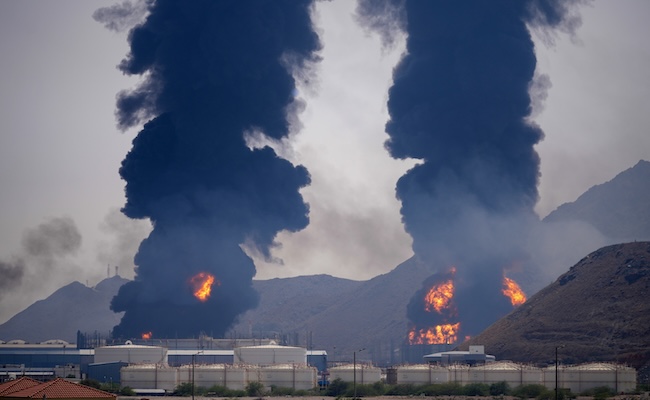
Top image: Plumes of smoke and fire rise after debris from an intercepted Iranian drone struck an oil facility, according to authorities, in Fujairah, UAE, on March 14. Picture: AP Photo/Altaf Qadri.
Sign up to Currency’s weekly newsletters to receive your own bulletin of weekday news and weekend treats. Register here.