
“It’s Mr Shamukuni who got the concession.”
That allegation – captured on audio during a heated argument on July 17 2025 – sits at the centre of a bitter legal and political fight unfolding on the fringes of the Okavango Delta, where elephant hunts marketed at about $90,000 a kill, and lion and leopard hunts selling for as much as $80,000 are at stake in one of Africa’s most prized ecosystems.
The voice on the recording is purportedly that of 57-year-old Dawie Groenewald, a former South African police officer and one of two men at the heart of the dispute. He pleaded guilty in the US in 2010 to a felony linked to the illegal import of a leopard trophy. Groenewald also faces 1,600 charges in South Africa relating to rhino poaching, trafficking, racketeering and money-laundering – matters that remain before the courts. He denies wrongdoing.
The “Mr Shamukuni” referenced on the tape is Machana Ronald Shamukuni, a senior Botswana Democratic Party (BDP) figure who served as minister of justice until October 2024. Community petitioners and rival safari operators accuse him of using his political influence and proximity to state institutions to help swing a multimillion-dollar hunting lease to Groenewald in an alleged scheme that ultimately saw the concession transferred to the politician, but remaining under the South African’s control.
Among the most serious claims are allegations that, while he was still minister of justice, Shamukuni took Groenewald to meet two judges of the Maun High Court ahead of a key ruling lifting a moratorium on hunting. Shamukuni denies wrongdoing. No evidence has been presented or specific allegations made that any judge acted improperly.
Groenewald denies ever poaching an animal, claiming he has always hunted with permits. “I have never poached an animal in my life, and I never hunt illegally,” he tells Currency.
At issue is who gets to operate NG13 – a controlled hunting area in Botswana’s Ngamiland district. On paper, it’s managed for the community’s benefit through the Tcheku Community Trust, which represents San communities in and around Tobere, in the northwest of the country, near the Namibian border. In practical terms, NG13 is a licence to sell a scarce wildlife quota to wealthy foreign hunters. Alongside game such as impala, kudu and wildebeest, it includes dozens of buffalo, big cats and 25 elephants.
Court records, leaked audio and company documents show how the dispute over NG13 has become a proxy war: between rival safari operators; physical fighting between factions within a small, divided community trust; and between those who say politics has eclipsed process in a system designed to keep wildlife revenues as close as possible to the people living with them.
“Shamukuni abused his positions of trust as minister, member of parliament and BDP party leader to fool us into believing that Groenewald left and his company had taken over the lease,” says Pius Segobodi, a community member opposed to the contract awarded to the duo. “Even now, the community believes Shamukuni is the leaseholder,” yet he is only “renting out his name”.
The former justice minister was ousted from his position after the party lost the October 2024 elections to the opposition Umbrella for Democratic Change, led by current President Duma Boko. The handover ended the BDP’s 58-year run in power – and came as the economy buckled under the diamond slump. GDP contracted about 3% in 2024, and Moody’s has warned of a further 6% contraction in 2025.
A concession worth fighting for
The NG13 quota is the economic engine of the concession, worth millions of dollars in a deeply rural population of about 600 people. That kind of money is supposed to translate into community projects and household income, especially in a remote area where formal employment is scarce and government services are thin.
Botswana’s community-based natural resource management model is built on a straightforward principle: community trusts enter joint ventures with private safari operators. The department of wildlife and national parks is meant to regulate operators and quotas, while district officials serve as gatekeepers for disputes and compliance.
NG13, overseen by the Tcheku Community Trust, was supposed to follow that template, but has instead become a symbol of how the system may be being exploited.
Until early 2024, Old Man’s Pan, a Gaborone-based safari operator, held NG13’s operating rights. Relations between the company and the trust deteriorated over pricing, particularly elephant hunts for the 2025 season.
According to community accounts and court records, the trust pushed for elephant-hunt prices to rise by more than 50% to maximise revenue. Old Man’s Pan refused, arguing the proposed increases were commercially unviable.
The dispute culminated in a meeting in Maun on March 12 2024. After that meeting, the trust chair at the time, Alex Shenyemba, terminated Old Man’s Pan’s lease, accusing the company of fomenting unrest and of bypassing the trust by working directly with village development committees on projects linked to the lease.
Old Man’s Pan challenged the termination in court. In April 2024, the Maun High Court imposed a moratorium on all hunting in NG13 pending the determination of the dispute. The freeze halted hunting and revenue flows – and, petitioners later argued, created an opening for new interests to move in.
It was during the uncertainty created by the moratorium that Groenewald allegedly emerged as a prospective hunting partner for the trust.
Community members fighting his appointment say they were never consulted and submitted petitions to the Ngamiland district commissioner in early 2024, calling themselves “shocked” that someone with Groenewald’s track record had been awarded the lease.
They also accused the trust chair and some board members of accepting bribes to eject Old Man’s Pan in order to make way for Groenewald’s company, DK Superior (Pty) Ltd. Those allegations now form part of sworn statements and filings before Botswana’s high court, where appeals and counter-appeals from both parties are dominating the proceedings.
The allegations of political meddling
Petitioners allege that Groenewald would never have won the contract had it not been for Shamukuni – who, at the time, was both justice minister and an MP for Chobe, about 330km northeast of Tobere, near the Zambian and Zimbabwean borders. Before landing the justice minister role, he also served as the head of presidential affairs, governance and public administration, and as the minister of employment, labour productivity and skills development.
Segobodi says Shamukuni appeared alongside Groenewald in Tobere, introducing him to village elders as the community’s “next hunting partner”, urging them to work with the South African because Groenewald had “big plans” to develop the San community. He also allegedly told residents he would ensure the community got its share because he was Groenewald’s “business partner”.
In the same account, Segobodi notes that residents raised concerns not only about Groenewald’s criminal history but about claims that, in 2012, Groenewald had allegedly failed to pay BWP1.3m (R1.55m) in hunting revenues to a separate trust in the northwest of the country. Segobodi adds that Shamukuni again assured them that he would ensure Tobere got its share because of his relationship with Groenewald.
In sworn statements and interviews, petitioners have also alleged that Shamukuni and Groenewald organised a series of meetings in Shakawe and Maun with sympathetic officials from the trust and district authorities to co-ordinate their strategy against Old Man’s Pan.
“All those who attended were booked in hotels with all expenses paid,” Segobodi says. “They were also given money and promised bigger rewards for helping boot Old Man’s Pan out of the NG13. He even promised to buy each board member a Honda Fit for helping him secure the NG13 lease.”
Currency has not independently verified claims about payments, hotel bookings or promised vehicles beyond their appearance in sworn statements and interviews, with these questions being put to both Groenewald and Shamukuni.
Meeting of the judges
Segobodi, who is leading the campaign against the awarding of the concession to the Groenewald-Shamukuni duo, explains that while a September 2024 high court decision lifting the hunting moratorium “made legal sense”, petitioners question how it came to be, given that, just weeks before the hearing, Shamukuni had allegedly taken Groenewald to meet two judges of the Maun High Court.
“In Maun, Shamukuni said as the local MP, he worried that the hunting freeze in the NG13 was impacting human livelihoods,” said Segobodi, who attended the meeting. “He made it clear that the matter needed to be settled urgently and in favour of the community. He even warned that the Botswana Democratic Party could lose the [October 2024] elections if the courts dragged out the case or failed to settle it in favour of the community.”
When the allegation that Shamukuni had met judges began circulating in Tobere, it inflamed a community already split over NG13, with people demanding explanations from the politician – even from those who had supported the BDP leader. The fallout led to physical clashes between rival sections of the small San community in Tobere, says Segobodi.
Tensions escalated again on July 17 2025, when Groenewald confronted employees of Old Man’s Pan who had returned to NG13 to collect equipment left behind during their eviction. The confrontation was recorded.
In the audio, Groenewald – leaving camp with a hunting party – would appear to challenge the men for “trespassing” and complain they are “driving on our hunting roads”, insisting “there is nothing to collect here”.
Old Man’s Pan staff suggest involving a nearby unit of the Botswana Defence Force to resolve the dispute. They say they had already alerted the soldiers and propose going together; Groenewald refuses, saying he is “busy with these people” and will speak to the army officials himself, as a mediator tries to calm the increasingly tense exchange.
It was during this exchange that Groenewald repeatedly denied being the leaseholder. “It’s not my concession,” he said. The staffers were not allowed to take the equipment, as Groenewald insisted there was nothing for them on the property.
Tracing who owns what
The timelines of events around who exactly runs the show at DK Superior (Pty) Ltd – which is named as the owner of the hunting lease signed in October 2024 – muddy the waters even further.
According to filings with the Pretoria-based Companies and Intellectual Properties Commission (CIPC), the company, based at No. 20 Carel Street, Polokwane, was first registered in 2018, with Groenewald named a director in May 2019. The records show he resigned on December 13 2024, and that Shamukuni was appointed the same day. Other than Karien Oosthuizen, who first registered the business (and a network of other companies) and resigned in September last year, no other directors were listed under DK Superior (Pty) Ltd’s history.
That implies Groenewald was a director of the business when he signed the contract – for DK Superior (Pty) Ltd – when accepting the lease in October 2024.
The lines blur further still.
According to the Botswana Companies and Intellectual Property Agency (CIPA) register, Shamukuni is the owner and executive director of the Shamron Group, which is listed as trading from Plot No. 572, Kavimba Street, Plateau, Kasane, in the Chobe district. On January 9 2025, Shamukuni registered DK Superior Botswana. Shamukuni says DK Superior Botswana is a subsidiary of the Shamron Group. It claims to offer tailored tourism services to local and foreign clients.
A hunting quota offer letter from Tcheku Community Trust Board chair Alex Shenyemba dated May 20 2025, addressed to Groenewald trading as “DK Superior” at a postal address about 20km from Tobere, records that the 2025 quota was “negotiated down” to BWP1.8m from BWP2.9m.
That detail is central to a potential second fault line in the story: the trust pushed Old Man’s Pan out after demanding elephant-hunt prices be raised, yet under DK Superior’s tenure, the 2025 quota fee appears to have dropped sharply.
The letter also records promises to fund community projects – solar panels to pump water to three villages and the purchase of a community vehicle in 2025. Community members say these commitments have not been fulfilled.
The thicket of near-identical entities bearing the DK Superior name makes it harder for community members, officials and courts to track accountability.
In South Africa, Groenewald’s business is registered as DK Superior (Pty) Ltd and has also traded under the name DK Superior Safaris. In Botswana, three near-identical entities – DK Superior Botswana, DK Superiors Botswana and DK Superior Shakawe – were registered or reserved.
CIPA records also show Shamukuni initially reserved the name “DK Superiors Botswana” and later registered it as “DK Superior Botswana”. Currency could not establish any commercial activity by the company, which records indicate is dormant.
In court papers filed by Groenewald’s lawyers against Old Man’s Pan, challenging the judgment ordering DK Superior Pty Limited to cease hunting pending determination of the rightful ownership of the NG13 lease, only DK Superior Pty Limited of Polokwane is consistently referenced, which suggests that the Botswana entities have no standing in the country.
Taking aim from court to court
The NG13 dispute has spawned urgent applications, interdicts and appeals in Botswana’s high court – alongside allegations that hunting continued even after the court ordered it to stop.
On September 12 2025, a high court ruling allowed the Tcheku Community Trust and DK Superior (Pty) Ltd to carry on hunting while Old Man’s Pan appealed the loss of its contract.
But, on October 7, a high court order in Gaborone set aside that ruling after the judge treated the matter as urgent and the respondents – including DK Superior – failed to appear. In its appeal, Old Man’s Pan cited DK Superior (Pty) Ltd as the first respondent, the attorney-general as the second and the department of wildlife and national parks as the third.
The court issued a provisional order, known as a rule nisi, and set the matter down for October 16 in Maun, calling on the respondents to explain why hunting should not be halted, and allowing Old Man’s Pan to join the trust in the proceedings.
Old Man’s Pan director Leon Kachelhoffer says that despite the judgment, hunting continued.
“We served the order on Groenewald, the trust and Shamukuni,” Kachelhoffer says. “They ignored it.”
Kachelhoffer also provided Currency with a WhatsApp message that he says came from a number linked to Shamukuni. It states: “Let the duelling begin.” Currency has not independently authenticated the sender.
On October 25, the Maun High Court heard further argument. Judge Bugalo Maripe noted that none of the respondents had filed compelling papers, set aside the earlier order allowing hunting to continue, confirmed the rule nisi, and ordered DK Superior (Pty) Ltd to pay costs.
DK Superior (Pty) then appealed that decision only to file a “notice of withdrawal of action” dated November 10 2025, in the high court at Maun. In it, the company retracted its application against the respondents – including the attorney-general, the director of wildlife conservation and national parks, Old Man’s Pan and the Tcheku Community Development Trust.
Kachelhoffer argues the NG13 controversy reflects a broader vulnerability in Botswana’s community trophy-hunting programme, where connected interests can exploit governance gaps in the country of 2.4-million people.
He alleges he has faced intimidation for raising questions about community revenue flows – including BWP1.4m he says went missing from NG13’s hunting income. Efforts to force accountability through the courts and official channels have proven futile, the head of Old Man’s Pan adds.
Groenewald speaks out
In a detailed response to questions, Groenewald rejects the suggestion that he “hijacked” the NG13 concession or that he is using Shamukuni as a front.
“In Botswana, I am not the owner of the NG13 [hunting concession]. The owner is Machana Ronald Shamukuni,” he tells Currency.
Groenewald says he signed the October 2024 lease agreement on Shamukuni’s behalf because the politician was unable to attend.
He argues that the corporate structure is being misunderstood: Shamron Holdings in Botswana is a “sister company” to the South African entity, DK Superior (Pty) Ltd. Shamukuni’s Botswana company, Groenewald says, holds shares in the wider group.
Groenewald describes himself as a hunting agent who brings clients to Botswana and books hunts with Shamukuni and other operators. He also accuses Old Man’s Pan of wrongdoing and suggests the company is behind efforts to smear him, without offering more details.
Regarding Shamukuni, Groenewald argues that political involvement in hunting is widespread across the region. “There is too much politics in the trophy hunting industry,” he adds. “Every government official has a finger in every piece of the pie there.”
Asked to respond to allegations that he used his political influence to secure NG13, including claims that he met judges and that he is Groenewald’s business partner, Shamukuni dismisses the questions. “Nonsense … Garbage,” he tells Currency, without elaborating or commenting further.
Botswana’s community-based conservation model is often held up as a benchmark: conserve wildlife, share benefits and keep decision-making close to the people.
With the diamond-dependent economy struggling to wean itself from precious stones and its mining industry in decline, Botswana is seeking to boost other sectors, such as tourism, which accounts for nearly 5% of GDP and supports 11% of jobs once indirect effects are included, according to data compiled by the World Travel & Tourism Council. Foreign visitors spend more than twice as much as locals on travel, safaris and other activities, including trophy hunting.
For the San communities around Tobere, the stakes are not abstract. The hunting quota is meant to be one of the few significant income streams tied to their land.
“Public officials in Botswana have always abused and embezzled community funds, public resources and public trust,” Kachelhoffer says. “Politicians use positions to manipulate situations. They do not follow [trust] constitutions. The communities are defenceless. Who do they report this to? Whoever they report to refers them back to the Ngamiland DC [district commissioner]. Then it goes around in circles. We are in that fight. That’s why they hate us.”
ALSO READ:
- Exposed: The big business of selling South Africa’s big cats to Ambani’s Indian mega-zoo
- The currency of conservation
- South Africa’s birds: The price of extinction
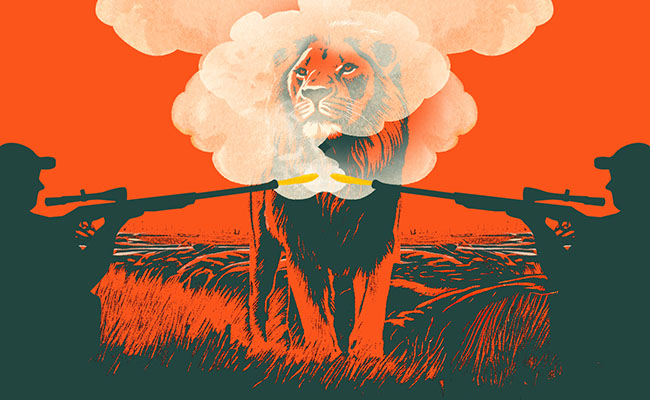
Top image: Rawpixel/vecteezy/Currency collage.
Sign up to Currency’s weekly newsletters to receive your own bulletin of weekday news and weekend treats. Register here.