

When President Cyril Ramaphosa sent the US packing, telling it he wouldn’t hand over the G20 to someone not of his stature at the closing of the summit in Joburg, everyone cheered.
Finally, someone was “standing up to Trump” and putting him in his place. Living in the moment of adulation, he went further. The US charge d’affaires, Marc Dillard, received the G20 presidency at a low-key ceremony in the offices of the department of international relations and co-operation (Dirco) in Pretoria a few days later.
It was curated political theatre, and it was loudly applauded. European leaders clapped the hardest. They, of course, would never confront US President Donald Trump themselves because of their concern for their trade relationship. In Ramaphosa, they had found someone who didn’t care about such trifles and was willing to roll the dice on his economy for a moment in the global spotlight.
The cost for South Africa of this moment of anti-Trump theatre will be severe, including a total review of all US aid and trade concessions, and a disinvitation from next year’s G20.
South Africa turned down the US request to be part of the handover at the G20, “Therefore, at my direction, South Africa will NOT be receiving an invitation to the 2026 G20, which will be hosted in the Great City of Miami, Florida next year,” Trump posted on his Truth Social platform.
The South African government response was, incredibly, the diplomatic version of “whatever”. Ramaphosa’s spokesperson said it should be accepted that “there won’t be a reset of the relationship”.
“President Trump continues to apply punitive measures against South Africa based on misinformation and distortions about our country,” said Ramaphosa. Trump should act “in the spirit of multilateralism, based on consensus, with all members participating on an equal footing.”
Tehran’s Africa chapter
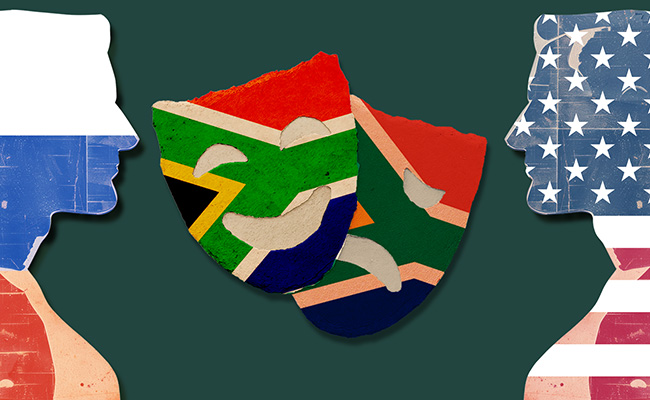
This spat with the US plays into Dirco’s strategy to realign South Africa, building relations with Iran, Russia and China and even Hamas, and drifting purposefully away from the world of democratic nations.
Dirco, which behaves like Tehran’s Africa chapter, is misleading the South African president over the extent to which this is all about Trump. “Despite the challenges and misunderstandings that have arisen, South Africa remains a firm and unwavering friend of the American people,” said Ramaphosa when he wasn’t reciting congratulatory anonymous comments about the warmth of South African hospitality, not to mention the generosity of the South African taxpayer towards the world. “We value the United States government and its people as a partner. We have common interests, common values and a shared wish to advance the prosperity and wellbeing of the people of both our countries.”
This is empirically incorrect. It neglects just how consistently SA has voted against the US this century on all matters in the UN, one bellwether of the extent to which the ANC government shares values with Washington, no matter the political stripe of the party in power there. Between 1994 and 2018, for example, voting coincidence in the UN General Assembly between South Africa and the US averaged 26%, meaning South Africa agreed on just one in five issues in the UN with its second-largest trade partner and largest investor. On human rights, voting overlap peaked at 62.5% in 1995 and reached its nadir at 8.3% in 2013, early in Barack Obama’s second term. On issues of economic development, the coincidence of interest was just 8.2%.
A relationship in peril
Even the most celebrationist American president would have to realise that Pretoria doesn’t like them, or share their worldview, no matter who sits in the Oval Office.
Relations with China, that bastion of human rights and freedoms about which Pretoria loves to reminisce, are strikingly positive. South Africa voted with China most of the time in the 23 years from 1994: in the high-80s and early-90s, averaging 89.1%.
It is now forgotten in the Trump frenzy, but the relationship with Washington was in peril under his predecessor, Joe Biden. He sharply criticised South Africa’s decision to accuse Israel of genocide, and it was his ambassador who said Pretoria was supplying arms to Russia.
It is perhaps even more forgotten that Kamala Harris, whom Trump defeated to ascend to the presidency, did not believe Israel was committing genocide. When asked about the genocide issue, her campaign clarified that “this is not her position”.
South Africa now blames Trump for the breach, misunderstanding the depth of the rift.
There was a different avenue open to Ramaphosa. Instead of a thin-skinned giving up on the intemperate Trump, would it have killed him to have played the closing ceremony differently? He could have handed the G20 over to Dillard, saying he valued the US relationship and was glad he attended, albeit just for the closing ceremony. That would have been the smart play.
Missed messaging
But Dirco and Ramaphosa appear unable to stay calm and analyse the Trump administration’s messaging. They don’t seem to get it that, when Trump accused the government of implementing “genocide” against Afrikaners, that this was a direct response to South Africa accusing Israel of “genocide” in Gaza.
South Africa views Trump’s genocide accusation as subjective and a deliberate misrepresentation. But they can’t see that the US views South Africa’s genocide claim against Israel in exactly the same terms.
This dysfunction is at the core of the meltdown in relations and, instead of ignoring it and acting with the same petulance as Trump, South Africa needs to find a way to sort this core issue out.
The failure to understand and deal with the Israel problem has led to several false starts. Ramaphosa’s visit to the White House was an attempt to reset relations, but Trump put the genocide matter on the table, and South Africa didn’t seem to get the message, focusing instead on the exaggerations in Trump’s presentation.
Trump sent South Africa’s US representative home because of his perceived alignment against Israel. Still, South Africa didn’t get the message.
When Trump negotiated a ceasefire between Israel and Hamas, South Africa was inexplicably subdued. Instead of congratulating Trump as world leaders did at a mini-summit in Egypt, South Africa sulked, apparently bereft that the foreign policy gift of Gaza was in danger of vanishing due to an outbreak of peace.
A poor strategy
Or perhaps this was due to the realisation that South Africa would, in the interests of peace, actually have to start talking to Israel rather than simply hurling claims of genocide, starting with exchanging ambassadors. That would be inconvenient to the ideologues at Dirco HQ and would take some explaining back in Tehran.
Abandoning a reset with the US and placing high-end manufacturing jobs at risk is a poor strategy. A better way would be to start understanding what is at the core of the broken relationship and being prepared to find some compromises that will take it forward.
Ramaphosa knows that for the rest of his presidency (barring one of those ANC recalls), Trump will be in the White House, and he has decided he has nothing to lose. Unfortunately, the country has a lot to lose by cutting ties with the US, and needs a more patient, more sophisticated strategic approach.
Since the road to improved relations with Washington runs through Jerusalem, don’t hold your breath.
Ray Hartley and Greg Mills are with the Platform for African Democrats.
ALSO READ:
- Now the party is over, who washes the G20 dishes?
- Memo to President Ramaphosa
- South Africa has chosen a risky approach to global politics: Three steps it must take to succeed
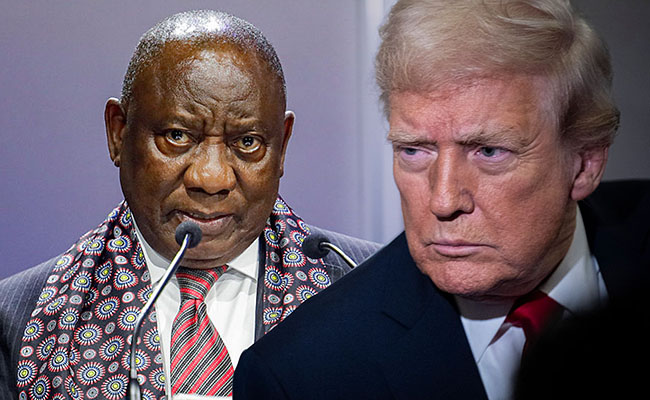
Top image: Cyril Ramaphosa and Donald Trump. Pictures: Sharon Seretlo/Gallo Images via Getty Images; Pete Marovich/Getty Images.
Sign up to Currency’s weekly newsletters to receive your own bulletin of weekday news and weekend treats. Register here.